
A joke about scale, told in diamonds
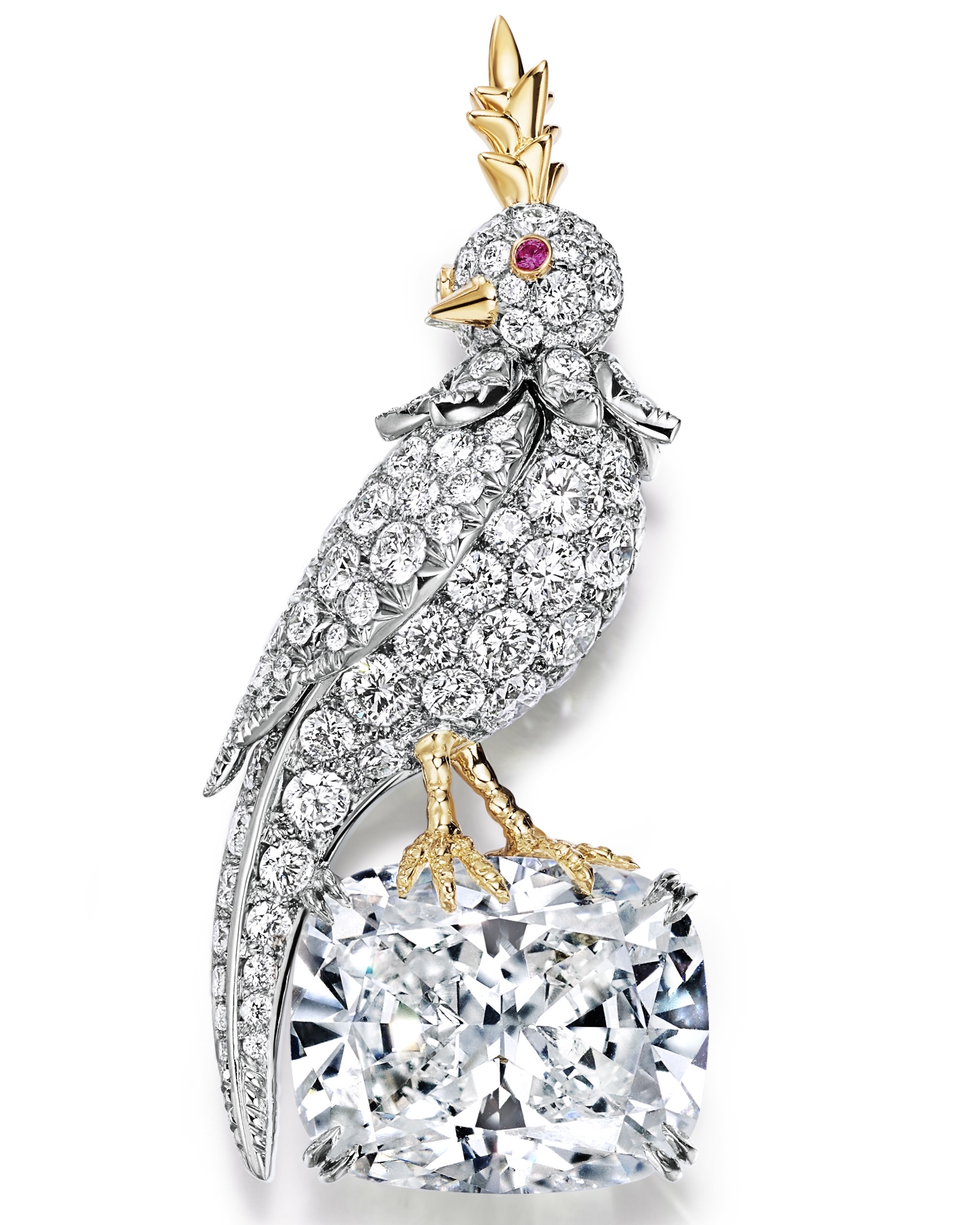
The joke, if it can be called that, is scale: a small bird, all diamonds and attitude, standing on a gemstone far too big for it. That was Jean Schlumberger's Bird on a Rock, designed for Tiffany & Co. in 1965 after his travels put rare birds in front of him in Asia and the Caribbean.
The proportions are the wit of the thing. A conventional brooch balances its elements; Schlumberger unbalanced his on purpose. The perch is cut like a jewel that should be the whole piece, and the bird — crested, bright-eyed, entirely unbothered — treats it as scenery. The classic form, the one the house still photographs as the design's reference, keeps the details that make the bird a character rather than an ornament: a gold crest and beak, and a pink sapphire for an eye. The eye is a small thing, and it does most of the work — it is what turns a diamond bird into this bird, looking back at you. One of the first was made for Rachel "Bunny" Mellon, the collector who became the design's first great patron. Sixty years on, the bird is still on its rock. What changed is everything around it.
The generation that turned a brooch into a collection
The current generation belongs to Nathalie Verdeille, Tiffany's chief artistic officer for jewelry and high jewelry, who has grown the single brooch into a full collection. That expansion is harder than it sounds. A motif survives being stretched only if the thing that makes it recognisable survives with it — and here the recognisable thing is not a stone, a metal or a setting technique. It is the silhouette: bird, oversized rock, done. Verdeille's collection keeps that silhouette fixed and lets everything else move, which is why a present-day piece reads as a Bird on a Rock at a glance, across a room, before any detail registers.
Seven parts, eight artisans, fifty hours
The workshop discipline is documented by the house: designers spent more than two years studying birds in motion before rendering the form, and master artisans sculpt and assemble seven components by hand to build each bird. More than eight artisans spend roughly 50 hours on a single brooch.
Two years of watching birds move, before a single form was drawn, is the detail that explains the rest. A bird that stands still in a drawing stands stiffly in metal; the collection's birds lean, tilt and perch with their weight placed the way a living bird places it, because the study came first and the sculpting followed it. And the seven components matter for the same reason: the bird is not cast as one piece and decorated. It is built, part by part, by hand, so that each element can be finished and adjusted before the assembly closes around it.
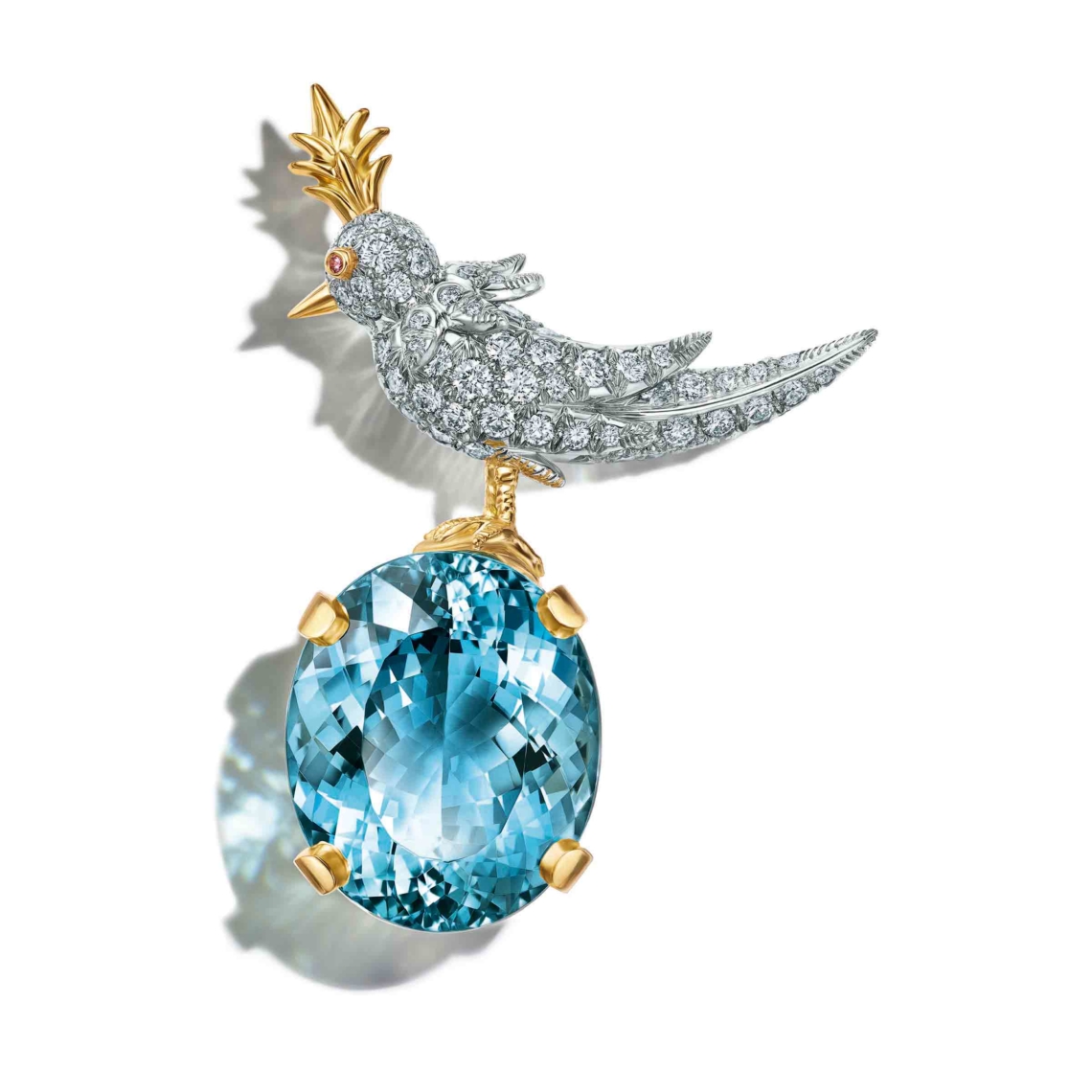
The perch changes — tourmaline, morganite, aquamarine, a white diamond — and the bird is re-sculpted to sit honestly on each stone. That last phrase is the workshop's real standard. A new stone is not a swap of one coloured base for another; the bird itself is reworked so its stance belongs to the stone it stands on. Change the rock, and the bird changes with it — while remaining, unmistakably, the same bird.
Once a year, the bird outruns itself
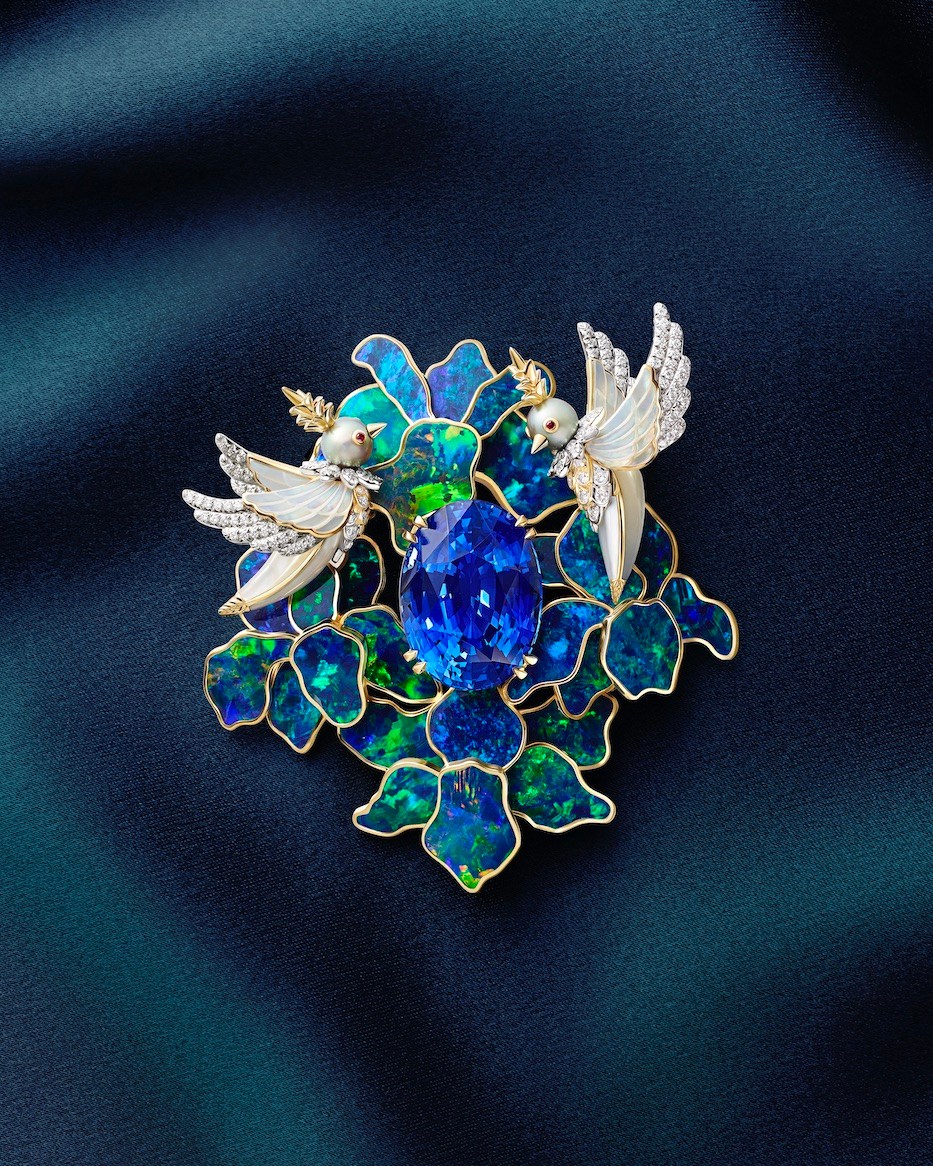
Then there is the annual escalation. Tiffany's Legendary Bird creations take the motif into one-of-a-kind high jewelry, one edition a year. The inaugural Argyle Edition arrived in 2025, built around Argyle pink diamonds. The 2026 Sapphire Edition centers an unenhanced sapphire of 38.48 carats from Madagascar, framed by two birds worked into a floral setting of black opal doublets and mother-of-pearl — a nod, Tiffany says, to the orchid motif and the favrile glass of its early lamps.
Notice what the annual edition does to the formula. The single bird becomes two. The perch becomes a composition. The setting reaches back past Schlumberger to the house's earlier decorative language, the orchids and favrile glass of its lamp era. Same bird, same perch idea; the composition around it belongs to its own decade. The Legendary Bird is not a bigger brooch. It is the motif, once a year, allowed to become a scene — and then, the year after, the collection returns to one bird on one rock, as if nothing had happened.
The night the generations crossed
The generations have crossed before. In 1995, for the Schlumberger retrospective in Paris, a Bird on a Rock was reset with the Tiffany Diamond, the house's 128.54-carat yellow stone. That pairing was a historical event, not a product — no figure from it belongs to the brooches being made today. It is kept in this story as history, and only as history: the one occasion when the bird stood on the most famous stone the house owns, staged for a retrospective of its designer's work, in the city where that work was honoured. The current collection's stones are its own. The 1995 perch was a tribute, and tributes are not inventory.
Previously's Take
Most heritage designs survive by being frozen — remade carefully, changed never; Bird on a Rock survives the other way. The silhouette is non-negotiable — bird, rock, done — while everything else, the stones, the setting, the number of birds, is allowed to move: a harder discipline than preservation, and why the 1965 bird still looks like news.
The numbers
Sources · 4 sources
- Tiffany & Co. — official Bird on a Rock record (heritage, craft, Legendary Bird — international site)
- LVMH, October 2026 — Les Journées Particulières account of the Bird on a Rock workshop (artisan count and hours)
- PaperCity Magazine, November 2021 — history of the Schlumberger brooch (Mellon commission; 1995 Tiffany Diamond setting)
- Europa Star, 2025 — Bird on a Rock Legacy coverage (Schlumberger biography, 1965 design)
Photographs: Tiffany & Co. / Natural Diamonds · Tiffany & Co. · Tiffany & Co. / The Diamond Collective