
The compromise every submersible started from
Every submersible before this one started from the same compromise. Acrylic pressure hulls came as spheres or cylinders because those are the shapes engineers knew how to certify, and passengers were fitted in around the geometry — two or three at a time, pressed against a round window, taking turns at the view they had paid for.
The compromise was never really about the water. A sphere holds pressure beautifully. It was about proof: a spherical hull's behaviour under load is understood, modelled and classed, and an industry that carries paying passengers does not improvise with the part that keeps the ocean out. So the sphere survived, dive after dive, less because it served the passenger than because it satisfied the certifier.
Triton's design team, coming off submersibles built for far greater depths, asked the impolite question out loud: if this one only has to reach 200 metres, why obey rules written for the whole ocean?
A sphere, pulled wide until it becomes a room
The answer is the 660/9 AVA. AVA stands for Advanced Versatile Acrylics, Triton's method for forming acrylic into a free-form pressure hull — the first of its kind, according to the company — and the hull it produces is a patent-pending expanded ellipse, designed by Dark Ocean Design: a sphere pulled wide until it becomes a room. Triton positions the boat as a direct replacement for the outmoded twin-hulled tourist submersibles that came before it, and the shape is the whole pitch.
Triton credits the ellipse with up to three times the interior viewing volume of a comparable spherical hull. The vessel is 4.5 metres wide but only 2.75 metres long — about the deck footprint of two jet skis — and 2.3 metres high, at 11,000 kg. Inside that footprint it carries a pilot and eight adult passengers, or six adults and four children, in a single shared volume of 6,300 litres. Nine people in one room, rather than nine people distributed around a geometry problem: that is the difference the shape buys, and it is why the name carries both numbers — 660 for the feet it is rated to, 9 for the people it seats.
An ellipse has to prove itself
A sphere distributes pressure evenly by nature; an ellipse has to be analysed, formed and proven until a classification society agrees it behaves. Nothing about the AVA's shape is self-certifying, and Triton could not simply assert that the stretched hull was as sound as the round one it replaced. The claim had to survive sea trials and an outside authority.
It did. The 660/9 came out with DNV certification, rated to 660 feet — 200 metres — a manufacturer's rating, independently classed. The running gear underneath the headline is workmanlike: 12 hours of endurance from a 57 kWh battery, eight 5.5 kW thrusters and a top speed of 3 knots. This is not a fast vehicle, and it was never meant to be. It is a room that moves slowly through water shallow enough for light, for as long as a working day, and the certification is what turns that proposition from a concept into something a cruise line can insure, crew and sell.
Why the wall disappears
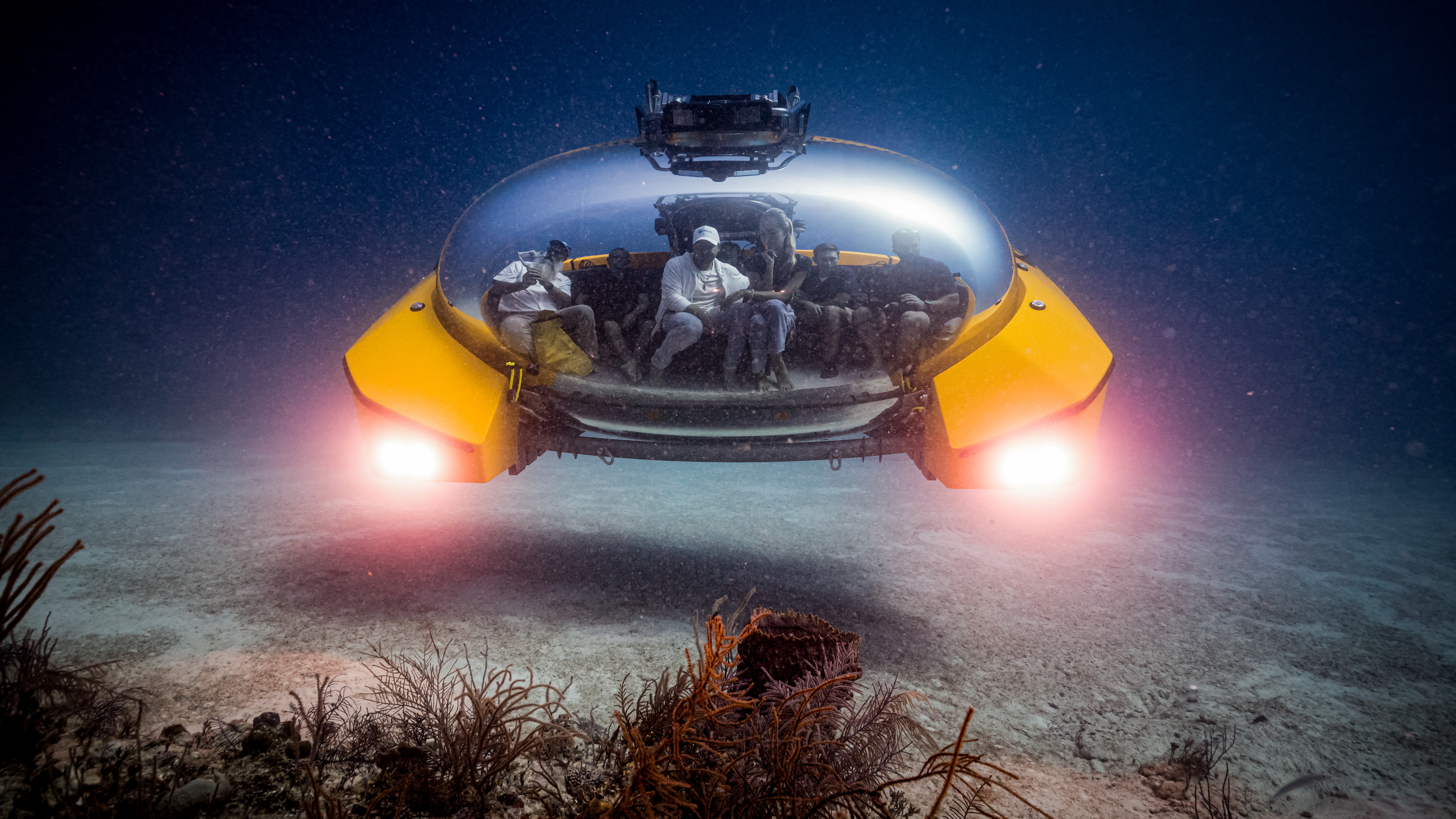
The material does the rest. Acrylic's refractive index sits close to water's, so once the hull is submerged the boundary between inside and outside all but disappears. In a conventional submersible the passenger looks through a window; in the AVA the passenger sits inside the window, with the view running up, below and behind the seating rather than stopping at a porthole's edge.
That is why there is no bad seat. The seating arcs through the middle of the acrylic, every place on the arc facing outward into the same continuous view, and the interior reconfigures between dives — dining, cocktails, spa, gaming — because what Triton sells cruise lines and resorts is not transport. It is an hour inside a room that happens to be underwater, and a room can be re-dressed for the next hour's purpose in a way a cockpit cannot.
First boat, first customer
The first production boat shows who the customer is. The 660/9 was conceived for Scenic Luxury Cruises; the first unit was delivered in 2024 as Scenic Neptune II, flown to Valparaíso, Chile, aboard a Boeing 747 and integrated onto the expedition ship Scenic Eclipse II. A submersible that travels by jumbo jet to meet its ship is not a private toy being delivered to a garage. It is fleet equipment, joining an itinerary — Scenic Eclipse II went on to Australian waters, with cruising planned across the surrounding region, Indonesia, New Zealand, the South Pacific and East Antarctica.
Triton publishes no price; the economics it does publish are the operator's — excursion tickets and full diving days — marking the AVA as working equipment for the hospitality trade, not a yacht toy. The passenger buys an hour. The operator buys the room. And the room exists because one design team decided that a certification habit, however well earned, was not the same thing as a law.
Previously's Take
The sphere was never a law of physics — it was a habit, a shape the industry could certify without thinking too hard. Triton's real product is proof the habit can be broken and classed: every passenger submersible designed from now on has to justify staying round.
The numbers
Sources · 5 sources
- Triton Submarines — 660/9 AVA model record and technical specification
- The World of Yachts — Scenic Eclipse II delivery report (DNV certification)
- New Atlas, April 24, 2024 — delivery report and Triton photography
- Superyacht News — AVA announcement (Lahey and Ramsay interview)
- The Triton, May 2024 — 660/9 AVA unveiling report (patent-pending hull form, delivery and integration aboard Scenic Eclipse II)
Photographs: Triton Submarines · Triton Submarines · Triton Submarines