
WASHINGTON
President Donald Trump used a few minutes in front of reporters on the White House South Lawn on Monday to deliver two of the bluntest foreign-policy messages of his presidency — one aimed at Ukraine’s president, the other at the whole of Europe — before departing for a campaign rally in Wichita, Kansas. According to the New York Post, the Washington Examiner and Stateline Daily, Trump said it was time for “somebody else” to negotiate on Ukraine’s behalf, defended his administration’s easing of sanctions pressure on Russia, and warned that Paris was, in his words, “going to be a Muslim city very soon.” Fifteen days out from the November 3 midterms, it was the kind of unscripted South Lawn performance that tends to swallow an entire news cycle — and this one arrived with wars, riots and a record-low approval number all attached to it.
Trump: “somebody else” for Ukraine
On Ukraine, Trump was responding to criticism from President Volodymyr Zelensky, who had said Trump was on the “wrong side of history,” according to the Post. Trump returned fire directly. “Zelensky is a man that should’ve had this war settled a long time ago,” he said, per the Post. “If he would’ve listened to me, he would’ve made a much better deal a long time ago and he’d have a million people living…” He then added the line that will lead every bulletin tonight: “I think it’s time for somebody else to negotiate on behalf of Ukraine.”
Trump also defended his administration’s posture toward Moscow, including easing sanctions and a diesel deal with Russia, saying, per the Post, “Russia, frankly, has been fine on Ukraine. They haven’t been doing much.” That assessment sits awkwardly next to the day’s other headline from the war: the Post reported that a Russian attack on a park on Monday killed 10 people, and that more than 125,000 Ukrainians have died in the war by current estimates. The contrast — a president describing Russia as “fine” — Trump’s word, per the Post — on the same day a park attack killed ten people — is exactly the kind of juxtaposition Zelensky’s “wrong side of history” remark was built on, and it guarantees the exchange will be argued about well beyond tonight.

Trump also played down speculation about a trilateral meeting with Russian President Vladimir Putin and Chinese President Xi Jinping in connection with his November trip to China, per the reports. Even the dismissal matters: the idea of a three-way great-power summit over Ukraine has been floating around diplomatic coverage for days, and the president’s shrug suggests Washington is not, at least publicly, building toward that kind of grand-bargain moment. What he is building toward, by his own account, is a negotiation in which Zelensky is no longer the central figure on Ukraine’s side of the table — a remarkable thing for an American president to say about an allied leader mid-war, and one Kyiv will have heard very clearly.
Trump on Paris: “going to be a Muslim city very soon”
The France portion of the exchange began with a question about President Emmanuel Macron, who has blamed the unrest sweeping France partly on fuel costs driven by Trump’s Iran war, according to the Examiner. Trump’s answer veered immediately to immigration. “Paris is going to be a Muslim city very soon, and that wasn’t the deal,” he said, per the Examiner. “I told Emmanuel, ‘You should close up your borders.’” He widened the warning from there, Trump said, per the Examiner: “If Europe doesn’t close its borders… Europe is finished.” On Truth Social, he put the same message in capital letters: “The migrants have taken over France. They must CLOSE THE BORDERS, FAST!” Trump wrote on Truth Social, per the Examiner’s account of the post.
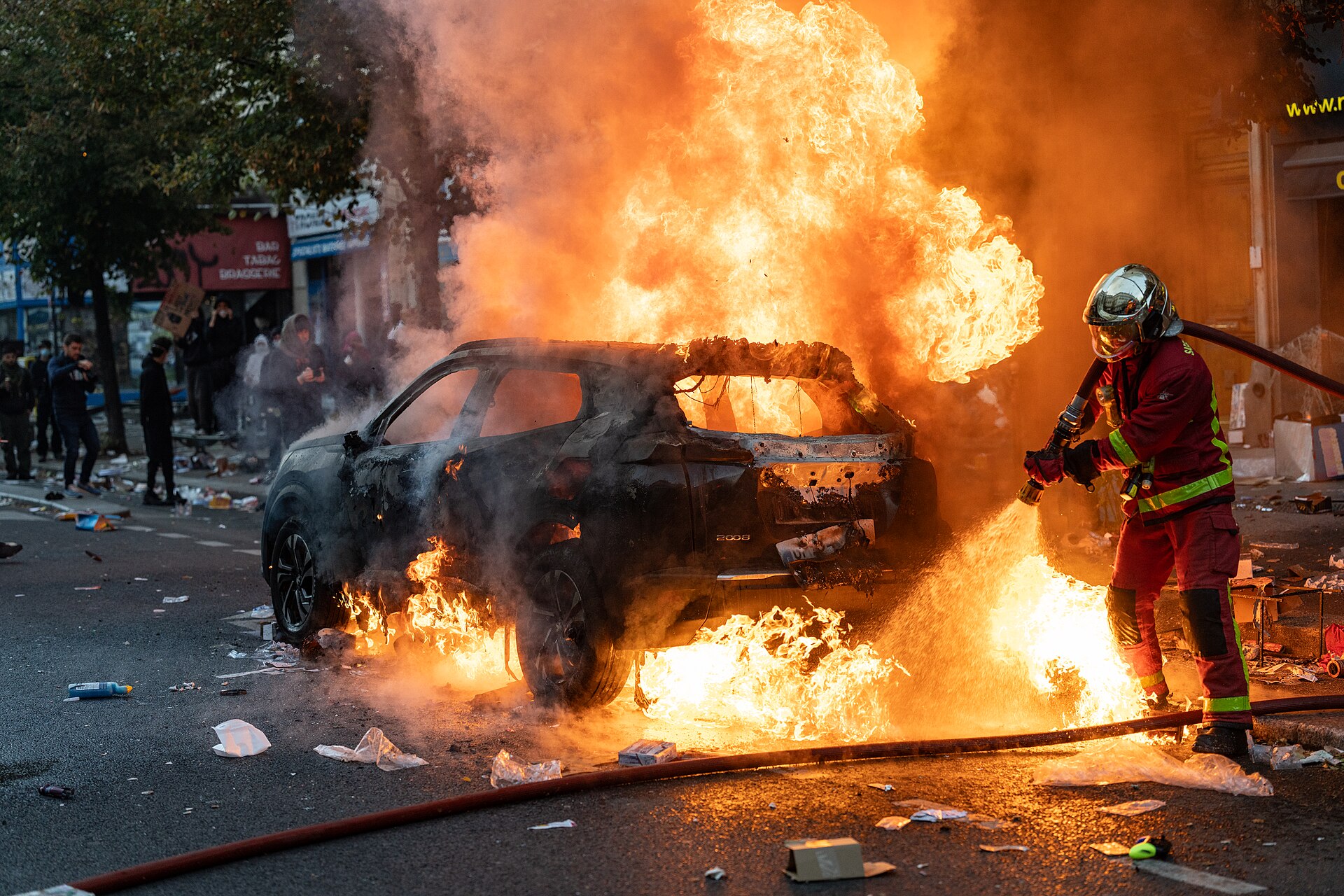
The unrest Trump was commenting on is real, large and still developing. Per Stateline Daily, a nationwide day of action on October 17 drew an estimated 550,000 to 800,000 demonstrators, with between 1,200 and 2,400 arrests and roughly 150 police officers injured. On Monday, protesters blocked the Louvre, and Prime Minister Sébastien Lecornu requested partial evening curfews. Stateline traced the movement’s origins to student protests in late September and an October 5 incident in Lens in which a 15-year-old lost a hand to a stun grenade — the kind of injury that turns a protest wave into a national reckoning. Our continuing coverage of the crisis is on the news front, including today’s reporting on the curfew requests and the Louvre blockade.
American reaction split along predictable lines. Vice President JD Vance blamed “Western liberals” for the crisis, per the reports, while House Speaker Mike Johnson called the situation “a chilling warning for all Americans.” In France itself, the most quoted pushback came from an unexpected direction: Marine Le Pen, the longtime leader of the French nationalist right, said that “Islam is compatible with the Republic,” Le Pen said, per Stateline Daily — a line that underlines how far outside even France’s own hard-right mainstream Trump’s framing landed. When Marine Le Pen is the voice of moderation in a transatlantic argument about Islam and France, the argument has travelled a long way from normal diplomatic discourse.
Fifteen days out
None of this happened in a political vacuum. Trump was leaving the White House to campaign in Wichita with the midterms 15 days away, and the domestic numbers trailing him are the worst of his presidency: as we reported this afternoon, a Reuters/Ipsos poll put his approval at a record-low 31 percent. Presidents in that position usually narrow their message. Trump, characteristically, widened his — taking on an allied president fighting a war, the president of France, and the entire European border regime in a single South Lawn session. Whether that is confidence or defiance, it is unmistakably the closing argument he has chosen: that the chaos abroad is proof of what happens when other leaders don’t listen to him. Voters deliver their verdict on that argument on November 3, and the Previously news desk will be covering every day of the run-in.
Sources · 3 sources
- New York Post — Trump's South Lawn remarks on Ukraine and Zelensky, and the park attack that killed 10 people on Monday
- Washington Examiner — Trump's remarks on Paris, Macron and European borders
- Stateline Daily — France unrest figures: October 17 day of action, arrests, injuries, the Louvre blockade and curfew requests