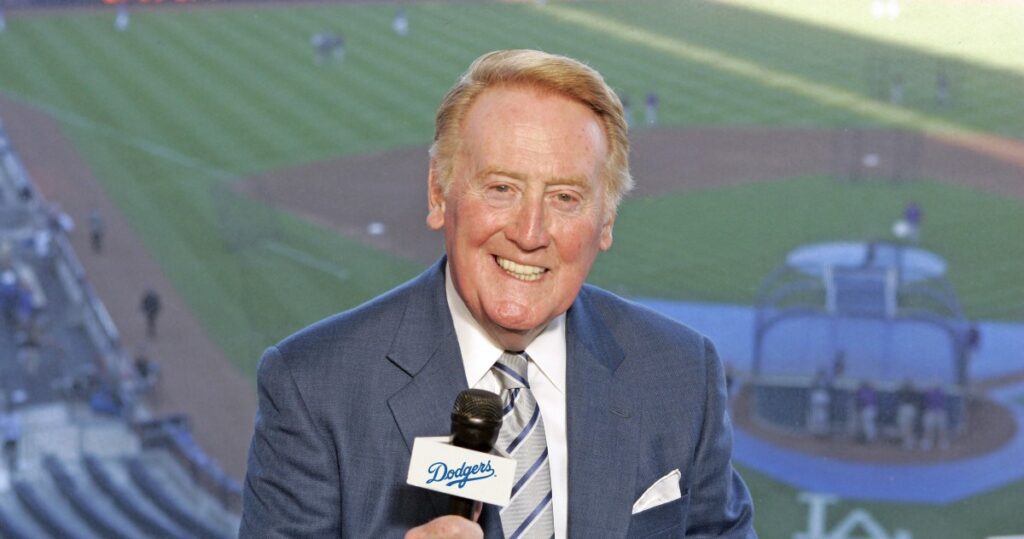
The short version: Ten years ago this month, Vin Scully walked into a broadcast booth in San Francisco, called a Dodgers game against the Giants at what was then AT&T Park, and then never called another one. Sixty-seven seasons — Brooklyn to Los Angeles, Ebbets Field to Dodger Stadium — ended with the voice that taught generations how baseball was supposed to sound saying goodbye the only way he knew how: warmly, gracefully, and with a Dr. Seuss line borrowed for the occasion. A decade later, no one has filled the silence he left behind, because no one could.
Start with the symmetry, because Scully himself would have loved it. His first cognizant memory of baseball fandom was as an eight-year-old in New York, passing a Chinese laundry with the World Series line score in the window: October 2, 1936, Yankees over the Giants, 18-4. "Oh, the poor Giants," the little boy thought — a Giants fan born within earshot of the Polo Grounds. Exactly eighty years later, on October 2, 2016, that same boy, now 88, called his final game: Dodgers at Giants, in San Francisco, the Giants clinching a wild card berth. He died on August 2, 2022, at 94 — on a night when the Dodgers were playing in that very same park, where a plaque in the press box now marks his final broadcast. The symmetry is almost too neat to be real, except that everything about Scully's career was almost too neat to be real.
The numbers are the easy part, and they are staggering anyway. Scully broadcast his first Dodgers game in 1950, at age 22, when the team still played in Brooklyn. He moved west with the club in 1958 and stayed through the 2016 season: 67 years with one franchise, the longest tenure of any broadcaster with a single team in sports history. He was inducted into the broadcasters' wing of the Baseball Hall of Fame in 1982. He called three perfect games, 25 no-hitters, 25 World Series, and 12 All-Star Games. In 2016, President Barack Obama awarded him the Presidential Medal of Freedom. The Dodgers placed him in their Ring of Honor the year after he retired. When he died, the news was announced during a Dodgers-Giants broadcast in San Francisco, and Giants broadcasters Duane Kuiper and Mike Krukow — rivals in every sense that mattered — were visibly emotional on the air.
But the numbers were never the point. The point was the voice, and what the voice did. Scully called games alone — no color commentator, no booth partner, no safety net — for most of his career, filling three hours of airtime with a mixture of play-by-play precision and storytelling that made a Tuesday night in July feel like an occasion. He knew the opposing team's roster as well as the Dodgers', which made him a pleasure to listen to no matter who you rooted for. He gave generations of fans their baseball education: Kirk Gibson's limping home run in Game 1 of the 1988 World Series ("She is gone!"), Hank Aaron's record 715th home run in 1974, Sandy Koufax's perfect game in 1965. He even called the most famous play in 49ers history — "The Catch," Joe Montana to Dwight Clark in the 1981 NFC Championship Game — during his years with CBS, a footnote in his career that would be the headline of anyone else's.
His final sign-off is worth quoting in full, because it is the rare goodbye that actually worked. "Don't be sad that it's over," he told his listeners that October night in San Francisco. "Smile because it happened." He had used the modified Dr. Seuss line before, and he meant it the way he meant everything: sincerely, without a trace of self-pity. Asked once about his legacy, he said, "I've always felt that I haven't really accomplished anything. What I've done is spend a lifetime talking about the accomplishments of others. I hope people would consider me a good human being and a good husband, father, and grandfather. The last thing would be the fact that I was a pretty good broadcaster." The humility was genuine. The "pretty good broadcaster" part was the only false note in the sentence.
Ten years on, the Dodgers have cycled through broadcasters, and the game has cycled through eras — the pitch clock, the shift ban, the ghost runner, all of it arriving after Scully left the booth. He would have adapted to all of it, probably, and found something graceful to say about each change. What he would not have changed is the thing that made him singular: the belief that a baseball broadcast was, at its best, an act of companionship. He talked to you, not at you. He assumed you were intelligent and that you loved the game, and he never once talked down to either assumption.
There is a temptation, on anniversaries like this, to declare that we will never see another like him. With Scully, it is not a temptation — it is a statement of fact. The conditions that made him possible don't exist anymore: the single-team lifetime, the solo booth, the unhurried three hours, the city that grew up with one voice on the radio. He was the last of a species. "Don't be sad that it's over," he said. "Smile because it happened." Ten years later, baseball is still smiling — and still listening for the echo.
Previously's culture desk revisits the voices that shaped the games we love.
Sources
- True Blue LA, The Decennial of Vin Scully's Swan Song, Oct 2026
- True Blue LA, Vin Scully, legendary Dodgers announcer for 67 years, dies at age of 94, Aug 2022
- SABR Games Project, October 2, 2016: Vin Scully calls his final game as Giants beat Dodgers to clinch wild card
- NBC Sports Bay Area, Vin Scully, legendary Dodgers broadcaster, dies at age of 94, Aug 2022
- LA Almanac, Vin Scully - Veteran Los Angeles Dodgers Sportscaster (photo by Floatjon, via Wikimedia Commons)