
An astronaut's idea of a hotel
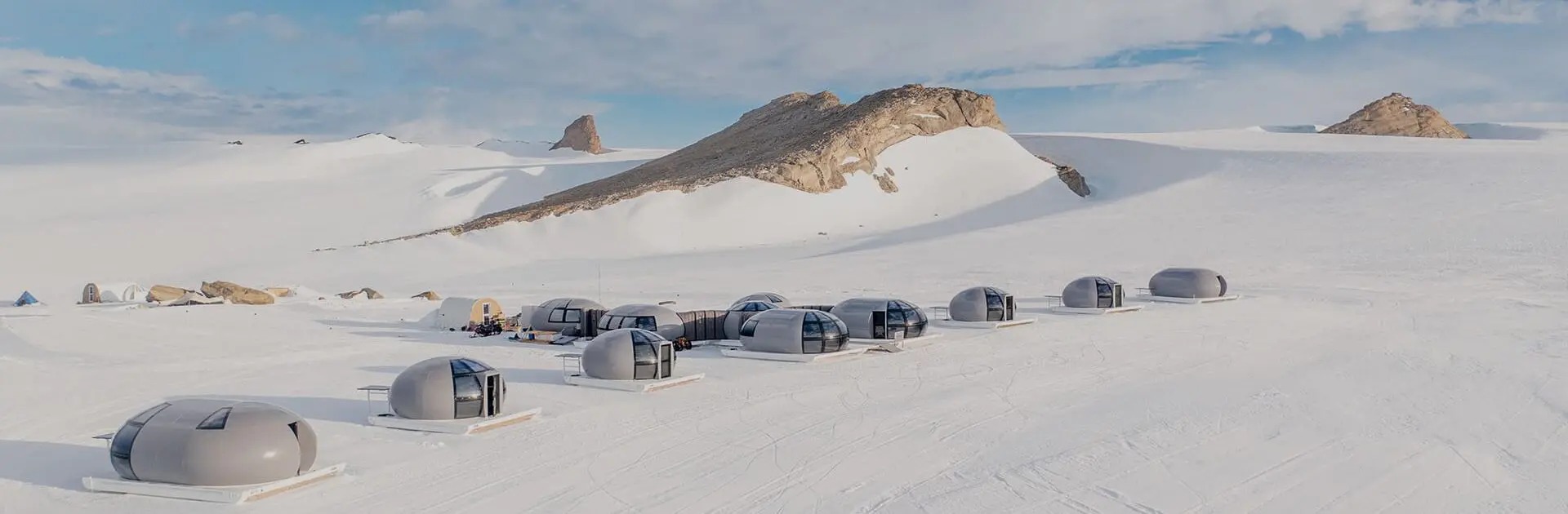
Echo began, fittingly, with an astronaut. White Desert says the idea for the camp was conceived in conversation with Buzz Aldrin during his visit to Antarctica, and the design follows the reference honestly: six domed pods that look less like hotel rooms than like something lowered gently onto the ice from orbit. Founder Patrick Woodhead tells it as a fusion that formed over years — conversations with Aldrin and with Colonel Terry Virts about Mars and living on the Moon, in a landscape he describes as the closest you can get to being on another planet.
The company behind it was founded in 2005 by Patrick and Robyn Woodhead. Patrick traces the idea to a 1,149-mile traverse of Antarctica on foot: storm-bound for four days, low on supplies, he and his teammates began asking why only scientists and the occasional polar explorer ever got to see the continent's interior. White Desert was the answer they built when they came home. Echo opened in 2022 as the company's third Antarctic camp, after Whichaway and Wolf's Fang, at 71°32′ S in Queen Maud Land, and it sleeps twelve guests — two to a pod, never more.
Six pods, flown in
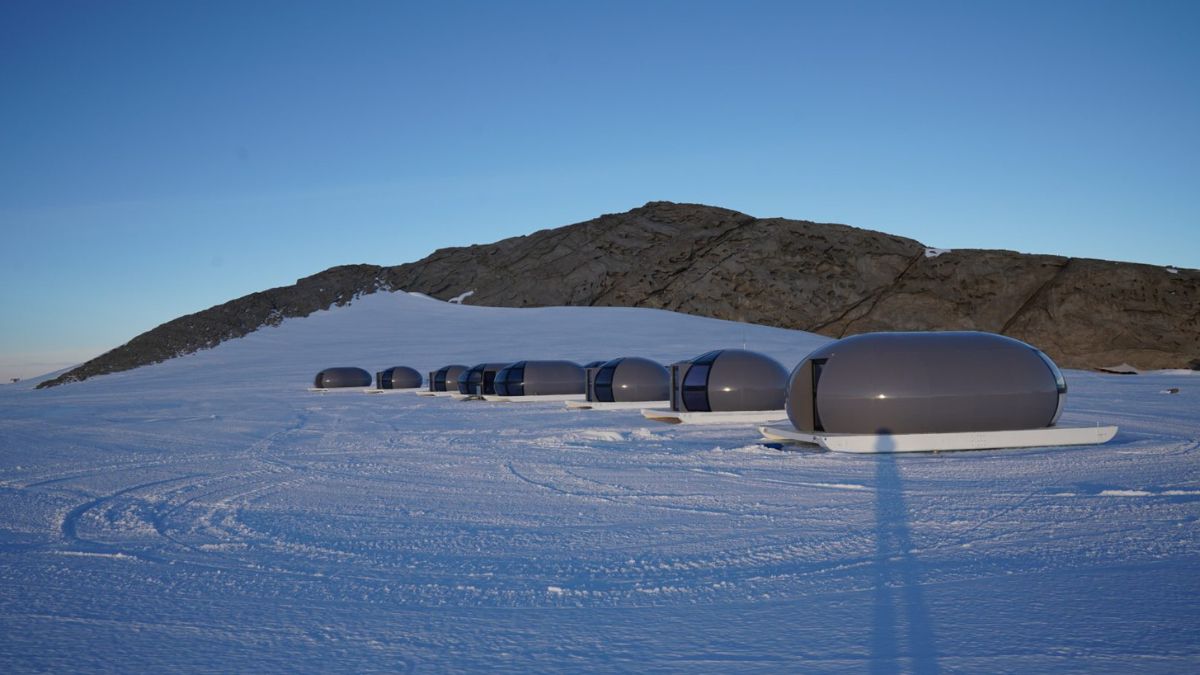
The pods themselves are the engineering story. White Desert's launch material describes six heated bedroom "sky pods" crafted from composite fibreglass, each with floor-to-ceiling windows facing the landscape. Composite matters out here: it is light enough to fly in, strong enough to shrug off katabatic winds, and it can be moulded into the smooth, sealed curves that keep heat in and weather out. The build was a logistics exercise before it was a design one — accounts of the project describe three years of planning and some 80 tonnes of air cargo moved to the ice, in a place with no port, no road and no hardware store.
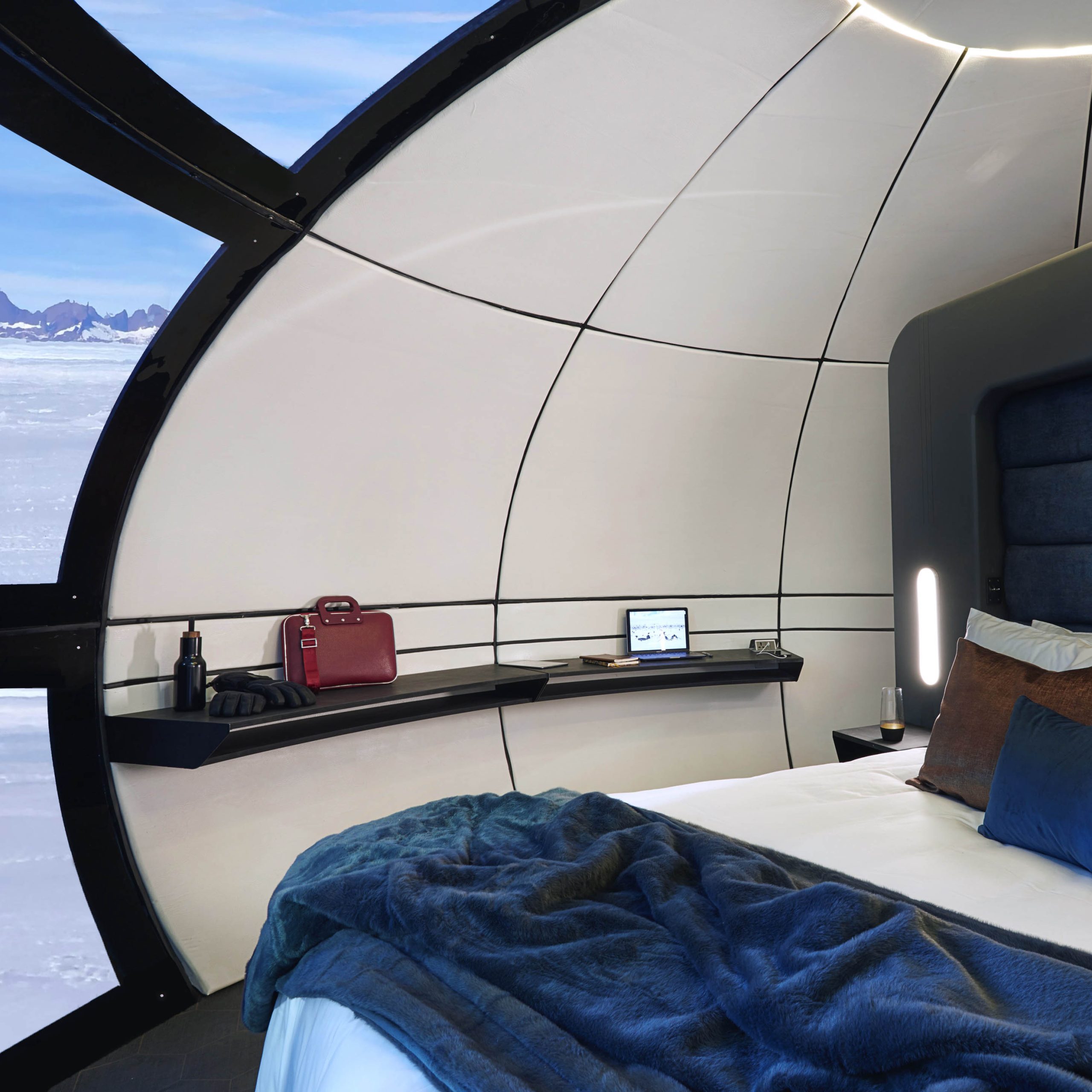
Inside, the space-age theme is played straight rather than as kitsch. Interiors carry retro detailing and original photographs taken from the International Space Station by its former commander, Colonel Terry Virts, himself a White Desert guest. Virts' verdict on the setting is on the launch record: "The mountains are the most beautiful I have seen across Earth, Venus and Mars." One honest change is worth recording: at launch, Echo's plan centred on communal lounge and dining pods with separate heated shower pods. White Desert's current Echo page describes the camp differently — a private en-suite shower in every pod. The camp has been upgraded in place, and the two layouts belong to different years.
The runway is rebuilt every season
Getting there is part of the engineering. Guests arrive in Cape Town two days early for an orientation and safety briefing, then fly five hours to Wolf's Fang Runway — a 1.9-mile strip of blue ice that White Desert operates exclusively and that its team must monitor, resurvey and recreate each season as the glacier shifts, grading it for every flight. On arrival, guests are taken to a private lounge where a martini shaken with 10,000-year-old ice is waiting. The flourish is deliberate, but it rests on the least glamorous work in the operation: a runway that has to be remade before anyone can land on it.
Eighty people behind twelve guests
The season is dictated by the continent, not the balance sheet: operations run roughly from late November to early February, when Antarctica permits visitors at all. Keeping twelve guests warm, fed and safe at the bottom of the world takes a small expedition of its own — Woodhead counts a team of 80 to 100 behind each season: pilots, camp managers, flight operations and communications crews, chefs, polar guides, doctors and hospitality staff. The supply chain explains the ratio. A can of Coke, Woodhead notes, carries a landed cost of $36 by the time it reaches camp.
What guests do with that support is the interior Antarctica almost nobody sees: guided hiking, ice climbing and mountaineering around camp, a trip to the emperor penguin colony at Atka Bay, and the journey to the South Pole for those who book it.
Built to vanish
Everything at Echo is provisional by design. Like all White Desert camps, it is built to be dismantled and removed, leaving no trace on the landscape beyond tracks in the snow — the operator's stated design policy, and the standard the camp is judged against. The company also pledges $1,000 per person per trip to its conservation, community and sustainability initiatives.
The price of admission, at launch, was set at USD 65,000 per person for a five-day tour including the return flights from Cape Town, accommodation, food and activities — White Desert now prices Echo trips by itinerary, quoted per journey rather than off a rate card. What the money is really buying is not square footage; a pod is a compact room by any city standard. It buys the supply chain behind the room: the fuel, the runway, the weather windows, and the people who make a hot shower possible at 71 degrees south.
Previously's Take
Echo's real luxury is reversibility: the most considered building in Antarctica is the one that can vanish. Six heated rooms, a full expedition staff — and when the season ends, nothing on the ice that says anyone was ever there.
The numbers
Sources · 5 sources
- White Desert — Echo camp page (white-desert.com): Aldrin origin, en-suite showers, floor-to-ceiling windows
- White Desert launch material, March 2022, via Hong Kong Tatler / HN Worth and Dwell: six composite-fibreglass sky pods, Terry Virts photography, dismantle-without-trace design, launch pricing
- Scott Dunn and Pelorus — Echo camp accommodation records: composite fibreglass pods, dismantlable design
- InsideHook — Patrick Woodhead interview on Echo: season length and expedition staffing scale
- Wikipedia — White Desert (company): Echo added 2022, six pods, twelve guests, coordinates
Photographs: White Desert · White Desert · White Desert