
The flaw every loudspeaker carries quietly
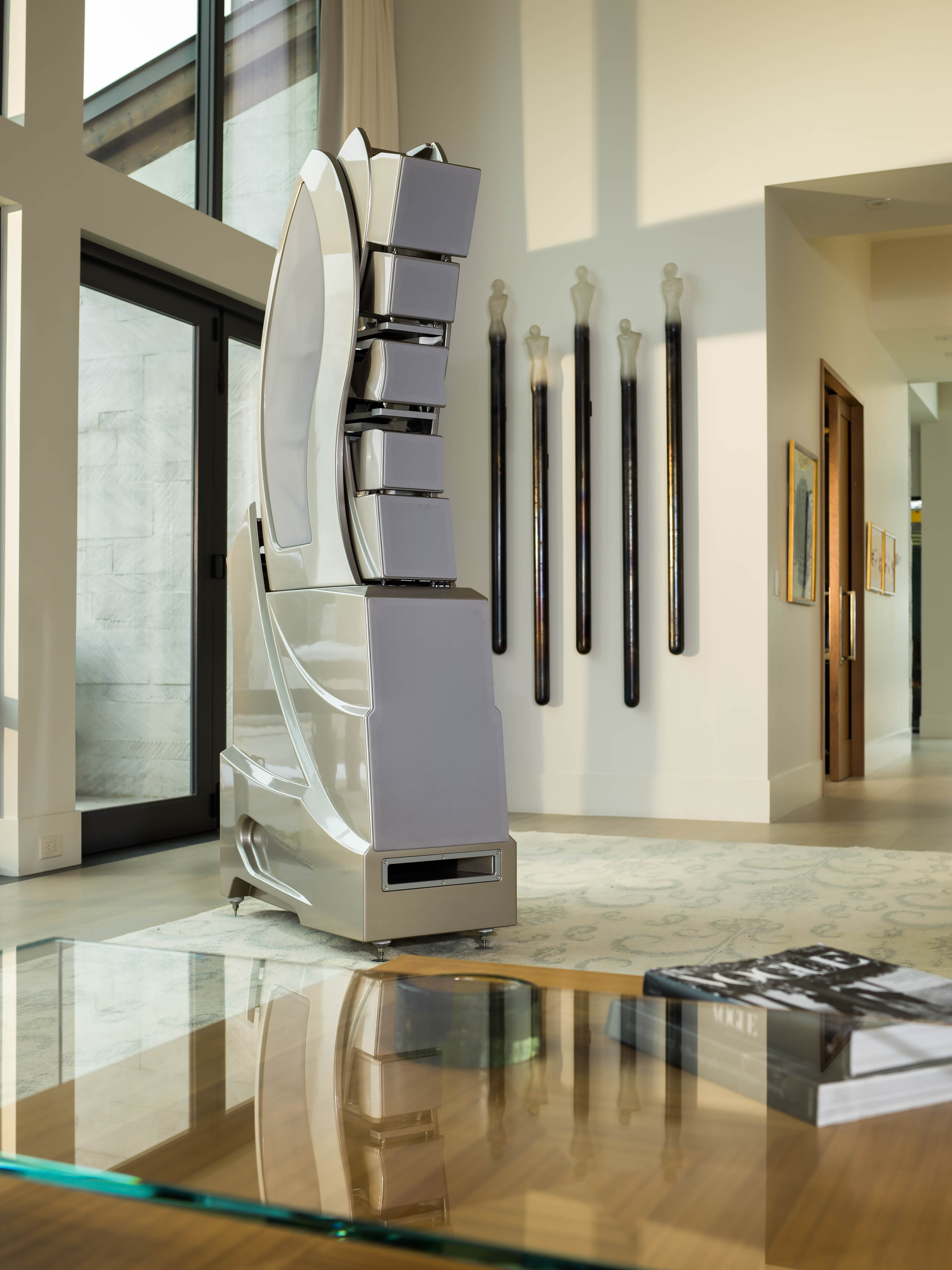
Every loudspeaker has the same quiet flaw. The drivers that make the treble, midrange and bass sit at different depths in the cabinet, so their sound leaves at slightly different times and arrives smeared — by microseconds, but the ear is good at microseconds. Dave Wilson built his company on refusing that smear, and the WAMM Master Chronosonic is where the refusal ended up: a loudspeaker designed backwards from a single question about time.
Most flagship speakers are designed forwards from the sound: choose the drivers, build the cabinet, tune the result. Wilson's question ran the other way. If the ear registers when each part of the sound arrives, then a speaker's first job is not to produce the frequencies — any competent design does that — but to deliver them together, as one event, the way the original performance produced them. Everything about the Master Chronosonic, including the way it looks, follows from taking that arrival problem literally.
An idea he had been carrying since 1981
Wilson's first commercial product, back in 1981, was the original WAMM — Wilson Audio Modular Monitor — a multi-module speaker whose parts could be physically shifted against each other. The modularity was never a styling choice. If the modules can move, their timing can be corrected; if they are fixed in one cabinet, the timing is whatever the cabinet's geometry happens to give you.
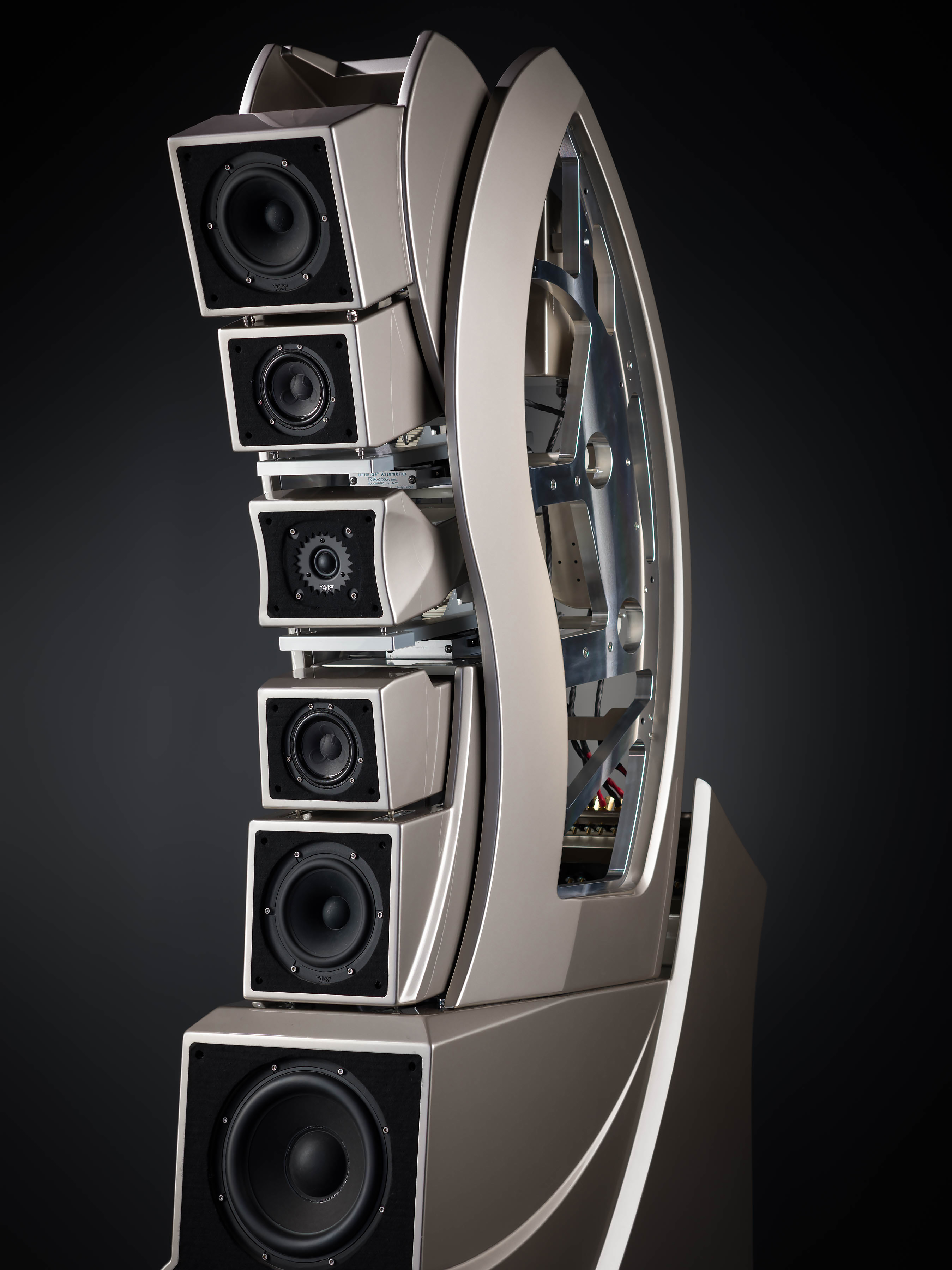
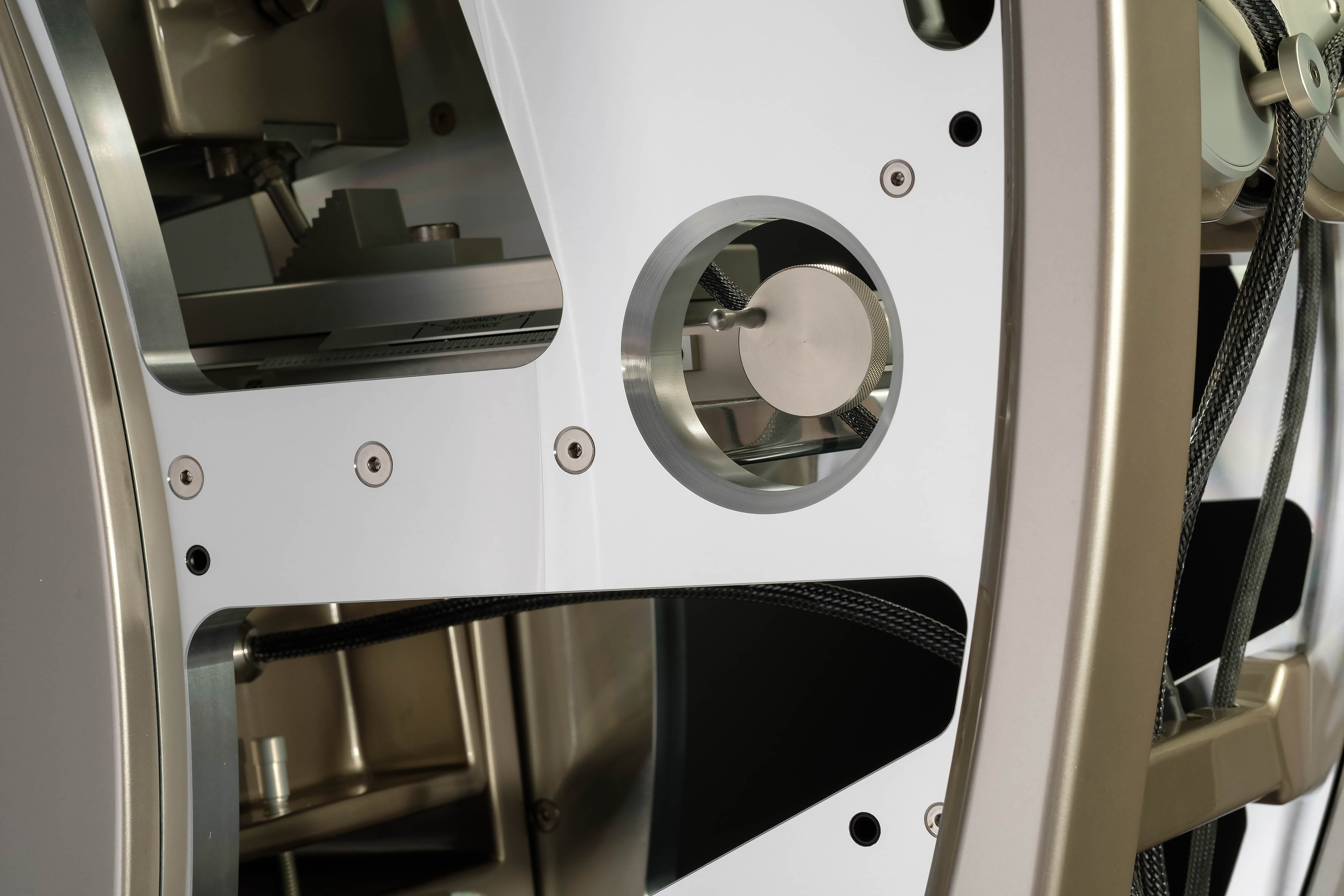
The Master Chronosonic, launched at the end of 2016 after nearly five years of development, takes that idea to its limit. Each channel stands over seven feet tall and weighs 900 pounds. Separate modules carry the drivers — two woofers, four midranges, two tweeters — and the five upper modules do not sit fixed. They ride on a gantry of aerospace aluminium, positioned by a geared micrometer system, and they move. Five years of development, in other words, were spent not on a new driver or a new material, but on perfecting the machinery that lets the parts of a speaker be placed in time.
Five microseconds, set to your chair
That movement is the whole point, and Wilson's own film explains it better than any spec sheet. In Magnum Opus, Dave Wilson talks through his early time-domain research — how a driver's position, in fractions of an inch, becomes arrival time at the seat.
The adjustment is calibrated to the actual room: listening distance and seat height are measured, and the modules are set so every frequency arrives together — precision Wilson puts at five microseconds. The timing is not set at the factory and hoped for. It is dialled in, in the room, to the chair.
That is a profound change in what a loudspeaker is. A conventional flagship is finished when it leaves the factory; the owner simply places it. The Master Chronosonic is finished in the owner's room, against measurements of the owner's seat, because its central claim — everything arrives at once — can only be true for a specific listener in a specific place. Move the chair, and strictly speaking the calibration moves with it. The speaker does not have a correct setting. It has a correct setting for you, there.
The engineering worn outside
The cabinetry is Wilson's own composites — X-Material and S-Material, with a W-Material developed for this speaker at the module interfaces — rather than the MDF most speakers are built from. The materials serve the same argument as the gantry: a module that must hold a micrometer setting cannot sit in a cabinet that flexes, resonates or creeps. Rigidity here is not about bragging rights. It is what keeps a five-microsecond adjustment true after the installers leave.
Unlike the original WAMM, which needed a separate subwoofer for the lowest octaves, the Master Chronosonic is a true full-range design on its own. The driver complement per channel shows how the range is covered without help: woofers of 10.5 and 12.5 inches at the bottom, two 4-inch and two 7-inch midranges through the middle, and a silk-dome tweeter with a second, rear-firing tweeter at the top. Every one of those drivers is a separate arrival-time problem, and every one is answered by the same gantry. The idea that began in 1981 as an array of boxes plus a subwoofer ends, in the Master Chronosonic, as a single self-sufficient instrument per channel — the full range, aligned in time, from one tower.
Seventy pairs, and the founder's name on it
Wilson limited production to 70 pairs, each taking roughly ten weeks to build in Provo, Utah, priced at $685,000 a pair. Ten weeks a pair and a run of 70 is not a product line in any normal sense; it is closer to a commission programme, a small number of instruments built slowly by a company that knew exactly how many it intended to make.
Dave Wilson died in 2018; the company, now led by his son Daryl, kept the WAMM in its line until 2026. It remains his magnum opus — less because of its size than because of what the size was for. Every other flagship asks to be looked at. This one asks to be measured.
Previously's Take
Plenty of expensive speakers hide their engineering behind veneer; the WAMM wears its outside — that exposed stack of boxes on a metal spine is the engineering. Wilson's bet was that time, not frequency, was the last thing between a recording and the feeling of being in the room, and nobody else ever built that argument this literally.
The numbers
Sources · 4 sources
- Wilson Audio — official product page, specifications and "Magnum Opus" film page
- The Absolute Sound — production announcement (MSRP, 70 pairs, build time)
- Stereophile, May 2025 — Munich report ($685,000/pair)
- What Hi-Fi? — launch coverage
Photographs: Wilson Audio · Wilson Audio · Wilson Audio