
The pattern gives it away
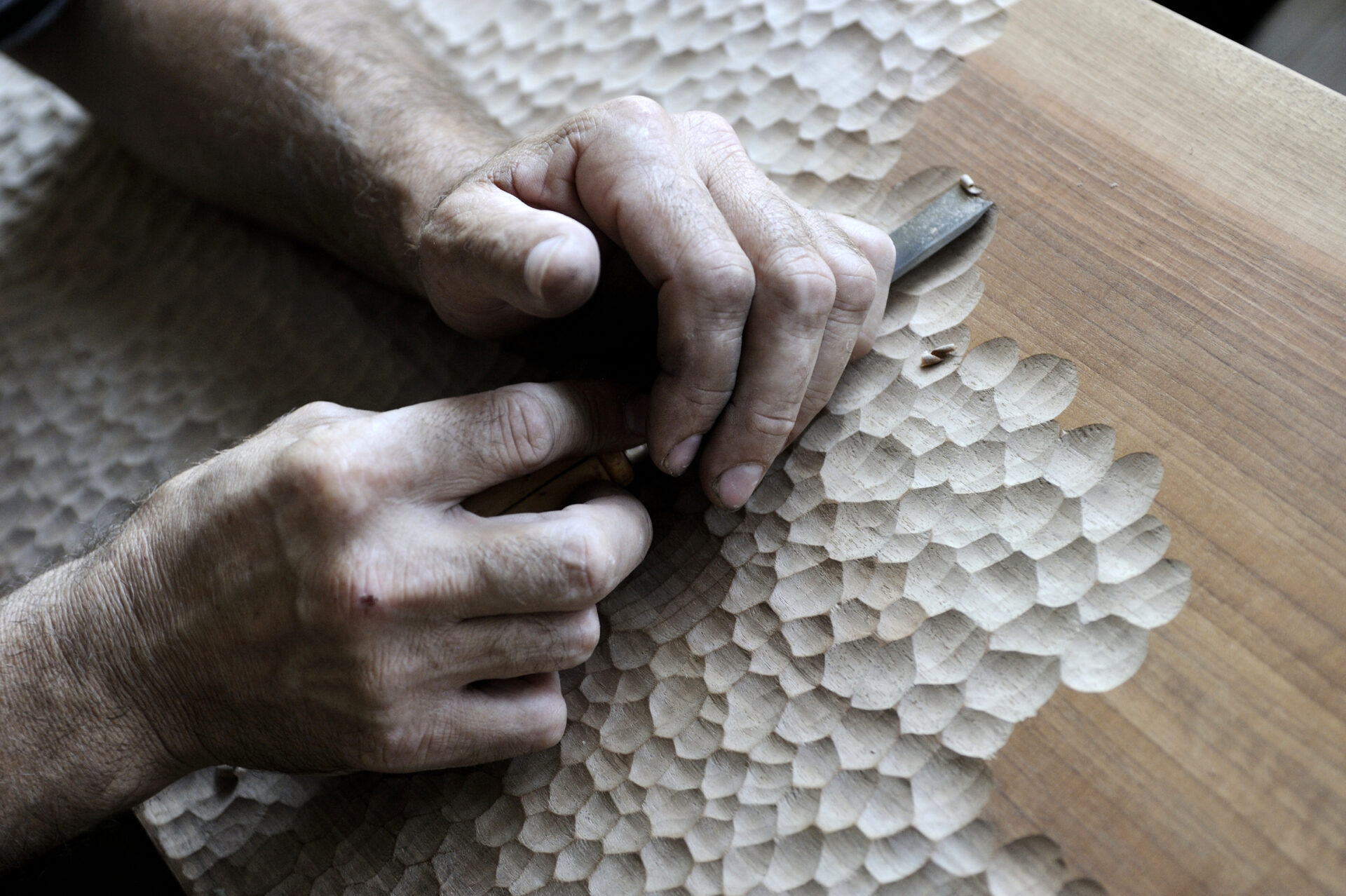
The pattern gives it away. Cover a tabletop in hundreds of small, overlapping hand-cut facets — each one a single decision of the chisel — and you are looking at Konjic woodcarving, a technique from a small town in Bosnia and Herzegovina that UNESCO inscribed on its Representative List of the Intangible Cultural Heritage of Humanity on 6 December 2017. One family, the Nikšić family behind the furniture company Zanat, has carried that technique for more than a century.
The pattern matters because it cannot be faked by a machine pass. Each facet is cut individually, and the surface reads as it does — dense, scaled, catching light differently from every angle — precisely because no two cuts are perfectly identical. That slight irregularity is not a flaw in the work. It is the signature of the method, and it is what the UNESCO inscription recognises: not a product line, but a way of working, held in the hands of a community of carvers.
An export craft before it was a heritage craft
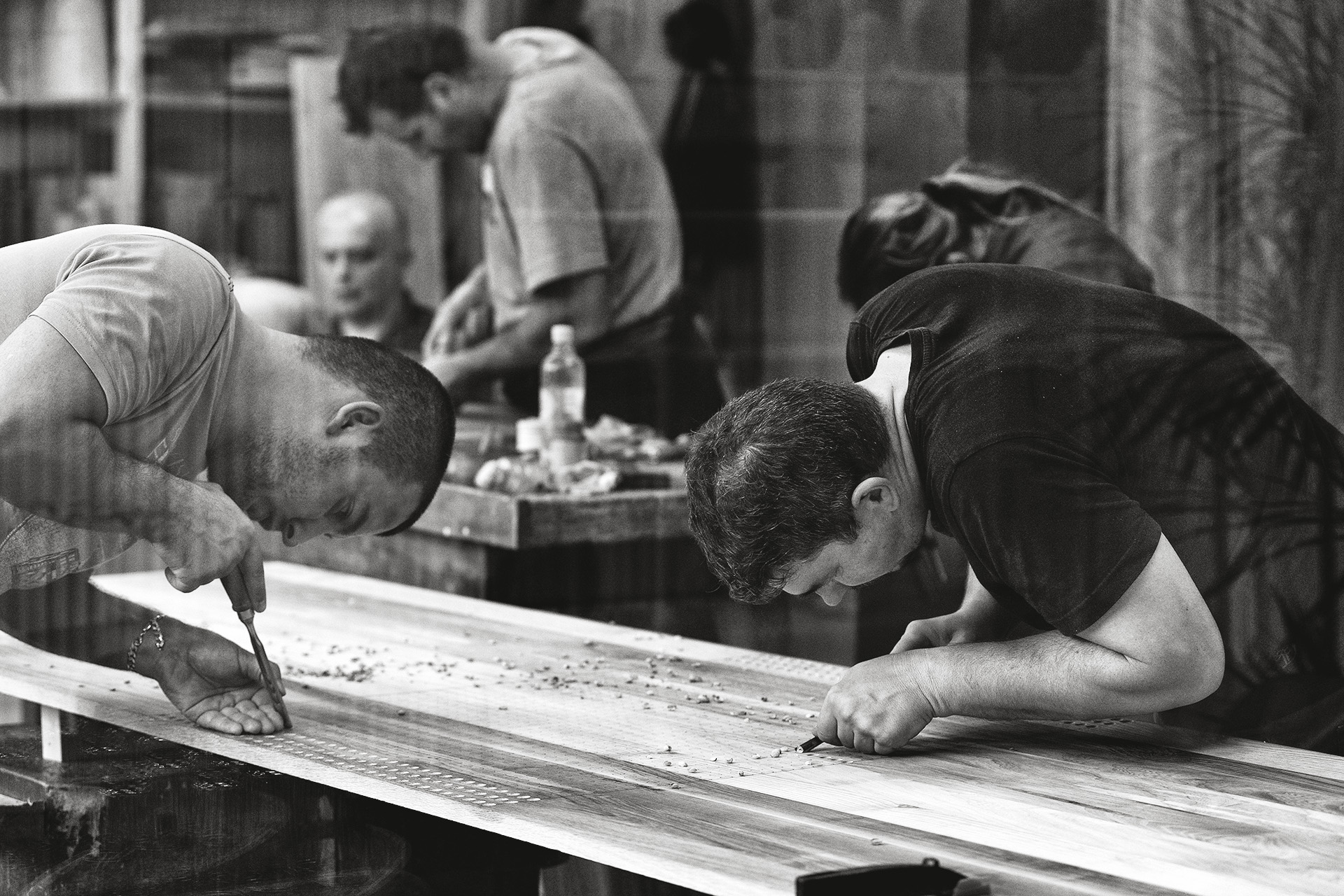
Zanat's own account starts with Gano Nikšić, who learned the carving method from a nearby village tradition that Austro-Hungarian-era schooling had already sharpened into an export craft: Konjic pieces were shown in Budapest in 1896, Brussels in 1897, Vienna in 1898 and the Paris Exposition Universelle of 1900. Gano taught his sons; Salih registered the family's first workshop in 1919, and Adem built it into a serious export business between the wars, when 36 carving workshops operated in Konjic.
Hold those dates in mind, because they correct the usual heritage story. Konjic carving was not a folk tradition discovered by the outside world in 2017. It was an industry with an international exhibition record before the First World War, a town where dozens of workshops competed and exported, and where carving was skilled employment rather than a sideline. The furniture in this story was never a hobby. It was a town's industry, written in walnut and maple.
Closed, reopened, closed, reopened
Then history kept interrupting. The Second World War and Yugoslav socialism closed the workshops; Adem's sons Mukerem and Besim reopened in the 1950s and kept the benches warm through decades when private business was barely tolerated. The Bosnian war stopped production again. Besim reopened in 1995 under the name Rukotvorine, and the fourth generation rebuilt from there — Adem, an architect, running the company, and his brother Orhan leaving a senior economist post at the World Bank in 2016 to come home and relaunch it with him as Zanat.
Count the restarts, because they are the family's real curriculum. The workshop tradition survived an empire's end, a war, a socialist state's suspicion of private trade, and a second, devastating war — not by being protected behind glass, but by being reopened, repeatedly, by people who treated carving as a livelihood worth rebuilding. Orhan's move in 2016 belongs in that sequence: a senior economist does not leave the World Bank for nostalgia. He left for a business he believed could work, run with his brother, in the town the family had never actually left behind.
The bet: contemporary design, carved the old way
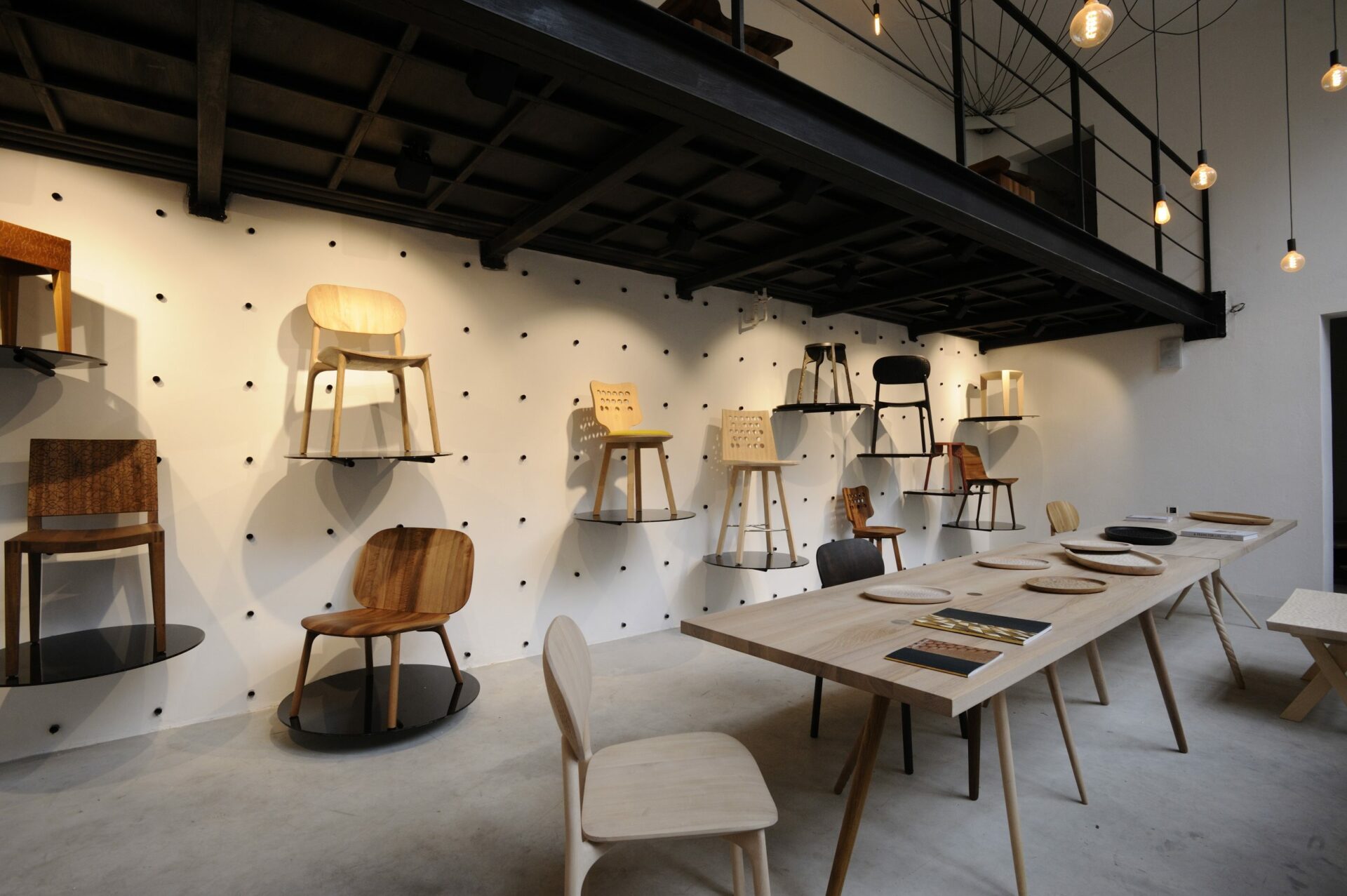
The relaunch made a deliberate bet: the carving would not be preserved as folklore. It would be put to work on contemporary design. Scandinavian designers Monica Förster and Harri Koskinen and Swedish architect Gert Wingårdh were among the first to design for the new company, and the model has held — international designers draw the forms, Konjic hands carve them, and young people from the town are hired and trained into a trade that was, in Orhan's words, close to extinction.
That division of labour is the whole strategy. The designers bring the forms of contemporary furniture — the chairs, tables and objects a modern buyer actually wants to live with. The carvers bring the surface only they can make. Neither half works alone: contemporary forms without the carving are ordinary furniture, and the carving without contemporary forms is a museum demonstration. Together, they make a product that can sell — and selling is what keeps apprentices at the bench, which is what keeps the technique alive.
The listing belongs to the town, not the brand
The UNESCO listing belongs to the technique and its community of carvers, not to the brand — Zanat is careful about that distinction, and it matters. The company is the craft's most visible employer, not its owner. It would be easy, and profitable in the short term, for a heritage company to blur that line and let buyers assume the honour attaches to its label. Zanat does the opposite, and the distinction is a large part of why the company's account of itself is credible.
The town underlines the point on its own account: Konjic's Woodcarving Museum, which tells this same story of family workshops and stubborn continuity, won the Luigi Micheletti Award in 2022, European museum recognition for a craft that outsiders had every chance to forget. The museum and the company are telling the same story from two sides — one preserving the record, the other keeping the benches full.
That is what a buyer actually brings home. A Zanat piece is contemporary furniture whose surface could only have been made one way: slowly, by hand, in a town that has refused to stop carving through every reason history gave it to stop.
Previously's Take
Heritage brands usually sell you the past, varnished; Zanat sells something rarer — a living skill with a future order book. The UNESCO inscription could have frozen Konjic carving in a museum; instead it sits on dining tables designed last year, cut by carvers trained this decade, in a workshop one family keeps reopening.
The numbers
Sources · 3 sources
- Zanat — "The Story of Zanat," official company history (four generations, workshop dates, 2016 relaunch, designer collaborations)
- UNESCO Intangible Cultural Heritage — "Konjic woodcarving," Representative List inscription 2017 (element record and official film, Federal Ministry of Culture and Sport of Bosnia and Herzegovina, 2014)
- Luigi Micheletti Award — Woodcarving Museum, Konjic (2022 winner record; Gano Nikšić and the craft's history)
Photographs: Zanat · Zanat · Zanat