Tennessee basketball has a Michigan problem — and a Final Four-sized hole in the most successful era in program history. The 2025–26 Volunteers ran all the way to a third consecutive Elite Eight, the latest chapter in a run of dominance no Tennessee team had ever produced: four straight Sweet 16s, five straight 25-win seasons, both program records. And for the third straight March, the season ended against a No. 1 seed playing for a national title. This time it was Michigan, the eventual national champion, delivering a 95–62 beating in the Midwest Regional final in Chicago — a 21–0 first-half run turning a dream season into a reckoning. The Vols are now 0–4 in the Elite Eight all time, and they own more NCAA Tournament wins than any program that has never reached a Final Four. The breakthrough is the only thing left.
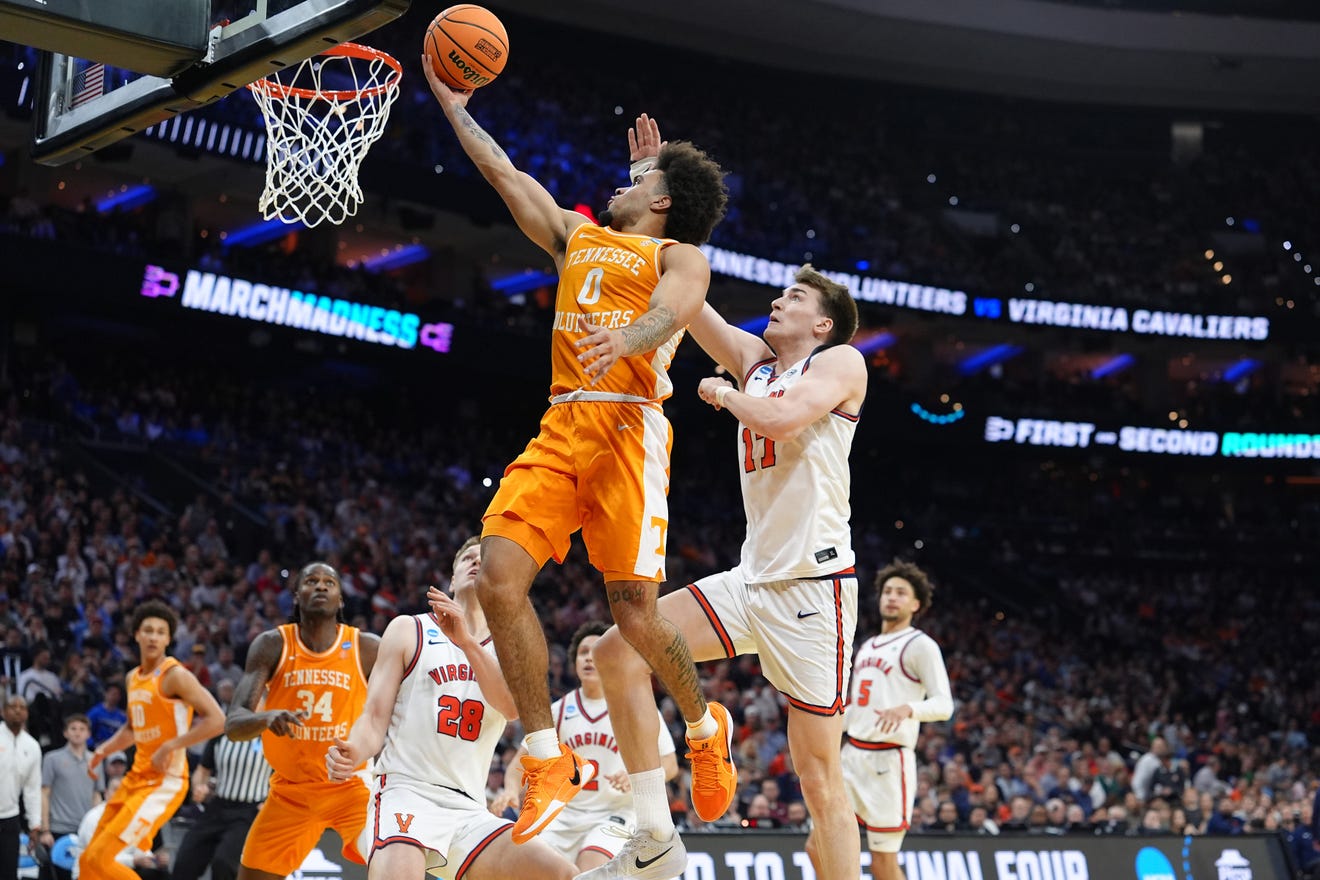
Give this team its due, though, because the 2025–26 run was the most improbable of the three. Tennessee lost 11 games before the tournament and earned a No. 6 seed — Rick Barnes's lowest seed in Knoxville. Then the Vols went to Philadelphia and ripped through the bracket: a 78–56 dismissal of No. 11 seed Miami (Ohio), a 79–72 win over No. 3 seed Virginia, and a 76–62 Sweet 16 takedown of No. 2 seed Iowa State. Point guard Ja'Kobi Gillespie was brilliant all March, pouring in 21 points with four assists against Michigan; center Felix Okpara battled foul trouble to deliver 10 points and seven boards; freshman Nate Ament showed flashes of the stardom Tennessee expects from him. It ended the way Elite Eights keep ending in Knoxville — against the best team in the country — but getting there from a 6-seed was pure Barnes.
Barnes, now entering his 12th season in Knoxville and his 40th as a head coach, has built the golden age of Tennessee basketball. The numbers are staggering: 861 career wins and counting, five Sweet 16s and three Elite Eights in eleven Tennessee seasons — before his arrival, the program had seven Sweet 16s and one Elite Eight in its entire history. His teams defend with a ferocity that has become the program's identity; even in the "down" defensive year of 2025–26, the Vols finished 32nd nationally in field-goal percentage defense. But the Michigan loss exposed the eternal Barnes question in the cruelest way: the Wolverines shot 52 percent, put five players in double figures — and held Tennessee to 32 percent from the field and 19 percent from three. "At some point, you've got to score the ball, too," Barnes said afterward. "We're going to have to shoot the ball better."
To his credit, Barnes — the most stubbornly defense-first elite coach of his generation — actually listened to himself. The 2026–27 roster rebuild through the transfer portal can be summed up in two words: shooters galore. VCU guard Terrence Hill (15.0 points per game, 37 percent from three), Cal guard Dai Dai Ames (16.9 points, 37.6 percent from deep) and Belmont guard Tyler Lundblade (15.6 points, a scorching 43 percent from three) headline a portal class designed to fix exactly what Michigan exposed. After the season, Barnes affirmed he is "100 percent committed" to returning — the Final Four chase continues with a roster remade in the image of the lesson.
The recent history is a highlight reel of near-misses and superstars. The 2023–24 team, led by SEC Player of the Year Dalton Knecht — the Northern Colorado transfer who became a lottery pick and an instant Knoxville folk hero — reached the Elite Eight before falling 72–66 to Purdue and Zach Edey. The 2024–25 team, with Chaz Lanier's silky scoring and Zakai Zeigler's bulldog point-guard play, made it back to the Elite Eight before running into Houston's buzzsaw, 69–50. Before them came the Grant Williams and Admiral Schofield teams that made Tennessee a No. 1 seed and a national title contender in 2018–19. The program has been knocking on the door for a decade. The door has not opened.
Go further back and the roots run deep. The 2010 team under Bruce Pearl — Wayne Chism, J.P. Prince, Bobby Maze — came within a point of the Final Four, falling 70–69 to Michigan State in the Elite Eight in one of the most agonizing losses in school history. The Pearl era made Thompson–Boling Arena (now the Food City Center) one of the loudest buildings in America and turned Tennessee into a national brand. Chris Lofton's sharpshooting, the 2008 team's No. 1 ranking, the SEC titles — Knoxville has loved basketball hard for a long time. Barnes simply took that love and gave it a decade of sustained excellence the program had never seen.
That is what makes the current moment so electric — and so heavy. Tennessee has never been closer to a Final Four while also never quite getting there: three straight Elite Eight losses to the No. 1 seeds that went on to define each tournament, four straight second weekends, a coach with 861 wins and one Final Four (Texas, 2003) still chasing the second. "We want more," Barnes said after Michigan. "There's no doubt we want more. We want to break through this thing. But you've got to get here first."
The 2026–27 Vols will look different — new shooters, new combinations, the same suffocating defensive DNA — but the mission is unchanged and the fan base's patience is wearing thin in the best possible way: this is no longer a program hoping for a good March. It is a program that expects to play on the final weekend and is tired of watching someone else do it. Rocky Top has the coach, the arena, the resources and now the shooters. All that's left is the one thing Tennessee basketball has never had: the last weekend of the season.