The Auburn Tigers went from SEC afterthought to Final Four fixture under Bruce Pearl, who arrived in 2014 and built a monster with energy, elite recruiting, and a home court that became the league's most intimidating. Auburn basketball's rise is one of the great program-building stories of the modern era.
The 2019 Final Four run was the breakthrough: the Tigers' overtime classic against Virginia in the national semifinal ended in heartbreak — a controversial foul call in the final second sent Kyle Guy to the line for the winning free throws — but the run announced Auburn as a national power. The 2025 team went back to the Final Four behind Johni Broome's All-American brilliance, proving 2019 was no fluke.
Before Pearl, the program's icon was Charles Barkley, who dominated the SEC from 1981-84 as 'the Round Mound of Rebound' before his Hall of Fame NBA career. Chuck Person — 'the Rifleman' — starred in the '80s too, and Cliff Ellis's 1999 team reached the Elite Eight. But nothing in program history matched the Pearl era's sustained excellence.
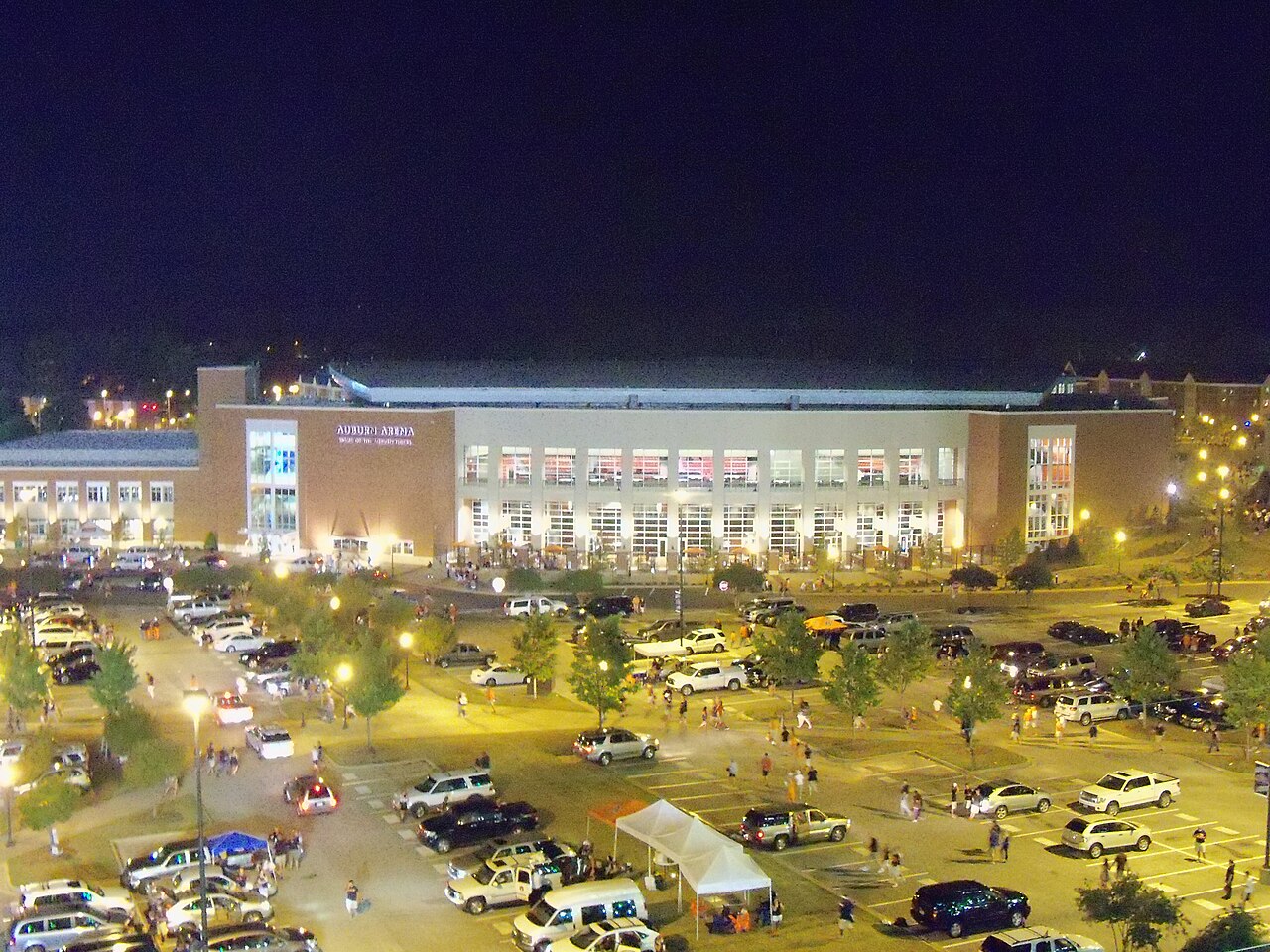
Neville Arena — 'the Jungle' — is the SEC's loudest room: 9,000-plus packed tight, the student section's 'War Eagle' thunder, and a building that Bruce Pearl turned into a fortress. Opponents don't just lose at Auburn; they get swallowed.
The Iron Bowl of basketball with Alabama has become must-see TV, with both programs peaking simultaneously and the rivalry reaching all-time intensity. The 2024-25 battles — with Final Four stakes on both sides — were among the best regular-season games in the country.
What defines Auburn is the roar: Pearl's energy, the Jungle's noise, and back-to-back Final Four eras. On the Plains, the Tigers don't play basketball quietly — and the rest of the SEC has learned to fear the trip to Neville.
The 2021-22 season added a new line to the record book: Auburn reached No. 1 in the AP poll for the first time in program history, with Jabari Smith's brilliance leading a team that spent weeks atop the sport. It was the ultimate validation of Pearl's build — from SEC afterthought to the nation's top-ranked team. The Tigers have become a recruiting power, a transfer-portal destination, and a program that expects deep March runs rather than hoping for them. On the Plains, the question is no longer whether Auburn belongs among the elite. It's how many banners the Pearl era will hang.
The Pearl era took its most dramatic turn yet when Bruce Pearl stunned the sport with his retirement ahead of the 2025-26 season — and handed the program to his son, Steven, who'd been the architect of Auburn's transfer-portal machine. Year one was a gut check: the Final Four roster was gutted, the new-look Tigers never found their footing in league play, and the season ended in the NIT. But it ended with a trophy. Auburn ripped through the 2026 NIT and beat Tulsa 92-86 in the championship game, with senior Kevin Overton earning Most Outstanding Player honors after averaging 18.6 points and shooting nearly 54 percent from three in the tournament. A program that expected the Final Four celebrated an NIT title — and Steven Pearl treated it like a foundation, not a consolation.
Now comes Year 2, and this roster is Steven Pearl's, built the way the Pearls build: aggressive in the portal, obsessed with versatility. The backcourt is the anchor and it's a good one — Tahaad Pettiford is back for his junior season after averaging 15.4 points and 3.8 assists, and his NIT run (5.2 assists per game) hinted at the next leap. Overton returns as the senior leader alongside him, giving Auburn one of the SEC's most proven guard duos. Around them, Pearl rebuilt the entire frontcourt: French seven-footer Narcisse Ngoy, Santa Clara's Bukky Oboye, and Creighton transfer Owen Freeman give Auburn three legitimate centers, while Troy's Thomas Dowd and South Alabama sniper Adam Olsen — who hit 39.5 percent of his threes on heavy volume — fill the forward spots. Vanderbilt combo guard George Kimble III adds depth, and Lithuanian wing Mantas Rubstavicius plus three-star Tampa freshman Caleb Williams round out a roster Pearl calls the most connected group he's had.
The national conversation is skeptical — Jon Rothstein slotted Auburn 11th in his SEC preseason rankings, behind a Florida team he has as the league's best — but the Pearls have thrived on being underestimated. What left with Bruce's retirement wasn't the culture: Neville Arena remains one of the loudest, most suffocating home courts in America, the recruiting machine is still humming, and the standard — set by the 2019 and 2025 Final Four teams — hasn't moved. Steven Pearl spent years as the lead transfer evaluator on his father's staff; this roster, with its interchangeable 6-foot-8 forwards and shooting at every spot, is exactly the kind of positionless puzzle Auburn has used to break the SEC before.
The storylines write themselves: can a father-to-son handoff actually work at this level? Can Pettiford become the All-SEC star Auburn needs him to be? And can a completely rebuilt frontcourt gel fast enough to survive the nation's toughest league? Auburn went from SEC afterthought to Final Four fixture in a decade; the 2026-27 season will tell us whether the second act of the Pearl era is a sequel or a new show entirely. On the Plains, they're betting on Steven.