
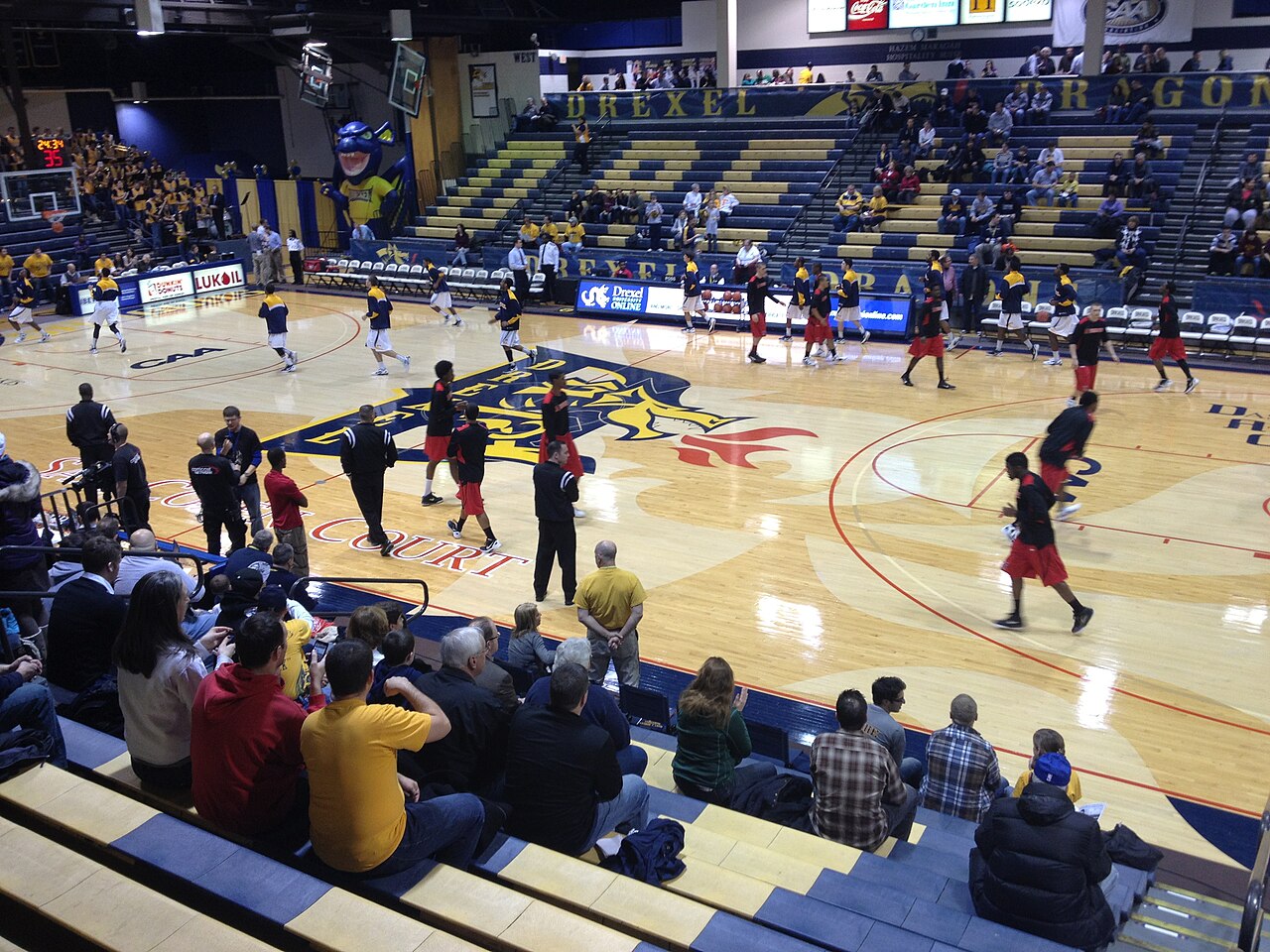
The Drexel Dragons play in the shadow of Philadelphia’s basketball royalty and refuse to act like it. This is a program from University City that crashed the Big 5 party, owns one of the NCAA tournament’s great upset wins, and keeps producing teams built on defense, toughness and the particular swagger of a school that knows it belongs in the conversation. As the 2026–27 season opens, the Dragons are in year eleven under head coach Zach Spiker — the longest-tenured coach in the Coastal Athletic Association — with a roster that looks like a United Nations of big men and a defense-first identity that never really left.
The program’s signature moment came in 1996, when Malik Rose and the Dragons stormed the NCAA tournament as a 12-seed and knocked off Memphis — one of those wins that gets replayed every March and still defines what Drexel basketball is supposed to be. That team turned a generation of Philadelphia kids into Dragon believers, and Rose went on to a long NBA career that gave the program a permanent professional standard-bearer.
Then came the Bruiser Flint years (2001–16), when Drexel became the CAA’s resident giant-killer: teams that flirted with the tournament every March, beat power-conference opponents in November, and built a reputation as the program nobody wanted to draw. The near-misses were agonizing — the 2007 team that fell one win short of a bid remains a “what if” in program lore — but the identity calcified: long, athletic, ferocious on defense, and utterly unafraid.
Spiker, hired from Army in the spring of 2016, took that identity and finally converted it back into March hardware. In 2021, the Dragons won the CAA tournament — the program’s first league title in a quarter-century — and returned to the NCAA tournament for the first time since the Rose era, drawing Illinois as a 16-seed. The result was never really in doubt, but the banner was: Drexel had its championship, and Spiker had validated a decade of steady building.
The 2026–27 edition is built the Drexel way, with a twist: size, and lots of it, from everywhere. The Dragons roster features not one but two 7-footers — Ralph Akuta, the 285-pound junior who is a load on both ends, and Martin de LaPorterie, the 7-foot-1 Frenchman whose length changes games defensively. Around them is a genuinely international rotation: Sweden’s Villiam Garcia Adsten, England’s Clem Edomwonyin, Spain’s Ignacio Campoy Galvez, Russia’s Victor Panov and Germany’s Adrian Petkovic, mixed with Philadelphia-area products like Horace Simmons Jr. and Josh Reed. Senior guards Max Davis and Eli Beard, plus veterans Garfield Turner and Shane Blakeney, give Spiker the backcourt steadiness his system demands.
The system is the star. Spiker’s teams defend in the half court, grind possessions, and win with physicality and execution rather than flash — the old Flint formula, modernized. In a CAA that has sent Charleston, Delaware, Towson and others to recent Marches, defense travels, and Drexel’s pack-line principles have kept the Dragons in the league’s upper tier even through roster turnover.
The setting is one of college basketball’s great small-room experiences. The Daskalakis Athletic Center — the DAC, to everyone who matters — is a 1975 bandbox in University City where 2,500 fans sound like 10,000 and the student section, the DAC Pack, makes life miserable for visitors. Drexel’s place in the Philadelphia basketball ecosystem is its own storyline: the Dragons crash the Big 5’s party every year, measuring themselves against Temple, La Salle, Villanova, Saint Joseph’s and Penn in the city’s gloriously petty neighborhood wars.
What defines Drexel right now is the pursuit of a second Spiker-era breakthrough. The 2021 title ended a 25-year drought; the program’s ambition is for league championships to become a habit rather than a generational event. The CAA remains a gauntlet where one bad weekend erases four good months, and the Dragons have lived that heartbreak more than once. But with twin towers in the middle, a veteran backcourt, and a coach who has seen every version of this league, Drexel has the ingredients to be the team nobody wants in March. Again.
The modern Drexel story also runs through its big men. Amari Williams, the 6-foot-10 Englishman who won three straight CAA Defensive Player of the Year awards, anchored Spiker’s best recent teams before finishing his career at Kentucky — the latest Dragon to prove the program develops pros. Before Williams, the Flint era’s near-misses — none more painful than the 2007 squad that fell one CAA final short of the tournament — taught a generation of fans that Drexel’s margin is always thin and its fight is always real. The Dragons do not get the benefit of the doubt in March; they have to take it.
The Philadelphia angle gives every season an extra edge. The Dragons measure themselves against the Big 5 — Temple, La Salle, Villanova, Saint Joseph’s, Penn — in the city’s gloriously petty neighborhood wars, and nothing energizes the DAC Pack like beating a bigger Philly name in November. The revamped Big 5 Classic has given those games a formal stage, and Drexel has relished the role of spoiler: a program with a mid-major budget and a major-conference attitude, playing in a bandbox where the crowd noise bounces off the low ceiling and onto the court.