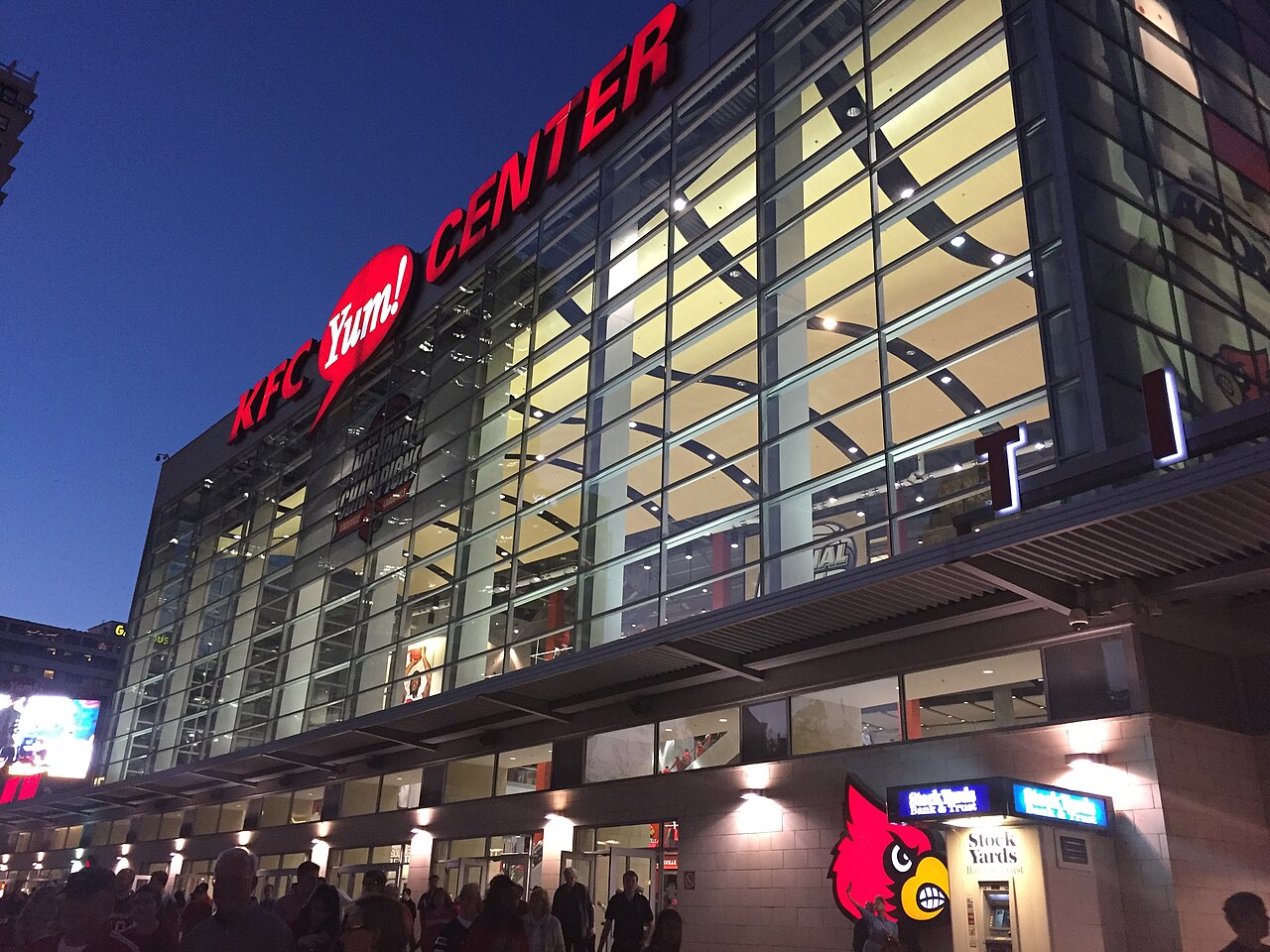
Few programs in college basketball carry as much weight — or have endured as much turbulence — as Louisville. This is the school of Denny Crum, who built a powerhouse and cut down the nets in 1980 and 1986. It’s the school of the 2013 national championship, later vacated in the FBI-fueled scandal that poisoned the end of the Rick Pitino era. It’s one of the great home-court cathedrals in the sport: the KFC Yum! Center, 20,000-plus strong in downtown Louisville, where the Cardinals have played in front of some of the most passionate fans in the country. And just two years ago, the program hit rock bottom: the Kenny Payne era ended with a 12-52 two-year record, a stretch so bleak it felt like an ending.
Instead, it was a beginning. In March 2024, Louisville hired Pat Kelsey away from the College of Charleston, betting on a coach whose teams played with relentless energy, shot the lights out, and embodied an up-tempo identity that had made Charleston must-watch basketball. The bet paid off immediately. Kelsey’s first Cardinals team (2024-25) went 27-8, finished near the top of the ACC, and returned Louisville to the NCAA Tournament for the first time since 2019 — one of the most dramatic single-season turnarounds in recent memory, and it earned Kelsey national Coach of the Year honors.
Year two raised the stakes. The 2025-26 Cardinals entered the season ranked No. 11 in the AP poll — as high as No. 6 at their peak — and were talked about in preseason as a legitimate Final Four contender. The centerpiece was freshman point guard Mikel Brown Jr., a consensus five-star and the No. 8 recruit in the 2025 class, the second-highest-rated prospect to commit to Louisville in the modern recruiting era. Brown was everything advertised and then some: 18.2 points and 4.7 assists per game, Third-Team All-ACC, ACC All-Rookie — and one of the great individual performances in program history, a 45-point eruption against NC State on February 9, 2026, that set the program and ACC record for points by a freshman and tied Wes Unseld’s 1967 single-game school record.
Brown wasn’t alone. Transfer guard Ryan Conwell led the team at 18.8 points and 4.8 rebounds per game and earned Second-Team All-ACC honors. Sharpshooter Isaac McKneely was lethal from deep. Sophomore Khani Rooths blossomed as a ball handler and creator. J’Vonne Hadley did a bit of everything and knocked down a team-high 44 percent of his threes. Guard Adrian Wooley, a transfer from Kennesaw State, gave Louisville clutch depth — including a game-winner against Miami to close the regular season. And Kobe Rodgers and Kasean Pryor brought grit off the bench.
But injuries wrote the season’s defining subplot. Brown suffered a lower back injury against Memphis on December 13, missed eight games, re-aggravated it at North Carolina on February 23, and then missed the final six games of the season — including all of the postseason. Louisville went 8-6 without him. The Cardinals feasted on overmatched opponents but went just 1-9 against Quad 1A competition, and their defense and frontcourt production lagged behind the standard Kelsey demands. Still, March delivered a breakthrough: Louisville beat USF in the NCAA Tournament’s first round — the program’s first tournament win since 2017, Kelsey’s first ever, and the first back-to-back March Madness appearances in over a decade — before falling to Michigan State in the second round. The Cardinals closed 24-11, 11-7 in the ACC. Kelsey was proud but blunt: “Losing at this round in this game is not the standard.”
The offseason brought the inevitable: five scholarship players exhausted their eligibility (Conwell, Hadley, McKneely, Aly Khalifa, and Rodgers), and Brown declared for the 2026 NBA Draft on April 7 as a projected lottery pick. So Kelsey did what Kelsey does — he went to the portal and built another monster. Louisville landed arguably the No. 1 transfer in the country: Flory Bidunga, the former Kansas center and one of the best interior defenders in America, a game-changing rim protector and elite lob threat Kelsey believes has another level offensively waiting to be unlocked. And the point-guard answer: Jackson Shelstad, Oregon’s third-team All-Big Ten floor general, who averaged 15.6 points, 4.9 assists, and 2.9 rebounds in 12 games last season before a hand injury and ligament damage cut his year short.
The portal haul didn’t stop there. Arkansas wing Karter Knox, Iowa forward Alvaro Folgueiras, Dayton guard De’Shayne Montgomery, USC center Gabe Dynes, and North Carolina guard Seth Trimble — who, like forward LJ Wells from Northern Kentucky, gained a fifth year of eligibility via the court injunctions that rocked college athletics in September 2026 — all joined the fold. Wells, the Norse’s best player last season at 15.0 points and 7.3 rebounds with 55.4 percent shooting, gives Kelsey another battle-tested veteran. Kelsey signed nine newcomers in June: six transfers plus a three-man high-school class headlined by five-star center Obinna Ekezie Jr., guard Isaac Ellis, and Chinese wing Boyuan Zhang.
The projected result is preseason top-10 in the country — No. 8 in RotoWire’s September 2026 preview — with a starting five that could be composed entirely of portal additions. The Shelstad-Bidunga pick-and-roll is being billed as the best point guard-center duo in the nation. Trimble, Knox, and Folgueiras are projected starters alongside them; Montgomery and Wooley — the only returning scholarship players besides former G-League guard London Johnson — provide backcourt depth most programs would kill for.
Expectations, of course, are the double-edged sword of Louisville basketball. This is a program that measures itself by Final Fours and banners, in an ACC where Duke, North Carolina, and now a rising group of contenders set the terms. The rivalry with Kentucky still defines the state’s basketball soul, and showdowns with blue bloods like Duke carry the weight of the Cardinals’ own pedigree. The Yum! Center will be packed and loud from night one; Louisville fans have been starved for greatness, and Kelsey has fed them hope at a dizzying pace.
What defines Louisville in 2026-27 is a program that has climbed from the abyss to the sport’s penthouse in two years and now wants the whole building. Two straight 24-plus-win seasons and back-to-back NCAA bids rebuilt the foundation. The talent on this roster is Final Four-caliber. The injuries that derailed year two are history; the portal machine that Kelsey has perfected has delivered its best class yet. The standard, as the coach keeps reminding everyone, is the Sweet 16 and beyond — a place Louisville hasn’t been since 2015. Cardinals fans don’t think that drought lasts much longer.


