
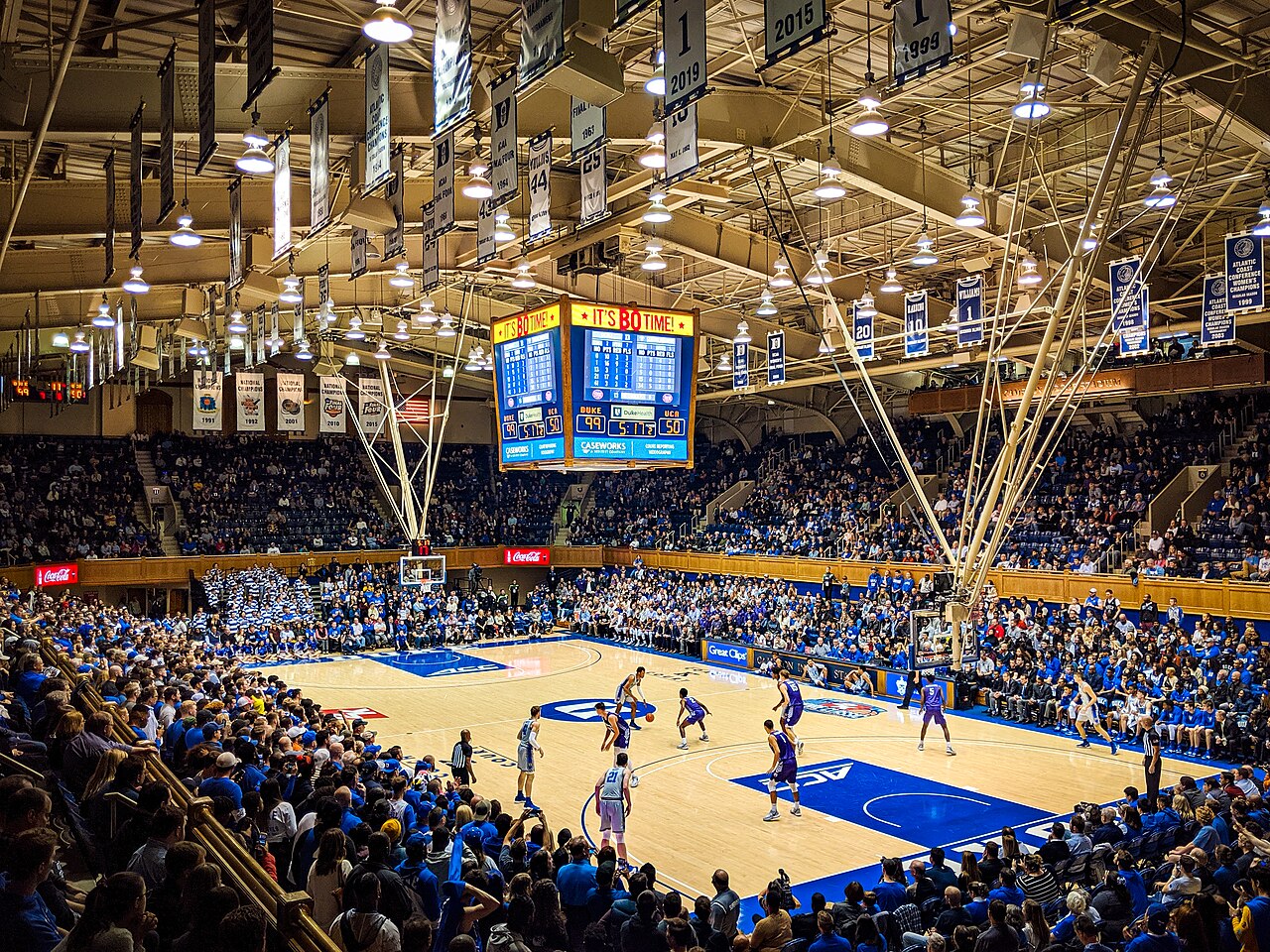
Duke is not just a college basketball program; it is the sport’s main character. Five national championships, the Cameron Crazies, the rivalry with North Carolina that defines the sport itself — and, for the past decade, an increasingly uncomfortable question: why hasn’t the most talented program in America won it all since 2015? As the 2026–27 season begins, head coach Jon Scheyer — now in his fifth season — has built what many consider his most complete roster yet, a veteran-heavy, transfer-fortified group that starts the year No. 2 in the country. The drought is 12 years old. The patience is wearing thin. The mission, as Scheyer has made clear, is Banner No. 6.
The recent history reads like a highlight reel with a cruel final act. The Cooper Flagg season of 2024–25 produced one of the most dominant teams of the modern era — Flagg was the consensus national player of the year, a generational two-way force, and the No. 1 pick in the 2025 NBA Draft — but ended in the Final Four with a collapse against Houston that still stings in Durham. Then came the Cameron Boozer era: one season, one coronation. Boozer was the CBS Sports National Player of the Year in 2025–26, averaging 22.5 points and dragging Duke to a 35-3 record, an ACC championship and the Elite Eight, where the Blue Devils fell to UConn in Washington. Three straight Elite Eights under Scheyer. Zero titles. For a program that measures itself in banners, the accounting is brutal.
Scheyer’s response to losing Boozer — the No. 3 pick in the 2026 NBA Draft — alongside fellow draftees Isaiah Evans and Maliq Brown, and transfers Darren Harris (Indiana) and Nik Khamenia (UConn), was to rebuild like a general manager rather than a recruiter. “When you lose Cam Boozer and everything he’s done for us, you can’t just replace that with another Cam Boozer,” Scheyer told On3 this fall. “I felt like we were in Moneyball for a second, trying to figure out not just how to replace that position, but how to replace that scoring punch and firepower in other ways.” The centerpiece of the Moneyball summer was John Blackwell, the Wisconsin transfer who arrives as a third-team All-Big Ten guard after averaging 19.1 points, 5.1 rebounds and 2.3 assists on 39 percent three-point shooting. He is, from day one, Scheyer’s No. 1 offensive option.
The portal haul did not stop there. Drew Scharnowski, the 6-foot-9 Belmont transfer, comes off first-team All-Missouri Valley honors plus all-defensive and most-improved recognition — a rugged frontcourt piece tailor-made for March. Jacob Theodosiou, via Wyoming and Loyola Maryland, adds 13.1 points per game of backcourt scoring. And critically, the returning core is the deepest of Scheyer’s tenure: senior captain Caleb Foster runs the show, sophomore Cayden Boozer — Cameron’s brother and a key rotation piece as a freshman (7.7 points, 11 starts) — takes a bigger role, Patrick Ngongba II anchors the paint after stunning the staff by turning down first-round draft buzz to return for his junior year, and Dame Sarr, last year’s top international prospect, is primed for a leap with 30 freshman starts under his belt. Sebastian Wilkins provides more veteran wing depth.
Then there is the freshman class, ranked No. 2 in the country by 247Sports: five-star forward Cameron Williams, a top-five national recruit who slides into the power-forward void Boozer leaves; Deron Rippey Jr. and Bryson Howard, two more top-30 talents who will push for rotation minutes immediately; and Joaquim Boumtje Boumtje, the 7-foot international prospect — just 17 years old — who gives Duke absurd frontcourt depth behind Ngongba. On paper, this is the most talented roster in America. Again.
The program’s standard, of course, was set long before any of them were born. Five national titles (1991, 1992, 2001, 2010, 2015). Mike Krzyzewski’s 1,202 wins. Christian Laettner’s shot. The 2010 and 2015 one-and-done machines. Cameron Indoor Stadium’s 9,314 seats and the Crazies who make it the loudest building in the sport. The Duke–North Carolina rivalry, the fiercest in American sports. All of it is the reason the current drought feels so heavy: this program does not do 12-year gaps between championships. The last drought this long ended with the 1991 breakthrough, and everyone in Durham knows the history.
The ACC landscape, meanwhile, is a minefield of blue bloods and rising powers, and the non-conference schedule will once again be a November gauntlet designed to forge a Final Four team. The question hanging over everything is the one RotoWire put bluntly in its preseason preview: with the talent Duke has amassed, zero titles since 2015 is inexcusable, and it is time for Scheyer to prove he can out-coach the best in the biggest games. Three Elite Eights in four years say he belongs in the room. The next step is the only one that counts.
What defines Duke right now is the convergence of everything: a senior captain, a star transfer, a lottery-pick center who chose the Brotherhood over the draft, a top-two recruiting class, and a coach entering year five with the deepest team he has ever had. The Moneyball rebuild was the admission that the one-and-done era alone was not finishing the job. This roster — older, tougher, deeper — is the answer. In Durham, the expectation is never the Final Four. It is the last Monday night in April. Banner No. 6, or the season is a failure. That is Duke.


