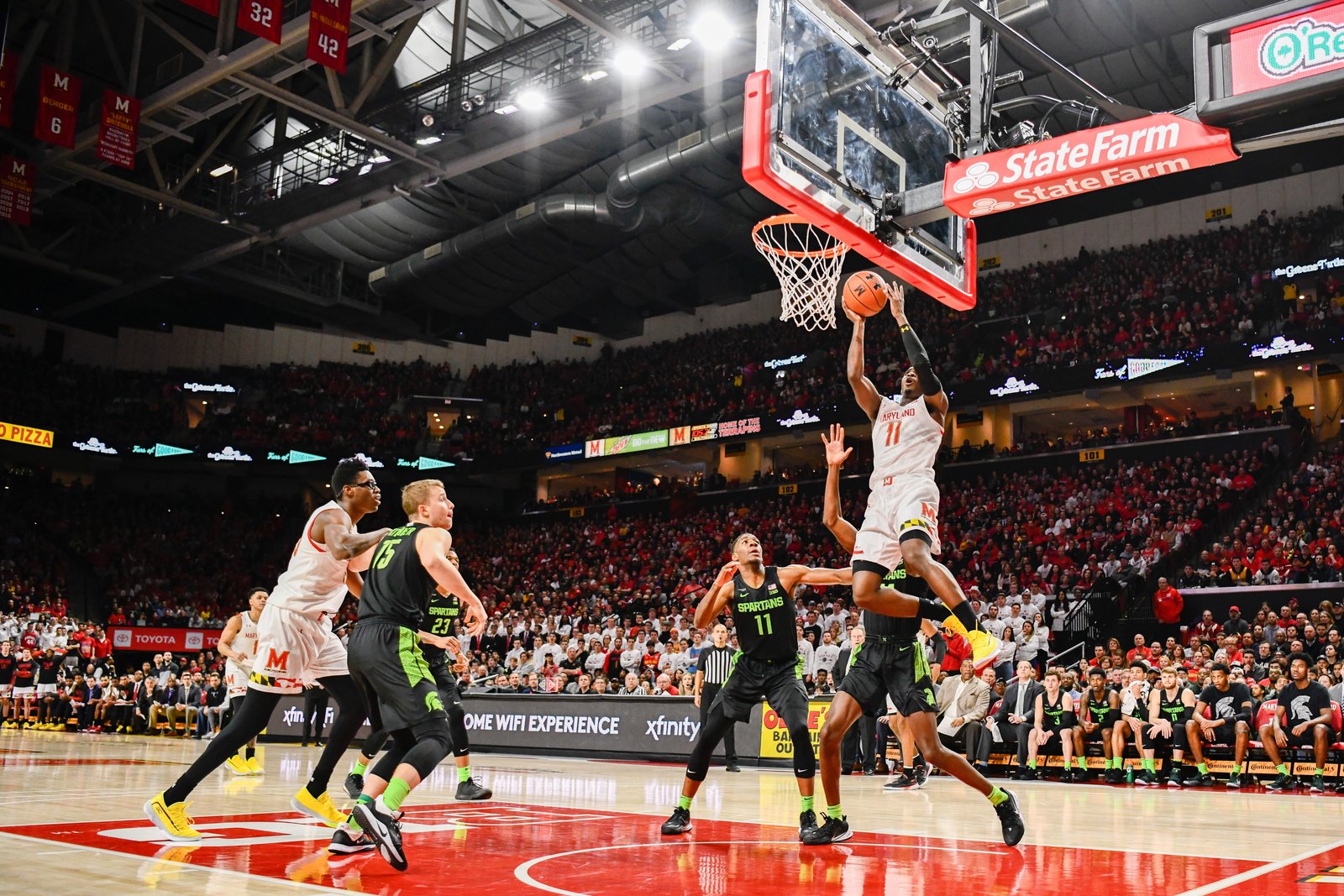
The Maryland Terrapins are college basketball royalty in the District of Columbia suburbs — the program that won the 2002 national championship, launched the Midnight Madness tradition through Lefty Driesell, and turned the Xfinity Center into one of the loudest buildings in the Big Ten. In College Park, the 2002 banner is scripture, Juan Dixon is a folk hero, and Gary Williams is the godfather of it all.
That 2002 title remains the program's crowning achievement: Williams's masterpiece, a 64-52 win over Indiana in the Atlanta final that capped back-to-back Final Four runs. Dixon — the Baltimore kid who overcame every obstacle to become the program's all-time leading scorer — poured in 18 in the final and was named Most Outstanding Player. Lonny Baxter and Steve Blake gave the Terps their spine. It was a title built on toughness and togetherness, the kind of team Maryland fans still measure everything against.
The Williams era (1989–2011) was the golden age in every sense: ACC contention year after year, a parade of pros, and a coach who became a College Park icon with his sweater-vest intensity and sideline fury. Before Williams, Lefty Driesell (1969–86) built the modern program from scratch — inventing Midnight Madness in 1971, winning 348 games, and coaching legends like Len Bias, whose tragic death in 1986 remains one of the darkest moments in American sports history.
The 2001 Final Four was the breakthrough that made 2002 possible: the Terps reached the national semifinals in Minneapolis and lost to Duke in a classic — a year later, in Atlanta, they finished the job. The back-to-back Final Fours announced Maryland as a national power, and the 2002 crown was the culmination.
The Xfinity Center — opened in 2002 as the Comcast Center — is the program's palace: 17,950 seats of Terrapin intensity where the student section's noise has swallowed ranked visitors for two decades. It replaced Cole Field House, the beloved old barn where Lefty's teams played, and the 2002 banner hanging in the Xfinity rafters watches over everything.
The program's pipeline of talent has never really dried up. Steve Francis, Juan Dixon, Alex Len, Diamond Stone, Melo Trimble, Kevin Huerter, Jalen Smith, Aaron Wiggins — Terps keep showing up in the NBA. The D.C.-Maryland-Virginia recruiting corridor is among the richest talent bases in America, and Maryland's identity has always been tied to keeping that homegrown talent home.
The Big Ten era has been a war. Since leaving the ACC, Maryland has battled Michigan State, Purdue, Michigan, Indiana and Ohio State on the biggest stages — and the Terps' 2024-25 "Crab Five" became one of the season's great stories, with freshman star Derik Queen delivering a Sweet 16 run before Kevin Willard's stunning departure for the Villanova job in the spring of 2025.
Enter Buzz Williams. The former Texas A&M coach arrived in College Park on April 1, 2025 — after the transfer portal had already opened — and was forced to build an entire roster from scratch. He brought his three best Aggies with him: bruising forward Pharrel Payne, versatile Solomon Washington, and guard Andre Mills. But portal misses elsewhere and injuries destroyed the season before it started. Payne — the team's best player — went down with a leg injury in mid-December and played only 10 games. Isaiah Watts struggled. The Terps finished 12-21, 4-16 in the Big Ten, tying the program record for losses in a season — a mark that had stood since 1941.
It was a humbling year in College Park, and Williams knew it. "I'm completely aware of how good Maryland is, and how disappointing our season has been," he said in February. Even superfan and ESPN broadcaster Scott Van Pelt — a Maryland alum — said on air that what he watched wasn't the Maryland standard. The Terps did manage a Big Ten Tournament win over Oregon before falling to Iowa, but the season was a failure by every measure.
Now comes the rebuild. The big news of the summer: the NCAA granted Pharrel Payne a medical redshirt, so the 6-foot-9 force — a bully-ball throwback who was dominating the paint before the injury — returns to College Park for 2026-27. CBS insider Jon Rothstein named Maryland one of the most improved teams in the country heading into year two under Williams. The roster on this page tells the story of the reset: Payne and Mills back as the foundation, Elijah Saunders and Aleks Alston providing frontcourt size, freshman Darius Adams and George Turkson Jr. adding length on the wing, and guards Myles Rice, David Coit, Isaiah Watts and Rakease Passmore competing in a rebuilt backcourt.
The standard in College Park doesn't move. This is a program with a national title, back-to-back Final Fours, a Hall-of-Fame lineage from Driesell to Williams, and a fanbase that fills the Xfinity Center believing the next banner is always one recruiting class away. Year two of Buzz Williams is about proving 2025-26 was the floor — and that the Terrapins are climbing back toward the standard that made Maryland one of the sport's proudest programs.


