In the winter of 2004, the Saint Joseph's Hawks did something that almost never happens in college basketball: they ran the table. Twenty-seven wins, zero losses, a No. 1 seed in the NCAA Tournament, and the consensus national player of the year in Jameer Nelson. The Hawks fell one game short of the Final Four, losing to Oklahoma State in the Elite Eight — but that 27-0 regular season made them immortal. On Hawk Hill, they still talk about that team the way other schools talk about championships.
Hawk history runs much deeper than 2004. In 1961, Saint Joseph's reached the Final Four — the program's only trip to the national semifinals — a banner from the golden age of Philadelphia basketball, when the Big 5 ruled the city's winters. The Hawks have been Big 5 royalty for generations: Villanova, Temple, La Salle, Penn, Drexel, and Saint Joseph's, six schools bound by geography and grudges, and the Hawks have always been right in the middle of it.
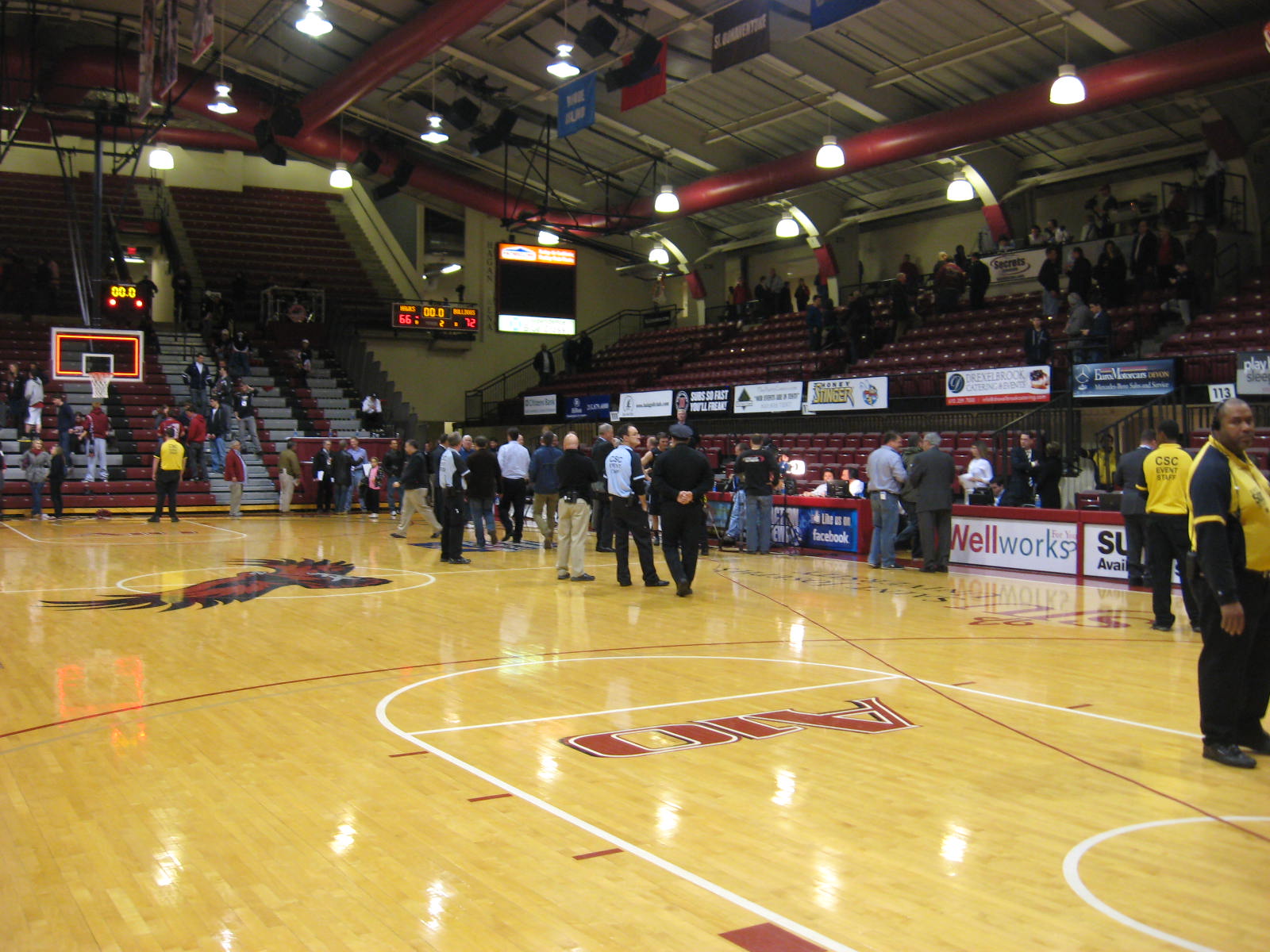
The home of it all is the Michael J. Hagan Arena, one of the great small gyms in America — intimate, steep, and deafening when it's full. Big 5 nights at Hagan are Philadelphia basketball at its purest. And then there's the Hawk itself: the mascot that never stops flapping its wings, from the opening tip to the final horn, through timeouts and halftime and everything in between. “The Hawk Will Never Die” isn't a slogan; it's a job description. It is, without question, one of the great traditions in all of sports.
Phil Martelli's 24-year run (1995-2019) gave the program its modern identity: smart, skilled, fearless — Philly toughness with a coach's feel for the game. The 2016 team added another March memory, winning the Atlantic 10 tournament and beating Cincinnati in the NCAA first round. Nelson's No. 14 hangs in the Hagan Arena rafters as the eternal standard: national player of the year, undefeated regular season, the most beloved Hawk ever.
The Billy Lange era (2019-2025) rebuilt the program's talent pipeline, and its signature achievement was player development — most visibly Rasheer Fleming, molded into a First Team All-Atlantic 10 performer and a 2025 NBA Draft pick. When the school moved on from Lange in the spring of 2025, it turned to one of the most respected program-builders in the sport: Steve Donahue.
Donahue — the former Cornell, Penn, and Boston College head coach who took the Big Red to the 2010 Sweet 16 — brought his deliberate, precision offense to Hawk Hill, along with a staff built for the modern game. Former Hawk star Dwayne Jones, the 2004-05 Atlantic 10 Defensive Player of the Year and a 12-year pro, coaches the frontcourt. Defensive coordinator Chris Flegler installed a scheme that finished last season as the No. 2-rated defense in the Atlantic 10 and No. 55 nationally. The message was clear: the Hawks would guard.
Year one worked. The 2025-26 Hawks went 24-12 overall and 13-5 in the Atlantic 10, surprising a league that had picked them lower, and the defense carried them through the winter. It was the kind of season that changes a program's trajectory — proof of concept for Donahue's system, and a foundation to build on.
The roster turns over the way rosters do now. Gone are leading guard Derek Simpson (13.8 points per game) and rim protector Justice Ajogbor, plus a wave of transfers: Deuce Jones, Dasear Haskins, Anthony Finkley, Jaden Smith, Steven Solano, Al Amadou, Kevin Kearney. What's left is a core the staff believes in, and a transfer class built to win now.
The centerpiece is junior guard Jaiden Glover-Toscano, who broke out at 15.7 points per game last season and returns as the unquestioned leader. Sophomore guard Austin Williford (7.8 ppg) showed real flashes as a freshman, and junior Khaafiq Myers (5.1 ppg) gives the backcourt another Philly-bred ballhandler. The development of that trio — all homegrown pieces — will decide how high this team can climb.
The portal brought experience where it's needed most. Logan Carey arrives from Maine as a senior guard; Sean Logan, a graduate transfer from Davidson, and Gavin Marrs, a senior from Oregon State, bring size and maturity to the frontcourt, tasked with replacing Ajogbor's presence at the rim. D-II additions Donovan Flamer (Elizabeth City State) and Luis Nonfon (Augusta) add depth and scoring punch, while freshmen Keoni Sacco and Davis Kemper round out a roster the staff rebuilt in a single offseason.
What should define this team is defense. Flegler's unit was already elite by Atlantic 10 standards a year ago, and the scheme now has a full year of buy-in. In a league where VCU, Dayton, Saint Louis, and George Mason all expect to contend, the Hawks' path to the top runs through stops — forcing tough shots, protecting the paint, and turning defense into the transition chances that Donahue's offense feasts on.
The Big 5 remains the soul of the schedule. Those city games — Villanova, Temple, La Salle, Penn, Drexel — carry a weight no November tournament can match, and Hagan Arena on a Big 5 night is one of the great atmospheres in the sport. Win those, and the season has meaning no matter what March brings.
The stakes for year two are real. The Atlantic 10 spent last season proving the league's old powers are vulnerable, and the Hawks — with a proven coach, an elite defense, and a star guard — are positioned to be the team that crashes the party. The question is whether the rebuilt frontcourt and the new pieces can gel fast enough to matter in March.
For now, though, the story is simpler. On Hawk Hill, the standard is the 2004 team and the 1961 team — the undefeated regular season and the Final Four. Every Hawk team since has chased them. This one, with its defense and its coach and its Philly guards, has as good a chance as any recent group to add a new chapter. The Hawk will never die — and neither will the belief.