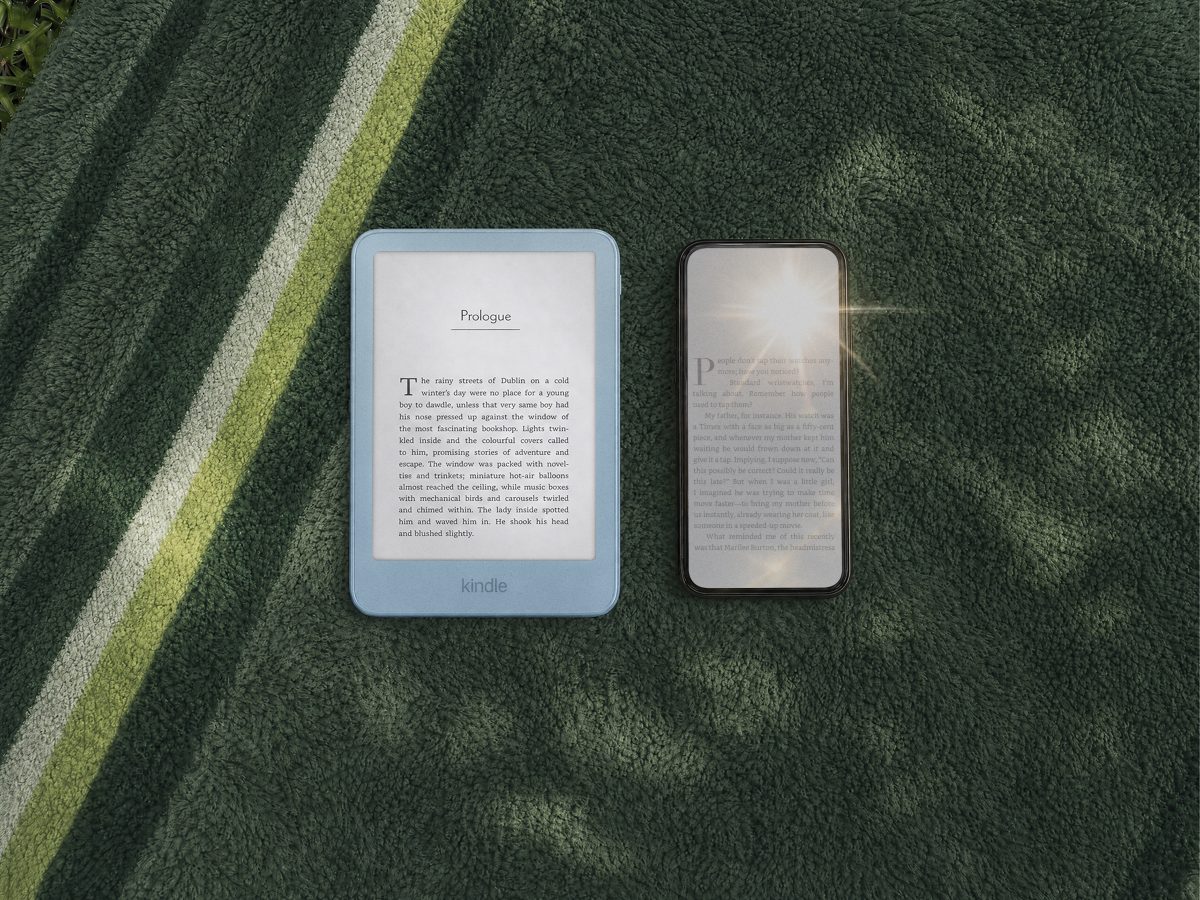
SEATTLE — The Kindle just got the biggest redesign of its life. On October 1, Amazon unveiled a completely rebuilt Kindle family — the base Kindle, the Kindle Paperwhite, and the Kindle Colorsoft — constructed around a new “reverse stack” display that erases the raised bezel every Kindle has carried since the first model launched in 2007. For the first time on any e-reader, the reading surface runs flush and edge to edge, with no lip interrupting the page. The base model is on sale now starting at $149.99; the Paperwhite and Colorsoft are up for preorder and ship October 28.
The timing is not accidental. The launch lands squarely on top of Prime Big Deal Days, October 6–7, and it arrives while the Kindle business is, by Amazon’s own account, on a tear: the company says Kindle has posted double-digit global growth for three straight years, with more than 720 billion pages read in 2025. In other words, the biggest hardware change in the product’s history is landing in front of the biggest audience the product has ever had.
The engineering, in plain English
To understand why this matters, you need to know how an e-reader screen is built. A Kindle display is a sandwich: an e-ink film, a capacitive touch layer, a light guide that throws light sideways across the page, and a transistor backplane that drives every pixel. For nearly twenty years, that sandwich has been assembled top-down inside a frame that wraps over its edges — and that overlap is where the raised bezel comes from. It is the lip of the tray the screen sits in.
“Reverse stack” flips the build order. Instead of dropping the display into a frame and letting the frame’s edge stand proud of the glass, Amazon constructs the stack so the display plane finishes level with the device’s edge — glass, frame, and body all on one continuous surface. Amazon calls it a first for the e-reader category. The payoff is more than cosmetic: a seamless edge-to-edge reading surface, thinner devices across the board, and body color that now wraps continuously from front to back instead of stopping dead at the bezel line.
That color wrap is the lineup’s other visual signature. The new Kindles come in Ube, a rich purple; Alpine Sky; Seaglass Green; Graphite; and Fig — which makes its debut on e-readers with this generation. It is the first time a Kindle has looked like a designed object from every angle rather than a screen bolted into a plastic frame.
The grip problem — and the dead zone that solves it
There is a reason every touchscreen e-reader has kept its bezel for two decades, and it is not nostalgia. The bezel is where your thumb lives. Readers grip the device by the frame, and the frame is a natural safe zone: touch it and nothing happens. Take the bezel away and that safe zone vanishes — every square millimeter of the front is now live display, and every casual grip becomes a potential accidental page turn.
Amazon’s answer is software, not hardware. The new Kindles run a real-time capacitive dead-zone system that continuously maps the contact profile of everything touching the screen. A resting thumb makes broad, stationary contact; an intentional tap is brief and pointed. The system reads that difference in real time and suppresses inputs from wherever it decides you are gripping, while keeping the rest of the surface responsive to deliberate taps.
At the launch briefing, Amazon’s vice president of devices, Kevin Keith, put it this way: “When you’re gripping the Kindle, wherever you put your thumb, it will self-detect a dead zone in the Cap touch,” he said. “It will just readjust, and it’ll know that the finger is there.” In plain terms: the screen watches where you are holding it and politely ignores that spot. It is the kind of invisible engineering that either works so well you never think about it — or fails loudly in the reviews. Readers will find out which within weeks.
The lineup, model by model
The 6-inch base Kindle is the one you can buy today. Amazon calls it the most pocket-sized Kindle it has ever made: 16GB of storage, up to six weeks of battery life, and books that open 30 percent faster than the prior model. It starts at $149.99 in Ube and Graphite. For the first time, the entry-level Kindle also comes in an aluminum version — 32GB of storage, a matte back made with 80 percent recycled aluminum, and a battery built with 100 percent recycled cobalt — at $189.99 in Alpine Sky Aluminum and Seaglass Green Aluminum.

The Kindle Paperwhite gets the biggest display in its history and, per Amazon, the highest contrast ratio of any Kindle — built on an oxide thin-film transistor backplane. The backplane is the layer of microscopic switches behind the e-ink that tells each pixel what to do; oxide transistors switch faster and leak less current than the silicon they replace, which is how you get deeper blacks, crisper text, and better efficiency in the same breath. The new Paperwhite is thinner, stays waterproof, and runs up to 12 weeks on a charge. It starts at $199.99 for 16GB in Graphite. The $249.99 Signature Edition adds 32GB, an aluminum rear, an auto-adjusting front light, pogo-pin charging for a dock, and a double-tap gesture to turn pages.
The Kindle Colorsoft — Amazon’s color e-reader — gets the same flush-front redesign, with what the company describes as a paper-like color display. It starts at $289.99 for 16GB, with a $319.99 Signature Edition at 32GB. Across the whole family, prices run from $149.99 to $319.99, and the Paperwhite and Colorsoft are available to preorder now, shipping October 28.
The small moves that matter
Two details tell you how seriously Amazon took the ergonomics. First, the power button has moved from the bottom edge — where it lived for years, right where your pinky goes — to the upper-right side, where a thumb can reach it one-handed. Second, the accessories: a Bluetooth page-turn remote for hands-free reading, a magnetic case with built-in page-turn buttons, and a new Kindle Kids edition with artist-designed covers, aimed at the youngest readers in the house.
Why Amazon is going big right now
Strip away the industrial design and the story is a business one. Amazon says the Kindle business has grown at a double-digit rate globally for three consecutive years, and that readers turned more than 720 billion pages in 2025. That is the kind of installed base that makes a ground-up hardware bet rational: when your audience is that large and still growing, a redesign is not a gamble, it is a retention play.
And the calendar does the rest. Announcing on October 1 put the new Kindles in front of shoppers days before Prime Big Deal Days on October 6–7 — the year’s second-biggest Amazon shopping event. A $149.99 base model, on sale now, sitting near the top of the deals page during a site-wide sale, is not a coincidence. It is the plan.
The real test, as always, is not the announcement but the reading. Flush fronts, dead zones, and recycled aluminum all sound good in a briefing; they have to survive beach bags, bathtubs, and toddlers. The base Kindle is shipping now, so the verdict will not take long. More tech from the news desk: Amazon’s redesign arrives as Apple rethinks its own hardware design leadership — our report on John Ternus’s expanding design role — and it lands in a year when component costs are biting across gadgets, as in our coverage of the RAM shortage squeezing gaming hardware prices. The e-reader, the quietest gadget in the house, just got loud.
Sources
- Amazon newsroom
aboutamazon.com — Oct 1 2026 - The new Kindle ditches the raised bezel in a push toward a smaller, lighter e-reader
TechCrunch — Oct 1 2026 - Amazon Kindle 2026 Goes Bezel-Free: Real-Time Grip Detection Stops Accidental Page Turns
Tech Times — Oct 2 2026 - Amazon Launches New Kindle, Kindle Paperwhite, and Kindle Colorsoft Models
Thurrott — Oct 1 2026 - Amazon’s New Kindle Lineup Compared: Kindle vs Paperwhite vs Colorsoft
TechRepublic — Oct 2026 - New Kindle Lineup: Prices, Colors and Ship Dates
TechMyMoney — Oct 2 2026 - Amazon’s New Kindle Ditches the Bezel in Major Design Refresh
Analytics Insight — Oct 1 2026