

Anime is not a niche anymore, and now there is a receipt with a lot of zeros on it.
The Association of Japanese Animations (AJA) presented the preliminary figures from its annual Anime Industry Report at TIFFCOM in Tokyo on Friday, and the headline number is a record: worldwide spending on anime reached ¥4.45 trillion — about $28.2 billion — in 2025, up 15.8% from the year before. According to Deadline, that growth rate is itself a record, edging past the 15.7% posted in 2024, and it is the first time the market has ever crossed ¥4 trillion.
The shape of the business is the real story. Overseas revenue climbed 17.2% to ¥2.54 trillion ($16.1 billion) and now makes up 57.1% of the total — the rest of the world outspending Japan on Japan's own art form for the third year running, with the gap widening every year. Anime News Network's read of the same figures underlines how complete the flip is: a decade ago this was a domestic industry with an export side hustle; now the export side is the majority.

What nobody predicted was the home market. For years the pattern held: overseas demand surged while spending inside Japan barely moved — domestic growth was just 4.6% in 2024 while overseas jumped 26%. In 2025 both engines fired at once. Japanese spending grew 14.1% to ¥1.91 trillion ($12.1 billion), a break from the plateau the industry had accepted as permanent.
The year had a blockbuster to thank. Demon Slayer: Kimetsu no Yaiba – The Movie: Infinity Castle grossed around $800 million worldwide, making it the highest-grossing Japanese film of all time, and Chainsaw Man – The Movie: Reze Arc added more than $190 million on top. Masahiro Hasegawa, the report's editor-in-chief, pointed to Japanese titles placing high at box offices and on global streaming charts. “Just last week, I saw a report that a Japanese anime was No. 2 globally,” he said, in Variety's account of the presentation. “I believe the breakthrough has truly been achieved.”
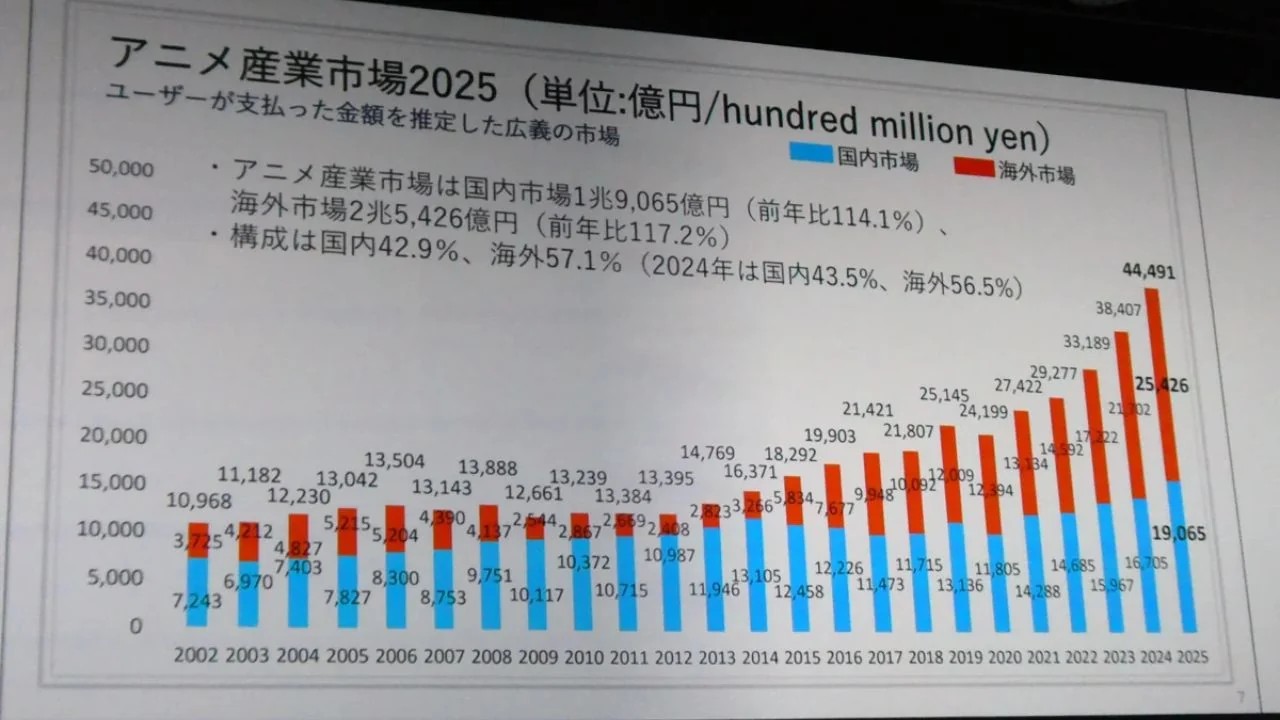
The AJA measures the business two ways, and the second one matters for where the money actually lands. The broad ¥4.45 trillion counts everything consumers spend — television, film, streaming, merchandise, music, live events. The narrower measure, revenue earned by the animation studios themselves, also set a record: ¥505.5 billion ($3.2 billion), up 8.4%, with overseas work rising to 27.9% of studio revenue. More studios are holding equity in their own productions instead of letting the traditional production-committee model capture the upside — one reason the studios' slice is growing even though it remains a small fraction of the consumer total.
These are preliminary figures; the final numbers will appear in the 2026 edition of the Anime Industry Report when it is published in December. But the direction is not in doubt, and Tokyo is planning around it: a government content program is targeting ¥20 trillion in overseas Japanese content sales by 2033, with anime alone expected to deliver ¥6 trillion of it. On 2025's evidence, that no longer reads like a fantasy number.