
LAS VEGAS
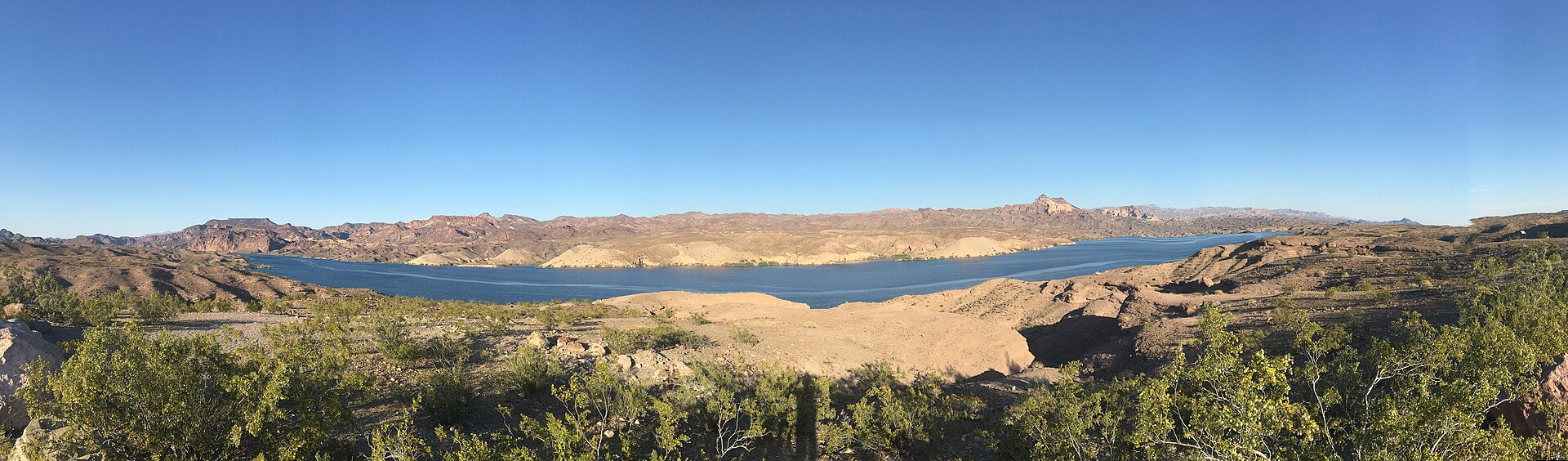
Nevada's fight over the Colorado River now has a second state standing beside it in court. Arizona announced on Friday that it is joining Nevada's lawsuit challenging the federal government's plan for operating the river after 2026 — a plan both states say loads the burden of a shrinking river onto the three Lower Basin states while requiring no mandatory cuts at all from the four states upstream. For Las Vegas, this is not an abstract water-law dispute. The river is the valley's primary water supply, the lawsuit says the federal rules threaten the water security of more than 2.3 million Southern Nevada residents, and under the framework's outer limits Nevada's share could be cut by roughly seven-tenths — to less than the region actually used last year.
Arizona's move came through Governor Katie Hobbs and the Arizona Department of Water Resources, which said Friday they had filed to intervene in the case Nevada brought in August. Arizona water director Tom Buschatzke announced the state's intention on October 16. Nevada filed suit in federal district court in Nevada on August 24, three days after Interior Secretary Doug Burgum signed the new operating plan. The current river guidelines expire on December 31, and the federal plan would govern operations after that date — which is why a lawsuit filed in the fall is, in practical terms, a fight over the rules that take effect in a matter of weeks.
What the federal plan requires — and what it does not
The plan at the center of the case, finalized by the Interior Department and the Bureau of Reclamation, would cut deliveries to the Lower Basin states — Arizona, California and Nevada — by 1.25 million acre-feet in each of the next two years, more than twice the largest reductions required under the expiring guidelines. Arizona's share of that reduction is the largest at 760,000 acre-feet a year; California's is 440,000 and Nevada's is 50,000 under the near-term split the department adopted. The Upper Basin states — Colorado, New Mexico, Utah and Wyoming — would not be subject to mandatory reductions under the plan. That asymmetry is the heart of both states' legal and political case.
Buschatzke laid out Arizona's objections in two parts. First, he said, the plan fails to deliver the water Arizona and its fellow Lower Basin states are owed under the Law of the River — the body of law built on the 1922 Colorado River Compact and the allocations it set among the seven basin states. Second, provisions he described as sideboards in the plan's later years could require reductions of up to 3 million acre-feet a year, imposed in priority order on the Lower Basin. Reductions on that scale, he said, could effectively dry up the Central Arizona Project canal system and many on-river communities, and would more than double the cuts the Lower Basin states agreed to among themselves.
The numbers underneath the Nevada case
Nevada's exposure looks small in the near-term table — 50,000 acre-feet a year — and severe in the long-term one. Nevada's total Colorado River allocation is 300,000 acre-feet. Under the federal framework, reporting by The Nevada Independent found, that allocation could be cut by as much as 213,556 acre-feet, about 71 percent, if Lower Basin shortages reach the framework's outer limit, leaving Southern Nevada with less than 86,500 acre-feet a year. The region used about 198,000 acre-feet in 2025, according to the Southern Nevada Water Authority. In other words, at the framework's extreme, Nevada would be entitled to well under half the water it actually consumed last year — in a valley that, as KTNV's reporting on the lawsuit noted, has already cut its river consumption by more than 40 percent since 2002 even as its population grew by about 875,000 people.
An acre-foot is about 326,000 gallons — roughly enough to cover a football field a foot deep, or to supply two to three households for a year. Multiplied across a metropolitan area of more than 2.3 million people, the difference between the near-term number and the outer-limit number is the difference between a conservation program and a restructuring of how Las Vegas grows, builds and waters itself. That is why Nevada's lawsuit frames the rules as a threat to water security rather than a budgeting dispute, and why Governor Joe Lombardo welcomed Arizona's decision on Friday as an important step in challenging a plan that, in his words, unfairly burdens the Lower Basin and fails to require the Upper Basin to make meaningful reductions. Nevada, he said, remains committed to a negotiated solution but will not accept a framework that puts its water supply and communities at risk.
'Drawing a line in the sand'
Arizona's governor used the desert's own language. Hobbs said the federal government has refused to hold the Upper Basin states accountable for the water deliveries they owe Arizona under the compact, while threatening draconian cuts downstream. Arizona has always been willing to do its part to protect the river, she said, but will not accept a forced federal plan that solves the crisis on the backs of Arizona families, farmers and businesses. We are drawing a line in the sand, she said. Arizona's stakes run through the Central Arizona Project, the canal system carrying river water to Phoenix and Tucson, which holds relatively junior water rights: without the separate agreement among the Lower Basin states, Arizona officials say, the project's river allocation could be cut by 77 percent over the next two years. State water officials are telling cities and delivery agencies to keep planning for reductions of 660,000 acre-feet in 2027 and 2028 even as the legal challenge proceeds.
John Entsminger, general manager of the Southern Nevada Water Authority and Nevada's designated negotiator, said Arizona's decision shows it recognizes the same flaws Nevada sees in the process the federal government used to develop the post-2026 framework, including its environmental review. Decisions affecting the river, he said, should rest on a transparent, scientific and legally sound process. Both states were careful to separate the lawsuit from the negotiation: the three Lower Basin states proposed an agreement in May committing to conserve more than 3.2 million acre-feet through 2028, and finalizing that Lower Basin agreement — 760,000 acre-feet a year from Arizona, 440,000 from California and 50,000 from Nevada in the adopted near-term split — remains a stated priority in Phoenix and Las Vegas alike, court case or no court case.
What happens next
The case now proceeds in federal court in Nevada, with Arizona seeking to participate as a plaintiff even though, as its filing acknowledges, the two states' interests and preferred remedies do not overlap completely. The Bureau of Reclamation and the Interior Department had not responded to requests for comment in the Arizona Republic's reporting as of Friday. Upstream, the lawsuit has already drawn criticism: Utah's House speaker faulted Nevada's suit shortly after it was filed, saying it made a difficult situation harder — a preview of the Upper Basin's likely position that the river's problem is hydrology, not paperwork.
For Southern Nevadans, the calendar matters more than the courtroom choreography. The current guidelines expire at year's end. Either the negotiated Lower Basin agreement carries the next two years while judges decide whether the federal framework behind it is lawful, or the region enters 2027 under rules its own water authority is suing to stop. Las Vegas has spent two decades proving it can use dramatically less river water while growing dramatically larger. The question this lawsuit asks is whether Washington can require it to prove that again, on a schedule the downstream states did not choose. More Nevada coverage from the night, including the valley's growth pressures, is in our report on Harry Reid Airport's plan to grow from 39 gates to 65.
Sources · 4 sources
- Arizona Republic — Arizona joins Nevada's lawsuit challenging federal Colorado River cuts
- Las Vegas Focal — Arizona backs Nevada challenge to federal Colorado River rules
- Nevada Current — Arizona joins Nevada lawsuit over Colorado River cuts
- The Nevada Independent — 'Drawing a line in the sand': Arizona joins Nevada's lawsuit over Colorado River cuts