
Tuesday, October 6, 2026 — For nearly 30 years, the deal with audiobooks has been beautifully simple: someone reads, you listen. Audible would now like to renegotiate. Last Thursday, the Amazon-owned company launched three new features — Character Guide, Interactive Stories, and Visual Explorer — designed to turn listening from a passive experience into an interactive one. The headline act: you can now hold a real-time spoken conversation with an AI version of Renfield, the bug-eating servant from Dracula. The future of reading has arrived, and it wants to know what you think about the Master.
The timing is not subtle. Spotify has been muscling into audiobooks, the U.S. market hit $2.43 billion in sales last year, and every incumbent is hunting for a reason to exist beyond catalog size. Audible's answer is interactivity — make the app do things a book, and a rival app, cannot. The features are in beta, limited to the U.S. and UK for now, and starting on a deliberately small set of titles. Whether that's caution or a company still figuring out what it built is an open question. Let's take them one at a time.
Character Guide: never lose track of who's talking again
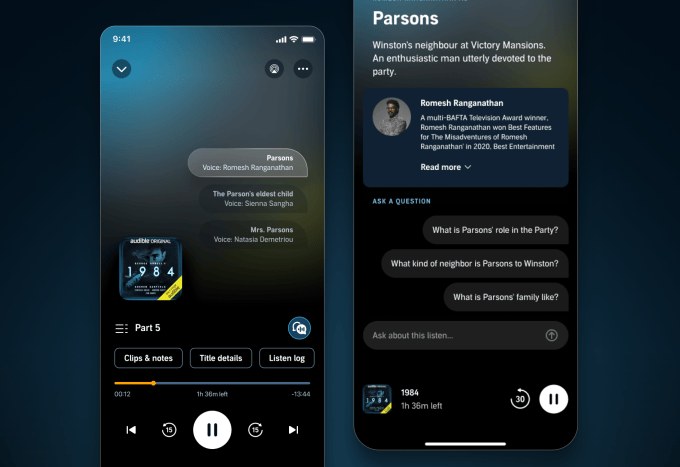
This is the least flashy of the three and probably the most useful. Anyone who listens to audiobooks knows the specific frustration: a full-cast production, a dozen characters, and suddenly you have no idea who's speaking. The Character Guide fixes it by displaying who's talking in real time directly on the player page, alongside spoiler-free character cards that showcase the narrator behind each voice with their bio. Audible says users will eventually be able to interact with the guide to ask questions about the story as it unfolds.
It debuts on Audible's new Original production of Bram Stoker's Dracula — and what a debut vehicle: a full-cast recording starring Jonathan Bailey, Ella Purnell, and Maggie Gyllenhaal, released October 1. A sprawling epistolary novel with a huge cast is exactly the kind of book where a real-time "who's speaking" readout earns its keep. The guide is also live on Audible's Original of George Orwell's 1984 and will arrive with the forthcoming sci-fi Original Exoplanet, from writer Benjamin Percy with The Martian and Project Hail Mary author Andy Weir as executive producer, on November 5. No gimmicks here, no AI weirdness — just a genuine usability fix for a real problem. This one's a keeper.
Interactive Stories: a conversation with Renfield
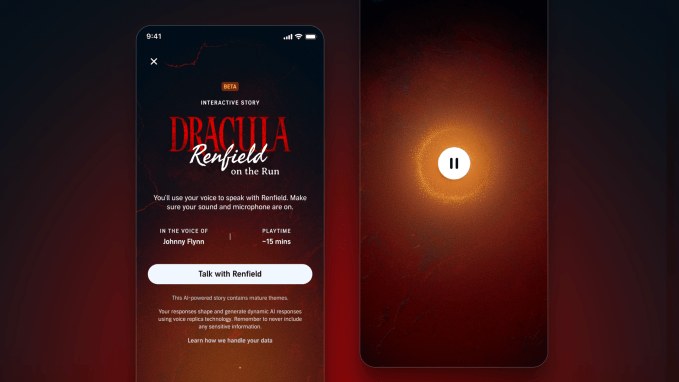
And then there's the wild one. Interactive Stories are separate bonus experiences — not woven into the audiobook itself — where generative AI lets you converse with a character from the book in real time. The character speaks first, assigning you a role, a goal, and stakes, and then you respond in your own words while the character reacts to what you say. The first character out of the gate: Renfield, Dracula's devoted, deeply unwell servant, arriving this fall. The second: Exoplanet, on November 5.
Choosing Renfield as the inaugural conversation partner is either inspired or deranged, and I genuinely can't decide which — which is probably the point. He's the perfect stress test: a character with a distinctive voice, a clear worldview (the Master provides), and enough instability to make every conversation unpredictable. Audible says the creators are involved in setting the foundations of these interactive stories so they stay grounded in the book's narrative — and faithful to the original creator's vision in the case of something like Dracula. That's the guardrail against the obvious failure mode: an AI Renfield who starts freelancing about cryptocurrency. Creator-defined personas reduce the risk of model drift, though as with any generative system, they can't eliminate it entirely — and there's a real open question about whether listeners will always know when a response is AI-generated rather than performed or scripted. For an industry built on authorship and voice, that distinction matters.
Visual Explorer: the quiet one that might matter most
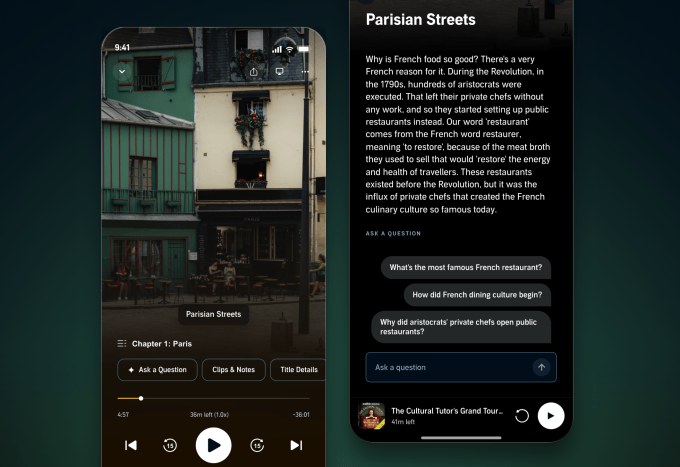
The third feature is the least dramatic and, for nonfiction listeners, potentially the most valuable. Visual Explorer displays supplementary imagery and contextual information — maps, landmarks, reference images — for places and locations mentioned in a title. Right now it exists on exactly one audiobook: The Cultural Tutor: A Modern Guide to History, Art and Philosophy in 49 Short Chapters by Sheehan Quirke, a book built around making culture accessible through short lessons on poetry, art, architecture, and geography.
One title is a toe in the water, but it's the right toe. A short lesson about a cathedral or a battlefield becomes a small guided tour when you can see what the narrator is describing — and for nonfiction, where comprehension is the whole point, a visual layer is a genuine enhancement rather than a novelty. If Audible expands this thoughtfully, Visual Explorer could become the feature that justifies the whole experiment. If it stays on one book, it's a demo. Watch this space.
Why now: Spotify is coming, and the market is huge
None of this happens in a vacuum. The audiobook market is growing fast — U.S. sales reached $2.43 billion in 2025, per Publishers Weekly via TechCrunch — driven by smartphones, packed schedules that make sitting down with a book feel like a luxury, and BookTok pushing reading back into the mainstream. The most popular audiobook genres now overlap heavily with BookTok's interests: fiction, sci-fi, thrillers, and romantasy. And Spotify's expansion into audio has forced incumbents to compete on experience rather than catalog alone.
"These new features invite listeners into a story in ways that simply weren't possible before, marking the latest step in our nearly 30-year journey to push audio storytelling forward," said Audible Chief Content Officer Rachel Ghiazza in the launch statement. "We're excited to build on these while working hand in hand with creators, because we know that more time spent with stories benefits everyone who helps bring them to life." The emphasis on creator involvement is doing real work in that quote — it's the company's answer, in advance, to the authorship question.
Future of reading or expensive gimmick? My honest take
Okay, the question the headline promised. Here's my genuine read: the Character Guide is the keeper — it solves a real, everyday frustration and it'll quietly become something listeners expect everywhere. Visual Explorer is the sleeper — narrow now, but the most defensible long-term value, especially for nonfiction. And Interactive Stories? It's the delightful experiment, the one you'll try once at a party and talk about for a week. Whether anyone wants to have a second conversation with Renfield is the entire ballgame, and nobody knows the answer yet — including, I'd wager, Audible.
That's fine. The honest version of this launch is a retention play dressed as innovation: give listeners reasons to spend more time inside the Audible app, on Audible Originals, where the margins live. There's nothing wrong with that, and the craft on display — a full-cast Dracula, creator-defined AI personas, a genuine usability fix — suggests a company taking the experiment seriously rather than shipping a demo for the press cycle. Talking to Renfield might be a gimmick. But the guide that tells you who's talking? That's the future, and it's already here. For more on how Amazon is rebuilding the reading experience, see the rebuilt Kindle; for the literary world's new voices, Ruixi Zhang's Women's Prize Discoveries win; and for the strangest book-adjacent thing you'll see this fall, a game about sorting books in a library full of bodies.
Sources
- Audible's new features let you explore book worlds — and use AI to talk to characters TechCrunch · Oct 1, 2026
- Audible Unveils Features To Explore Book Worlds, Talk To AI Characters Newsgab · Oct 2026
- Audible Beta Adds AI Character Conversations and Interactive World-Building Gaming Ideology · Oct 2026
- Audible Adds AI Conversations, Real-Time Character Guide, and Image Viewer to Audiobooks Particle · Oct 2026