Tuesday, October 6, 2026 — There is a new silhouette over Bilbao this morning, and it looks like nothing the city has seen before. The Bilbao Fine Arts Museum opened its new €45 million wing to the public today, a sweeping two-story pavilion by Foster + Partners that appears to float above the museum’s older buildings on a row of giant V-shaped steel columns. The project roughly doubles the museum’s exhibition space to about 6,000 square meters — and it is the most significant thing to happen to the city’s museum scene in a generation.
Before we go any further, let’s clear something up, because a few early write-ups have already muddled it: this is the Fine Arts Museum — the Museo de Bellas Artes — not the Guggenheim. The Guggenheim is the titanium flower everybody photographs, about 500 meters down the road. The Fine Arts Museum is Bilbao’s other great museum, its grand old gallery of Spanish and Basque art, and frankly it has been waiting in the Guggenheim’s shadow for nearly thirty years. Today is its day.
First, the not-the-Guggenheim thing
It matters more than you’d think. Bilbao is one of the few cities on earth with two genuinely world-class museums within a ten-minute walk of each other, and the world only ever talks about one of them. The Fine Arts Museum is the quiet one: founded on old-master and modern Spanish painting, deep in Basque art, holding roughly 2,000 paintings, 500 sculptures and an 800-piece decorative arts collection. As the museum’s director Miguel Zugaza said, “We’re only 500 metres from the Guggenheim but we’re not in competition with each other. We have very different offers and different histories.” Zugaza told The Art Newspaper that the Fine Arts Museum is “effectively the Basque Country’s national gallery,” and that this new stage in its history will extend what it can offer visitors “not only to Bilbao but to the whole of the Basque Country.”
So no, the city did not build a second titanium flower. It built the opposite: something that hovers.
The floating pavilion
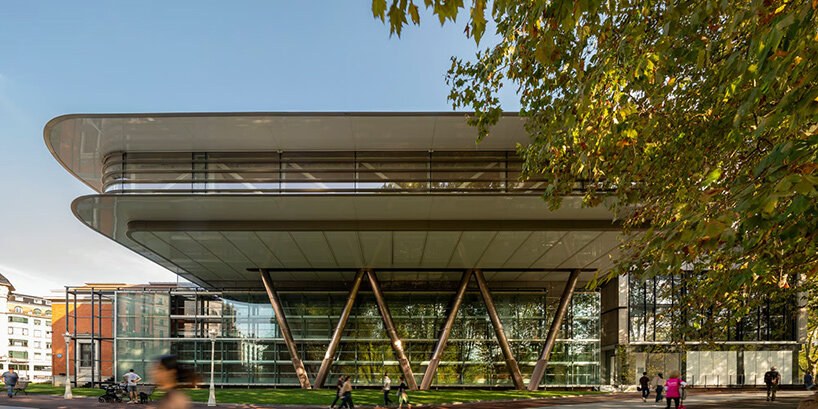
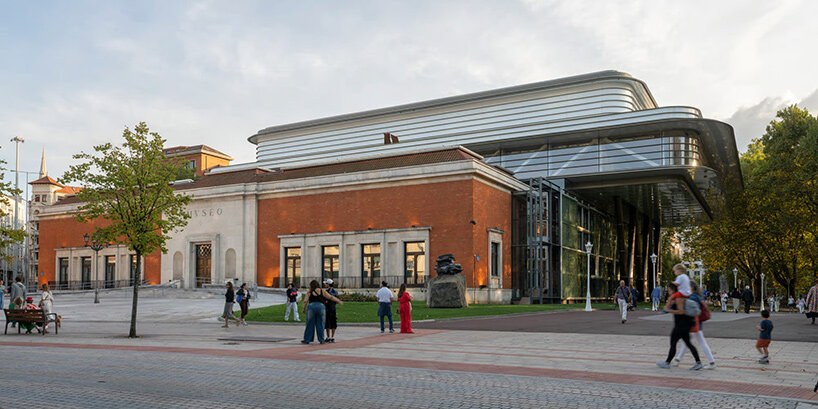
The extension, which Foster + Partners has named Agravitas, is two curved, light-filled upper stories that overhang the museum’s front facade and stretch 55 meters between groups of large tubular V-shaped steel columns. From the street, the museum’s silhouette has changed completely — long horizontal edges project well beyond the older masonry facades, with glazed sections revealing the depth of the volume behind. Deep cantilevers reach toward the surrounding city, and the whole thing reads less like a building than a bridge that decided to stay.
Foster + Partners designed it with Bilbao architect Luis María Uriarte, a choice with a nice bit of symmetry: Uriarte is the same architect who renovated both of the museum’s earlier buildings back in 2001 — the Neo-Classical structure from 1945 and the Modernist addition from 1970 (by Álvaro Líbano and Ricardo Beascoa). His firm won the international competition for this expansion in 2019, and the winning idea was disarmingly simple: expand upward, into the open air above the site, and leave the old buildings alone. Foster himself wrote in the project announcement that the design “will restore the existing mid-twentieth century building… create a new publicly accessible atrium space and add major new galleries for contemporary art in a floating pavilion.” The museum’s initial entrance in the 1945 red brick building has been restored as part of the work, and a new north-south route now crosses the whole complex.
The steel does a lot of the talking. The structure was produced locally, drawing on manufacturing expertise in the Basque Country — Bilbao is a steel town, after all, and the new wing wears that heritage overhead. The roof carries more than 500 square meters of photovoltaic panels, the projecting facade shades the glazing below, and natural ventilation and daylight are part of the environmental strategy. This is a building that knows where it lives.
A public square, indoors
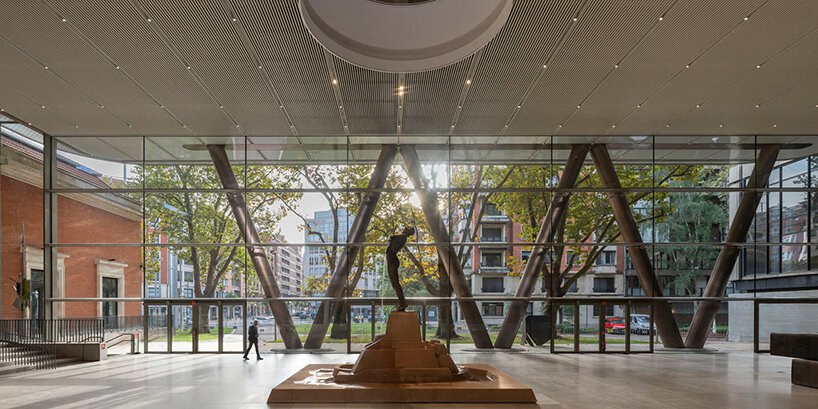
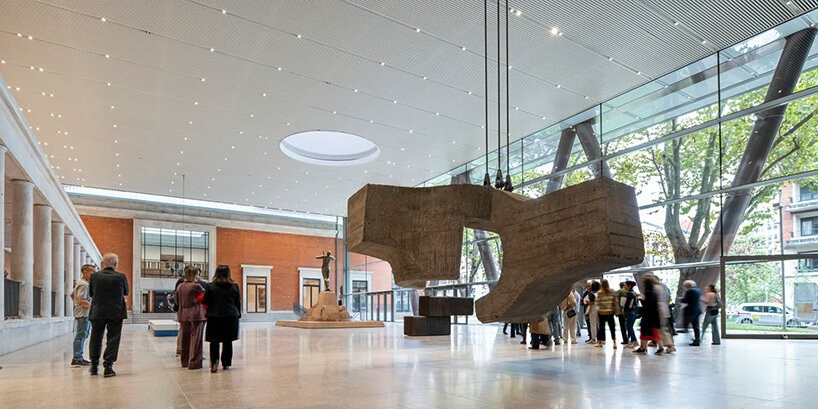
The cleverest move in the whole project isn’t the floating gallery — it’s the room underneath it. The former Plaza Arriaga, the square in front of the museum, has become a covered public atrium of more than 1,000 square meters, sheltered beneath the underside of the pavilion. Francisco Durrio’s restored monument to Bilbao-born composer Juan Crisóstomo de Arriaga returns to the center of the space, beneath a six-meter circular opening cut through the overhead structure. Works by Eduardo Chillida and Richard Serra occupy the atrium too, which means the museum’s free public space now opens with two of the heaviest hitters in modern sculpture.
This is the part that tells you what the project is really about. Zugaza said the thing that sold the museum on the Foster and Uriarte proposal was that “it didn’t interfere with the existing architecture. It enhanced it and offered a new dimension to the museum, integrating the two earlier styles of architecture, the 1945 building and the 1970 building, and uniting them in a very ingenious manner.” Along the new route through the complex, the older elevations have become interior walls around the shared space — the museum’s own history, turned into architecture you walk through.
What’s actually inside
Within Agravitas, roughly 2,300 square meters are devoted to new exhibition areas. The upper level holds BBK Museoa, a large column-free gallery built for temporary exhibitions — the kind of flexible white-box room the museum has never really had — with north-facing glazing that pulls daylight in toward the neighboring park. An adjoining terrace gives the museum new outdoor space for sculpture, and a restaurant up top gets the city-and-hill views. The expansion also adds about 1,635 square meters for the permanent collection, while further spaces below the main gallery take the museum’s architecture and design collection alongside educational uses. Across the wider complex, some 8,000 square meters of existing architecture have been renovated.
Outside, Foster + Partners pedestrianized the roundabout in front of the museum and cut traffic lanes, repositioning the building as a central cultural offering rather than something you drive past. The bill was €45 million, funded by the Basque government, the regional government, the provincial council, the Bilbao city council and the private BBK Banking Foundation — a genuinely civic stack, which feels right for a museum Zugaza describes as the Basque Country’s national gallery.
Bilbao’s first museum boom — the Guggenheim effect of 1997 — put the city on the world’s cultural map. This one is quieter, more local, and in its own way more interesting: the old museum, the one the city actually grew up with, finally getting room to breathe. It opened today. The titanium flower 500 meters away can share the skyline.
It’s a good season for museum-going, frankly — from the British Museum’s deep dive into 2,000 years of Korean art to the Met finally giving Lee Krasner equal billing with Pollock and even Sonic the Hedgehog’s 35th anniversary exhibition, the world’s galleries are having a moment. Bilbao’s just built the room for its own.
Sources
- Bilbao Fine Arts Museum Opens New €45M Foster Wing USA Art News · Oct 2026
- Foster + Partners completes floating addition above Bilbao Fine Arts Museum designboom · Oct 2026
- Foster + Partners to Remodel and Expand Bilbao Fine Arts Museum Bustler