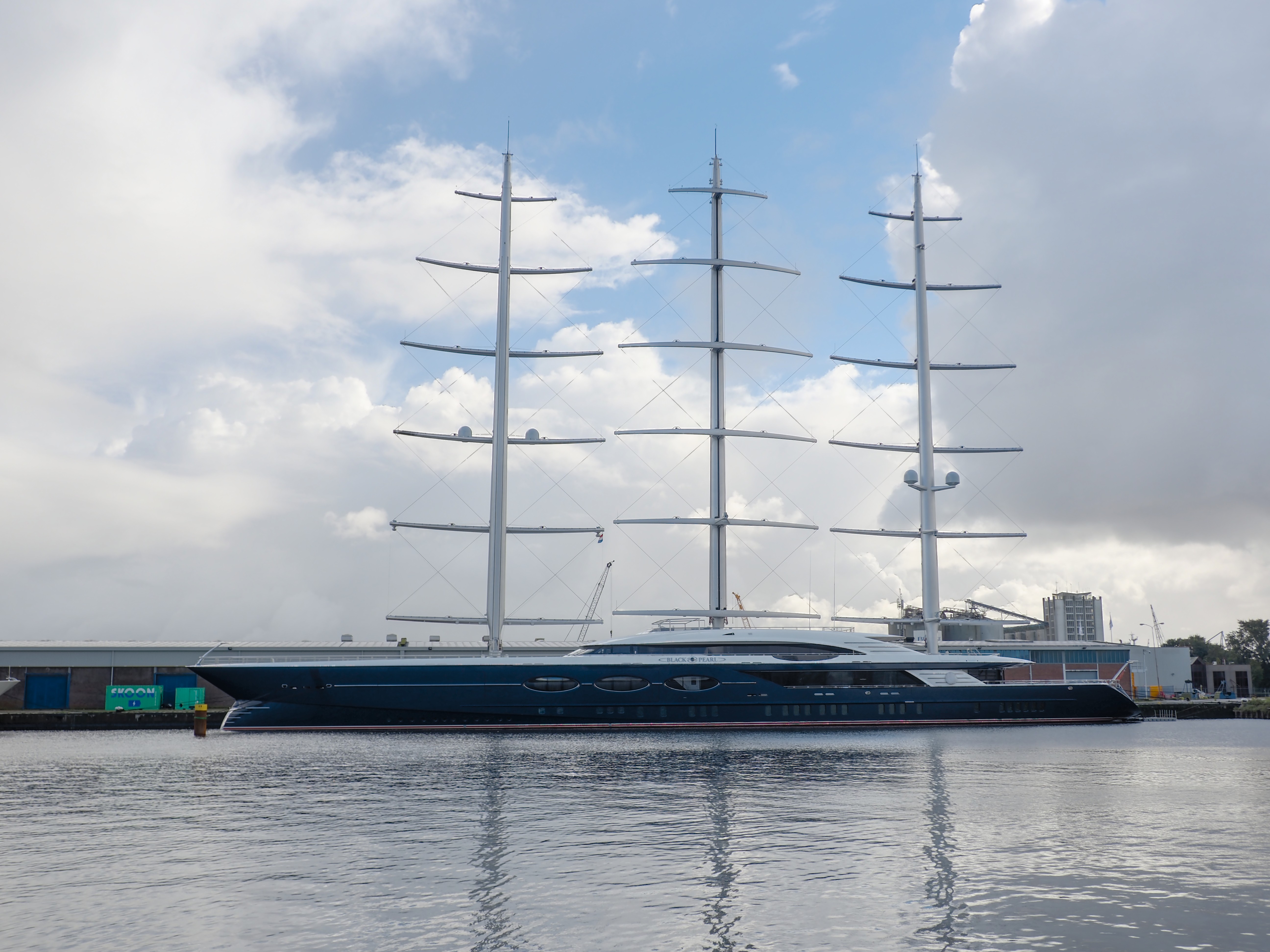

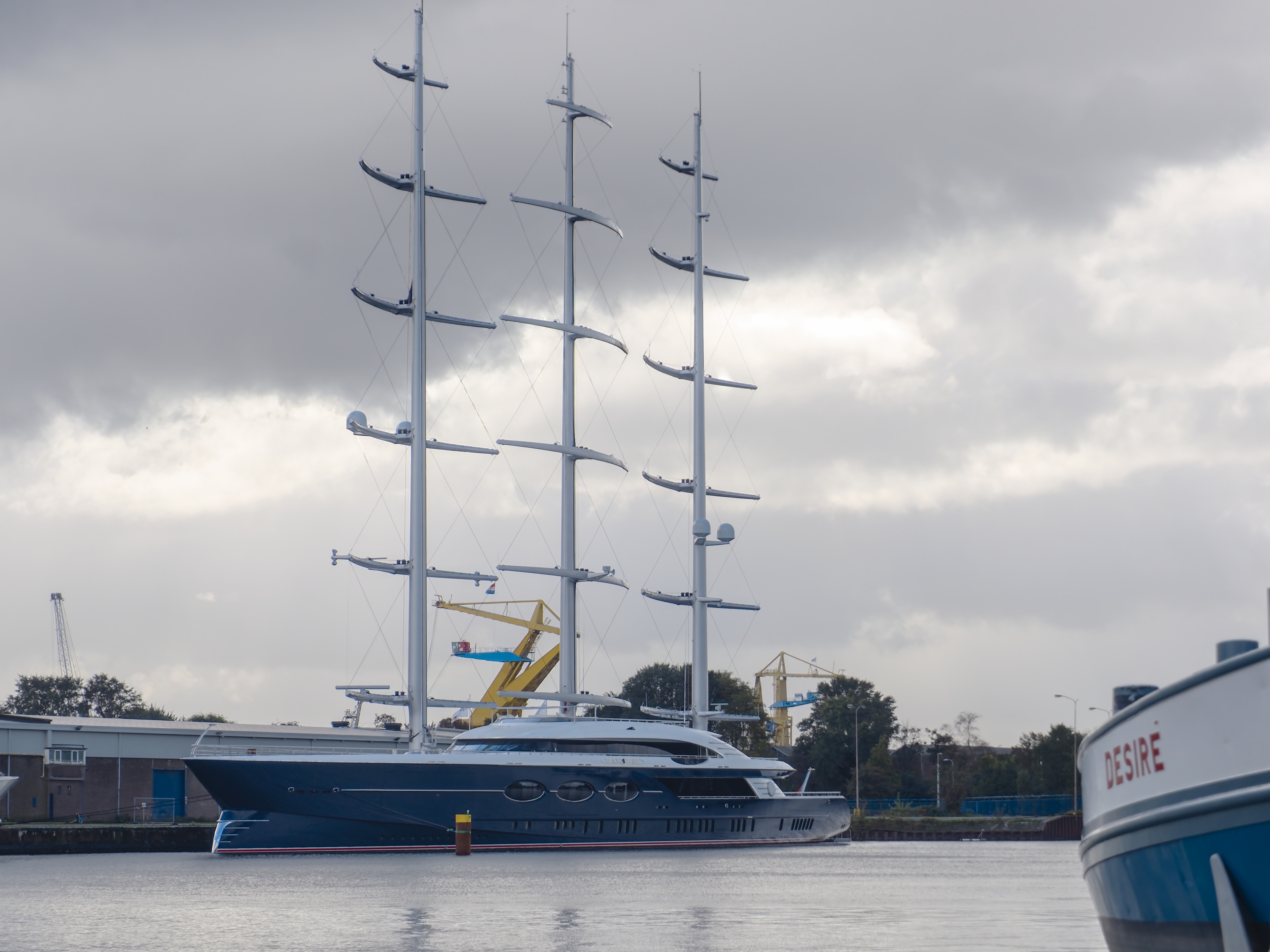
Even with the sails furled, Black Pearl makes its organising idea visible. Three tall masts carry curved horizontal yards above a dark hull. In the accompanying Amsterdam photographs, taken in October 2020, the rig is a structure waiting to work. Understanding how it moves is the way into the yacht.
Oceanco delivered the 106.7-metre Black Pearl in 2018. Dykstra Naval Architects identifies its role in designing the hull, the three 70-metre carbon DynaRig masts and the sailing system. This is a modern arrangement with an old visual echo: a large sailing vessel whose propulsion announces itself above the deck.
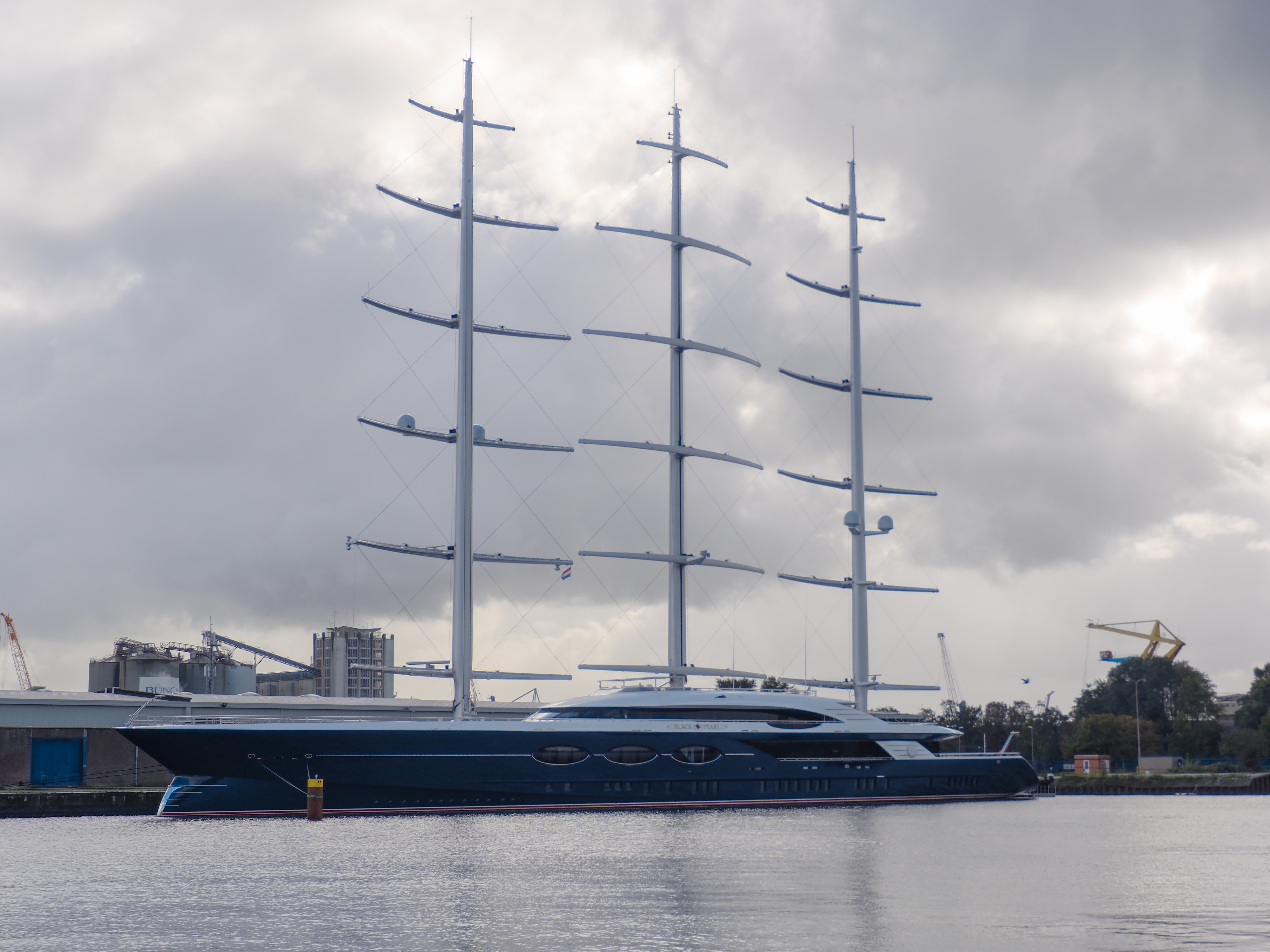
The resemblance does not explain the handling. In the DynaRig architecture described by supplier Southern Spars, the curved yards are fixed to a freestanding mast, and the mast itself rotates to change the sails’ angle. Individual sails deploy from furlers inside it. With the sails set, the arrangement forms a continuous panel. The mast is therefore doing a job that its appearance alone might not suggest.
Individual furling also lets the crew choose a sail plan for the conditions. Southern Spars describes integrated load monitoring and operation from a control panel or helm station. On Black Pearl, the scale is substantial: Oceanco lists 2,877 square metres of sail and says the sail plan can be set in seven minutes. Those are builder specifications, rather than an independently timed demonstration.
Sailing is only one part of the energy story. Oceanco describes a propulsion system that harvests kinetic energy while the yacht is under sail. Dykstra also identifies a regeneration mode and waste-heat recovery among the onboard systems, while Lateral records its involvement in developing the hybrid propulsion. Moving the vessel and supplying its electrical needs become connected design problems.
That connection should be understood as a system capability, not a guarantee about every passage. Wind, the chosen sailing mode and the demand onboard determine what any particular voyage requires. A rigorous account can explain the arrangement without converting an attractive environmental ambition into an unqualified result.
Black Pearl is compelling because its form remains legible while the method changes. The masts still communicate wind power. The rotation, furling controls and energy systems explain how that familiar source of propulsion is organised for this particular vessel. The silhouette opens the story; the coordination between its parts supplies the substance.
The details
Delivered in 2018, Black Pearl can set her 2,877 square metres of sail in about seven minutes. Under sail, her propulsion system harvests kinetic energy in a regeneration mode, and waste-heat recovery supports the hybrid plant.
Sources · 4 sources
- Oceanco — Black Pearl — fleet page
- Dykstra Naval Architects — Black Pearl — design page
- Southern Spars — DynaRig — rig system page
- Lateral Naval Architects — Black Pearl — project page
Photography
Photographs: Alf van Beem / Wikimedia Commons / Public domain
- Oceanco Black Pearl with its three DynaRig masts, photographed in Amsterdam on 11 October 2020.
- A broadside view of Black Pearl in Amsterdam on 11 October 2020, with the sails furled.
- An oblique view of Black Pearl and its three furled DynaRig masts in Amsterdam on 11 October 2020.