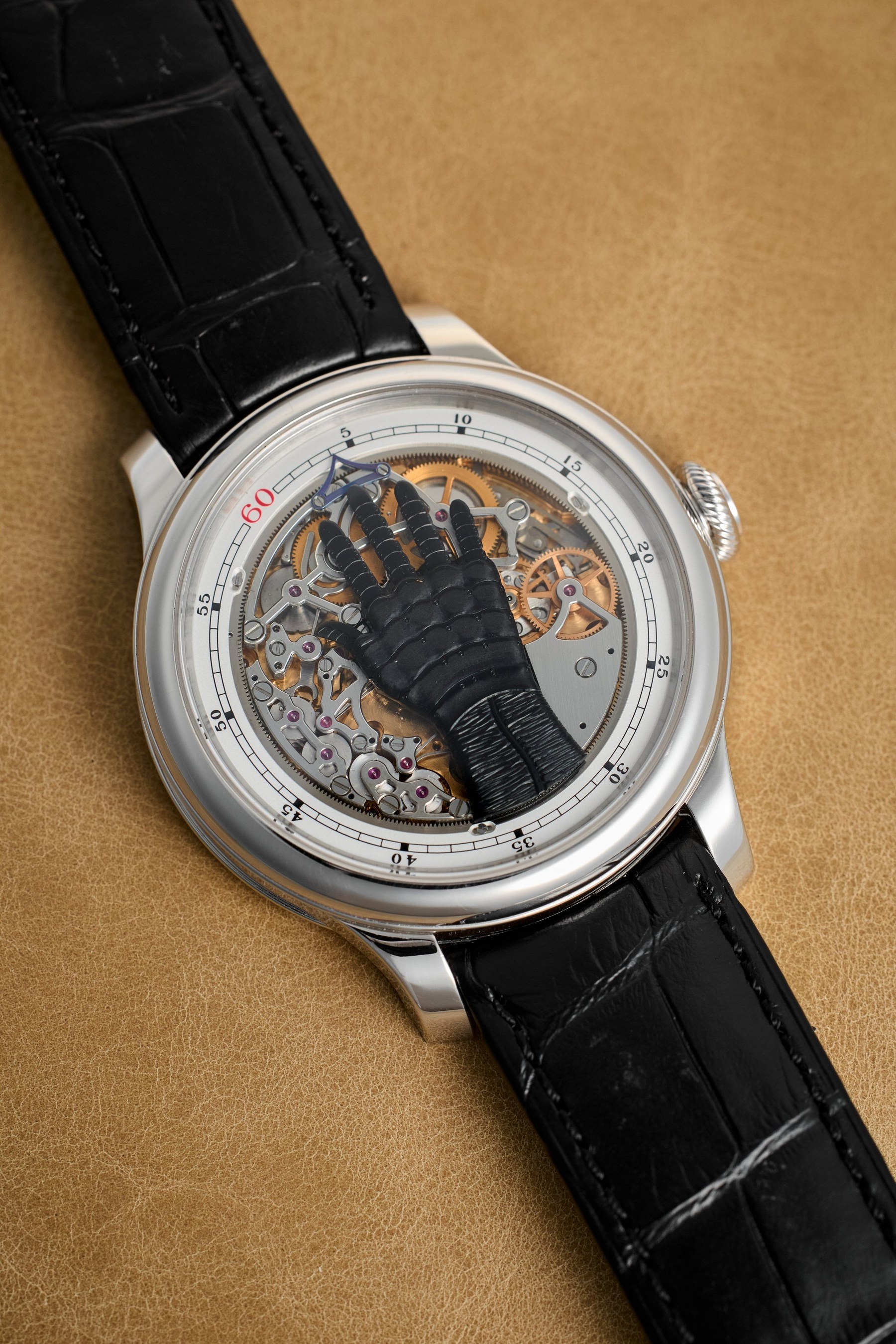
$10,755,000 — the lot price, buyer's premium included. F.P. Journe FFC Prototype, Lot 17, Phillips in Association with Bacs & Russo, The New York Watch Auction: XIII, New York, 6 December 2025. Sold from the collection of Francis Ford Coppola.
Hammer price: $9,000,000. The $10,755,000 is what the buyer actually pays the house, before any taxes, shipping or insurance that sit outside the auction total.
Estimate going in: in excess of $1,000,000. Bidding opened at the $1 million reserve, jumped to $3 million, then $5 million, slowed near $7 million, and was fought out between two phone bidders to the $9 million hammer in about eleven minutes.
At the time of the sale Phillips and Hodinkee both called it a world auction record for an F.P. Journe and for any wristwatch by an independent watchmaker, and the highest price for a non-charity wristwatch made in the 21st century. Those are December 2025 claims, stated as of the sale.
Coppola consigned seven watches in the sale. The seven together made $11,689,720. This one watch was nearly all of it.
On the other number you will see: a Phillips year-end article prints $10,775,000 in one passage (and a Phillips top-ten table repeats it) while printing $10,755,000 in another passage of the same article. The lot result, Hodinkee's sale-day report and The Value's lot report all agree on a $9 million hammer and a $10,755,000 total. The lot figure is $10,755,000; the $10,775,000 printing is the typo.
The exact object
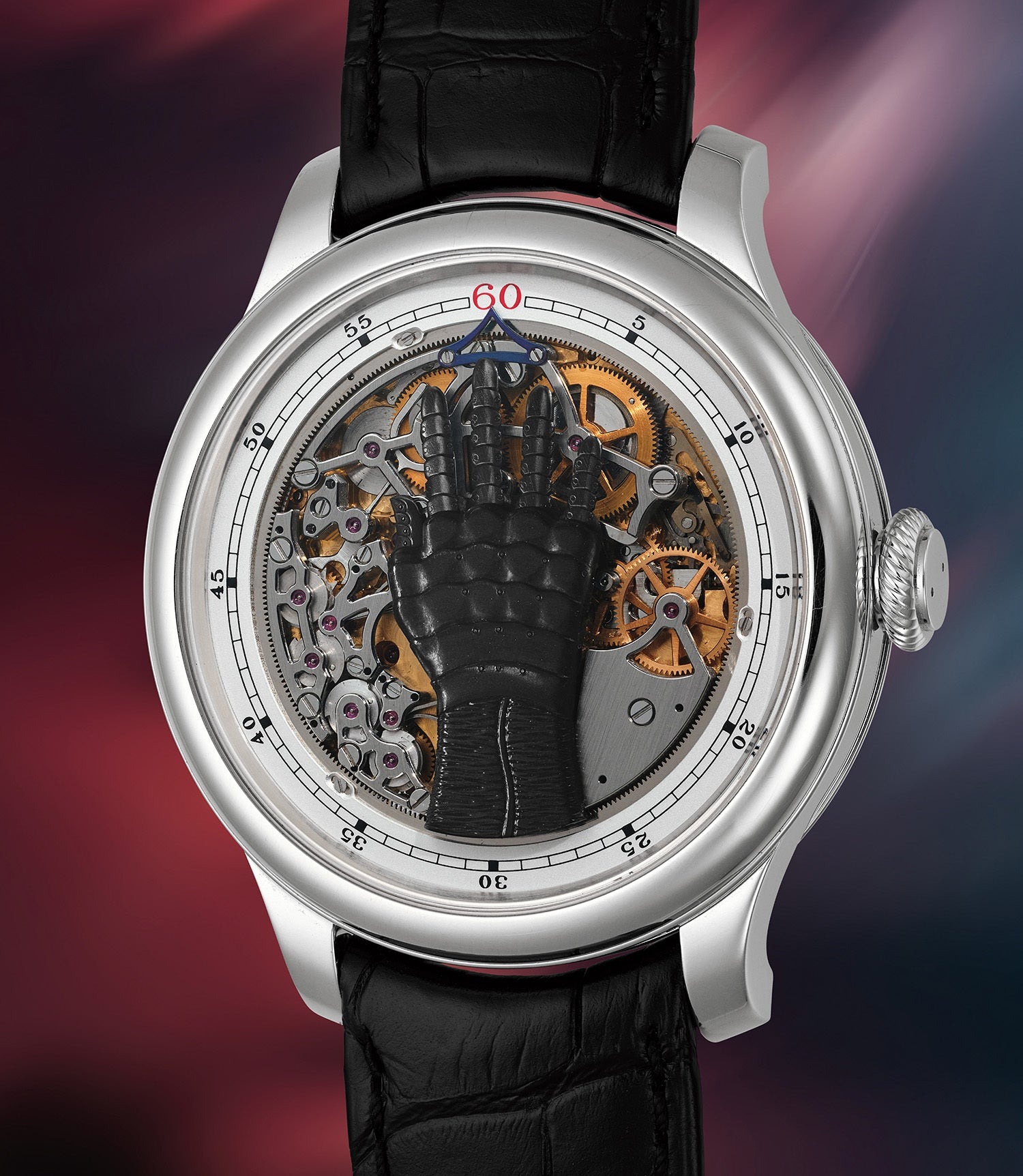
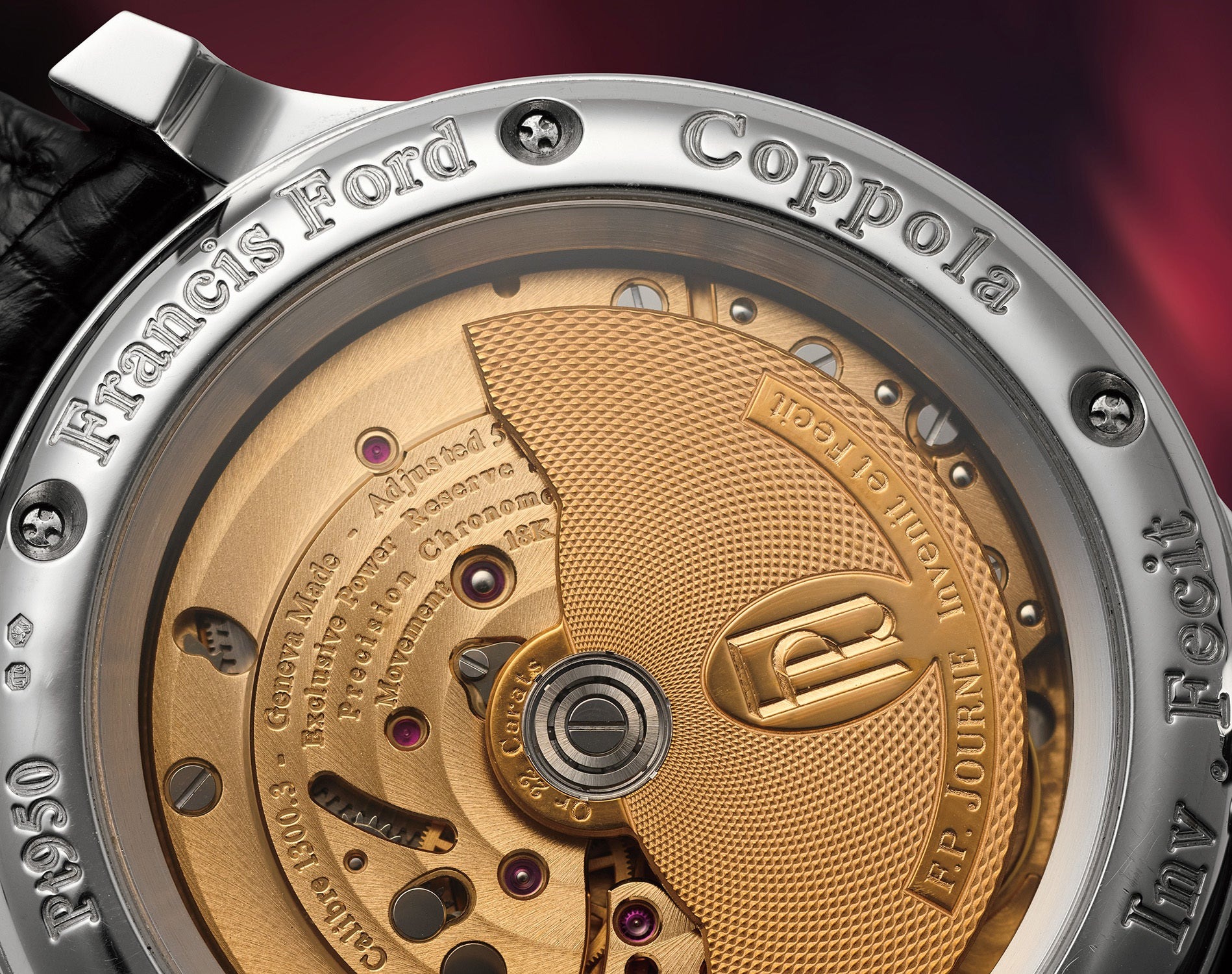
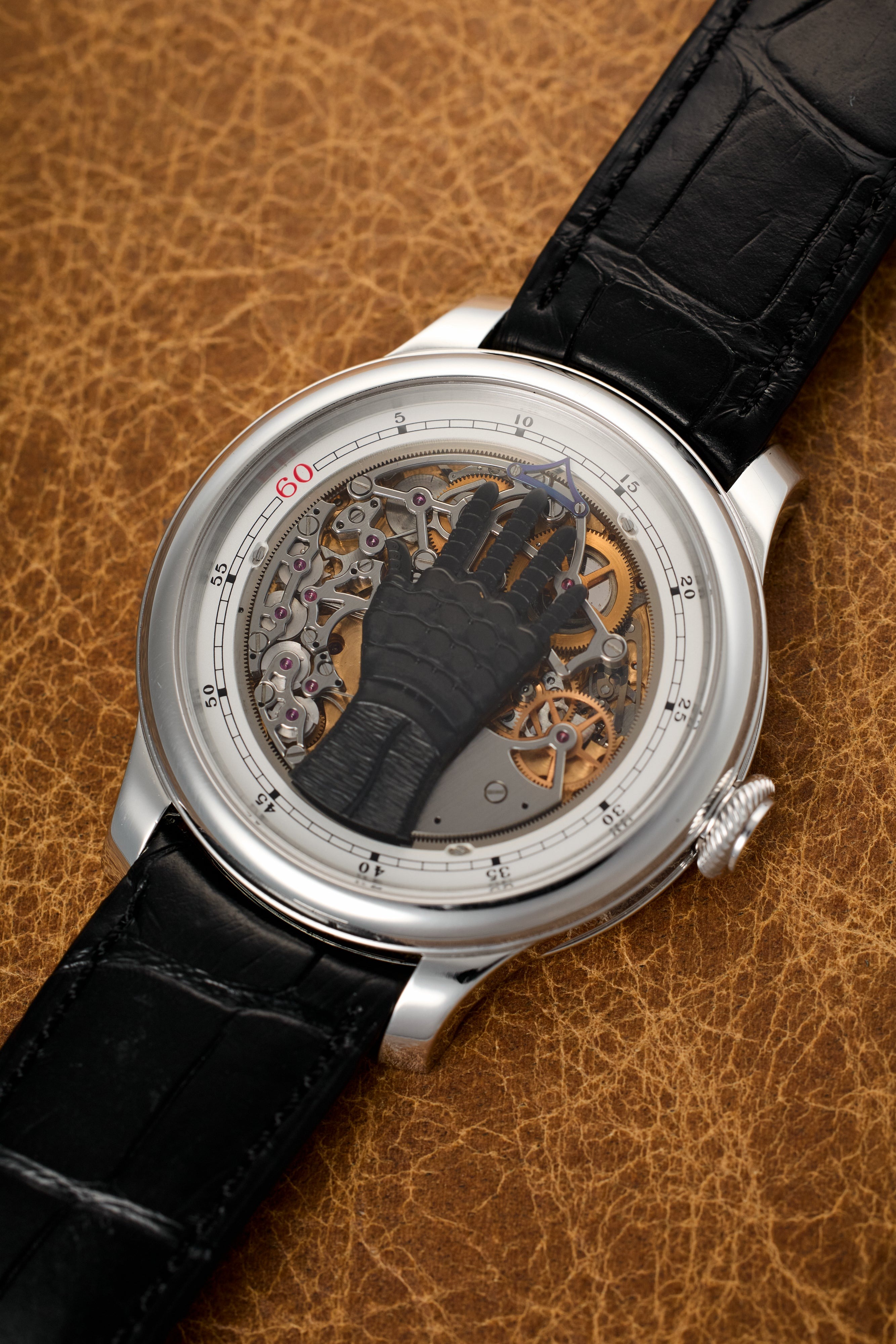
A 42mm platinum case, about 10.7mm thick, made circa 2021. The case number is not a number. It reads "Francis Ford Coppola."
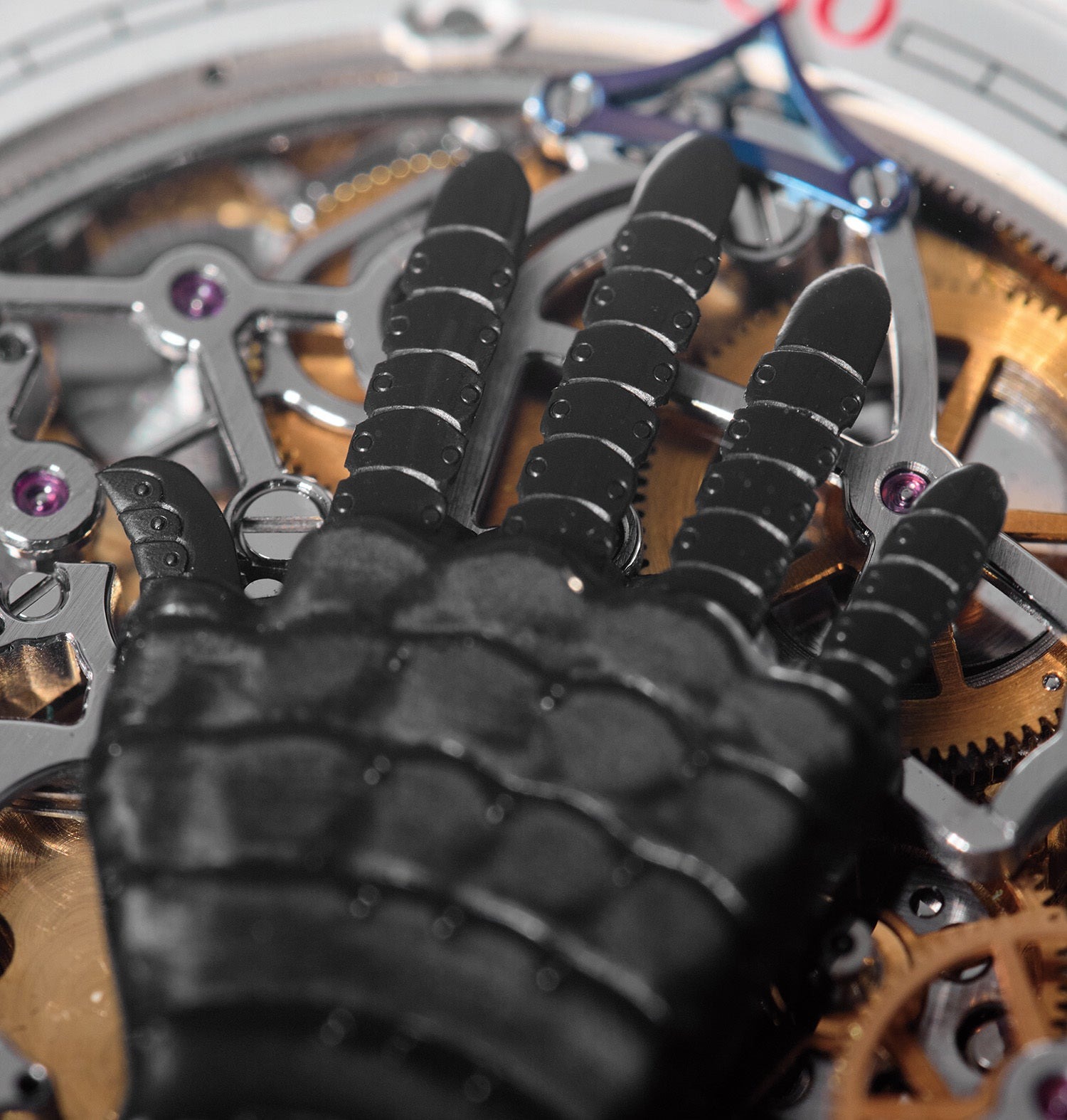
There is no hour hand in the usual sense. In the centre of the openworked dial sits a black-treated titanium hand — a small articulated human hand, modelled on a 16th-century prosthetic by Ambroise Paré, the French surgeon who pioneered artificial limbs. Its five fingers extend and fold back in different combinations to show the hour, changing instantaneously on the hour. Minutes run separately, on a rotating ring around the edge of the dial, read against a marker at 12 o'clock.
This configuration — black hand, steel bridges — exists twice. Coppola's is one. The other is expected to be displayed at the F.P. Journe museum in Geneva. Hodinkee's sale report adds the detail collectors care about: this prototype was built by François-Paul Journe's own hands and carries tool marks a production watch would not have.
It is also, in Hodinkee's phrase, the only F.P. Journe that did not begin as Journe's own idea. It began as Coppola's question.
Why a prototype brought this number
The question came first. At a dinner at Coppola's Napa Valley home in 2012, the director asked Journe whether anyone in history had made a watch that tells the time on the fingers of a hand, the way people once counted. Journe worked on the problem for years. How do you get twelve hours out of five fingers? The answer is a small mechanical computer on the wrist: stacks of cams, one programme of finger positions for each hour from 1 to 12, and circular springs that store energy from the running train and release it at the top of the hour so the fingers snap into their new pattern without draining the movement.
The base movement is serious watchmaking, not a novelty motor. The FFC is built on Journe's Octa calibre 1300.3 — automatic, made in 18-karat rose gold, with a 120-hour (five-day) power reserve and a remontoir d'égalité, a constant-force mechanism that evens out the power reaching the escapement. The hand mechanism had to be layered onto that without disturbing it. F.P. Journe makes fewer than 1,000 watches a year across everything it sells; the production FFC is made in a handful per year.
The prototype status is separate from the model. A production FFC is already one of the most wanted watches the brand makes — Hodinkee reported at least two people in the Phillips room wearing their own. But a production watch is a finished, repeatable object. This is the working prototype that created the model, made by the founder himself, for the man who asked the question. There is no second chance to buy that specific thing.
The Coppola history is documented, not decorative. Coppola's connection to the brand started with a Chronomètre à Résonance his wife Eleanor gave him. Pierre Halimi, head of Montres Journe America, recounted at the sale that Journe had told Coppola from the beginning: if you ever have a problem, sell the watch. Coppola, who self-financed Megalopolis, did. The resonance that started the relationship was the next lot in the same sale and made $584,200 — a useful measure of how much of the $10.755 million belonged to the FFC itself, and how much to the story only this prototype carries.
Keep the three premiums separate in your head, because the price mixes them: the mechanism, the prototype, and the owner. No honest reporting can split the $10,755,000 into three neat piles. Anyone who gives you an exact split is inventing it.
The ordinary counterpart
The honest counterpart here is not a cheap watch. It is the same watch, finished as a product.
The production FFC joined F.P. Journe's Classique collection in 2023, in platinum or rose gold with the same articulated-hand display. Reported prices for it have never been a single clean figure: specialist coverage has put it anywhere from about CHF 600,000 to CHF 840,000 before taxes depending on date and market, and Phillips' own Paul Boutros told The Hollywood Reporter before the sale that the prototype's $1 million estimate was set "in line with what the retail price would be" for a new production piece — roughly the $1 million mark.
On that reported ~$1 million basis, the prototype result is roughly ten to eleven times the price of ordering the production watch. That multiple compares a December 2025 auction total, premium included, with an unconfirmed, reported production price, because F.P. Journe does not publish an FFC list price and no confirmed production quote was obtained. The comparison shows the size of the prototype-and-provenance premium. It is not a valuation of the mechanism, which both watches share.
What the price includes — and what it does not
Included in the $10,755,000 lot:
- The FFC Prototype itself, circa 2021, 42mm platinum, black titanium hand, steel bridges, case number "Francis Ford Coppola."
- Certificate of authenticity and presentation box, per Phillips' lot description.
- The buyer's premium — it is already inside the $10,755,000 total. The hammer was $9,000,000.
Not included / not established:
- Sales tax, shipping and insurance after the sale are not in the auction total and are not stated in the lot reporting.
- No strap or accessory beyond the lot description is established.
- The buyer was anonymous — a phone bidder, unnamed in the reporting.
- The watch's service history and current condition beyond the lot description were not independently verified.
Sources · 6 sources
- Phillips — The New York Watch Auction: XIII, Lot 17 lot result and lot description: F.P. Journe FFC Prototype from the collection of Francis Ford Coppola, $10,755,000 including buyer's premium (hammer $9,000,000), 6 December 2025; certificate and presentation box per the lot description.
- Phillips, Year in Review 2025 — prints $10,755,000 and, in one passage, a conflicting $10,775,000; the conflict is documented in the article and the lot figure is used.
- Hodinkee — 'Francis Ford Coppola's Personal FFC Sells for $10.755 Million,' 6 December 2025: $9,000,000 hammer, eleven-minute bidding, one of two in this configuration, tool marks, Halimi and Boutros quotes.
- The Value, lot report, December 2025: Lot 17, 42mm, case number 'Francis Ford Coppola,' estimate in excess of $1,000,000, hammer $9,000,000, sold $10,755,000.
- F.P. Journe — the maker's FFC page and 2025–2028 catalogue: Paré prosthesis inspiration, production FFC in the Classique collection, official film.
- The Hollywood Reporter via Phillips' Paul Boutros — production FFC retail in the region of $1 million; reported basis only, as labelled in the article.