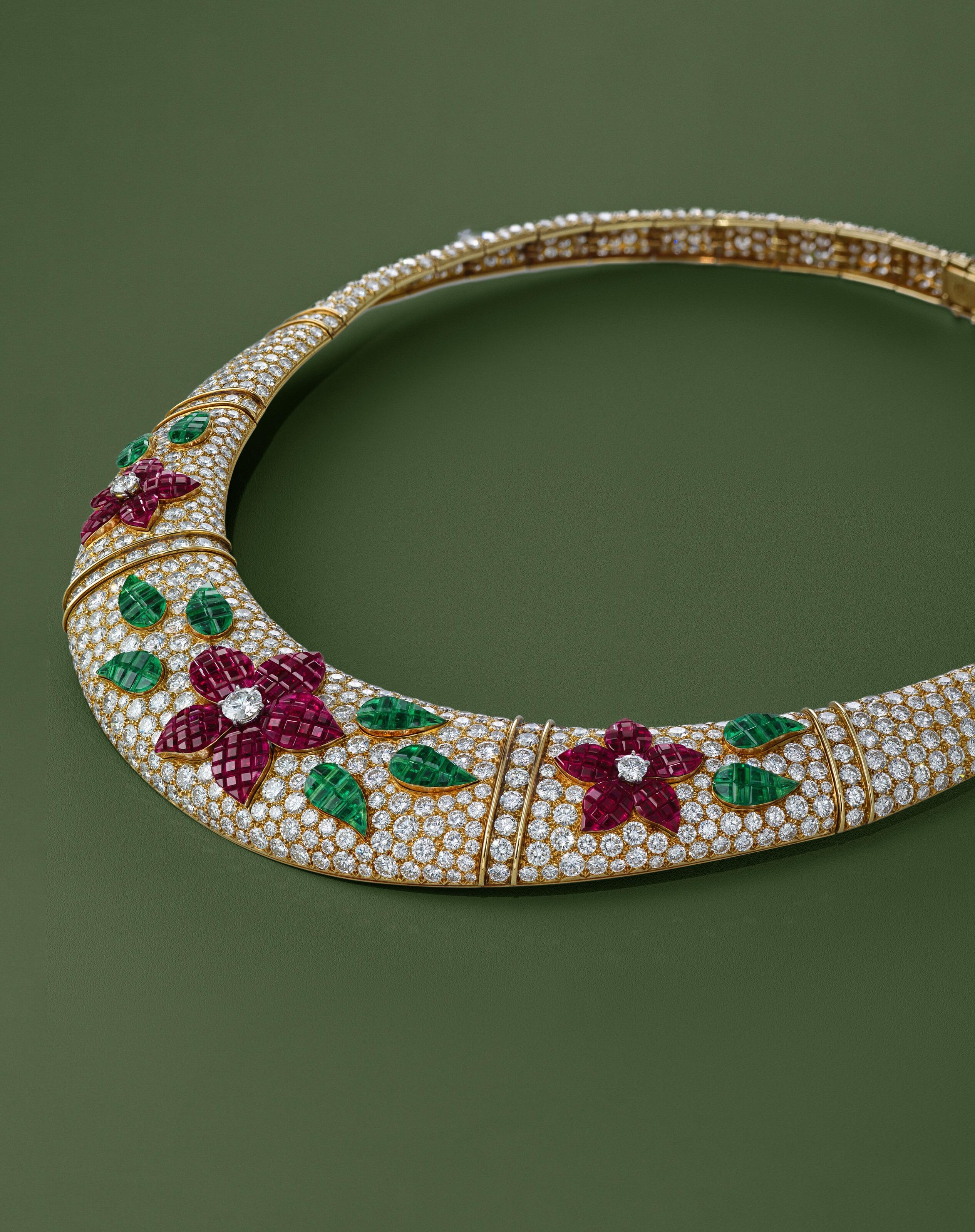
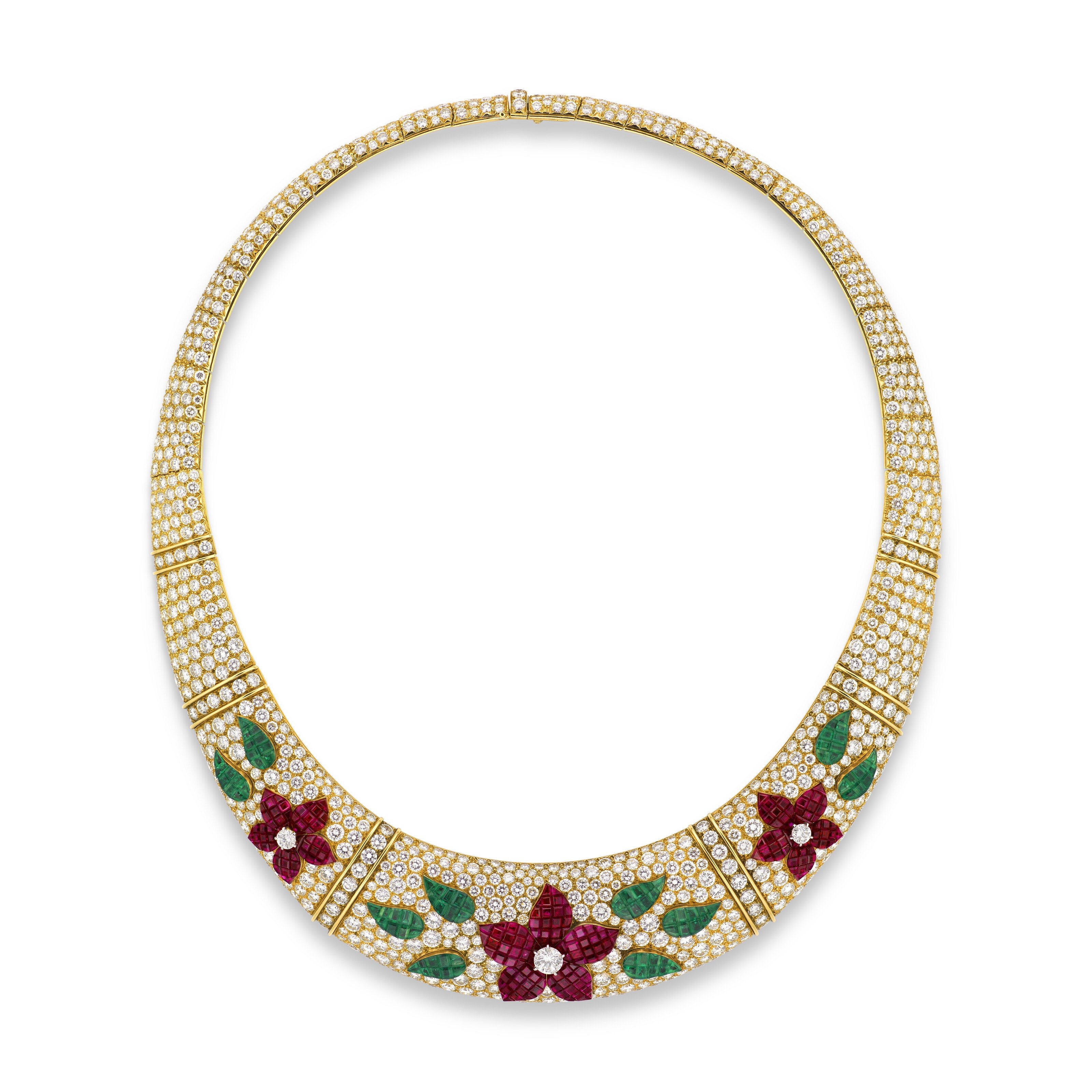
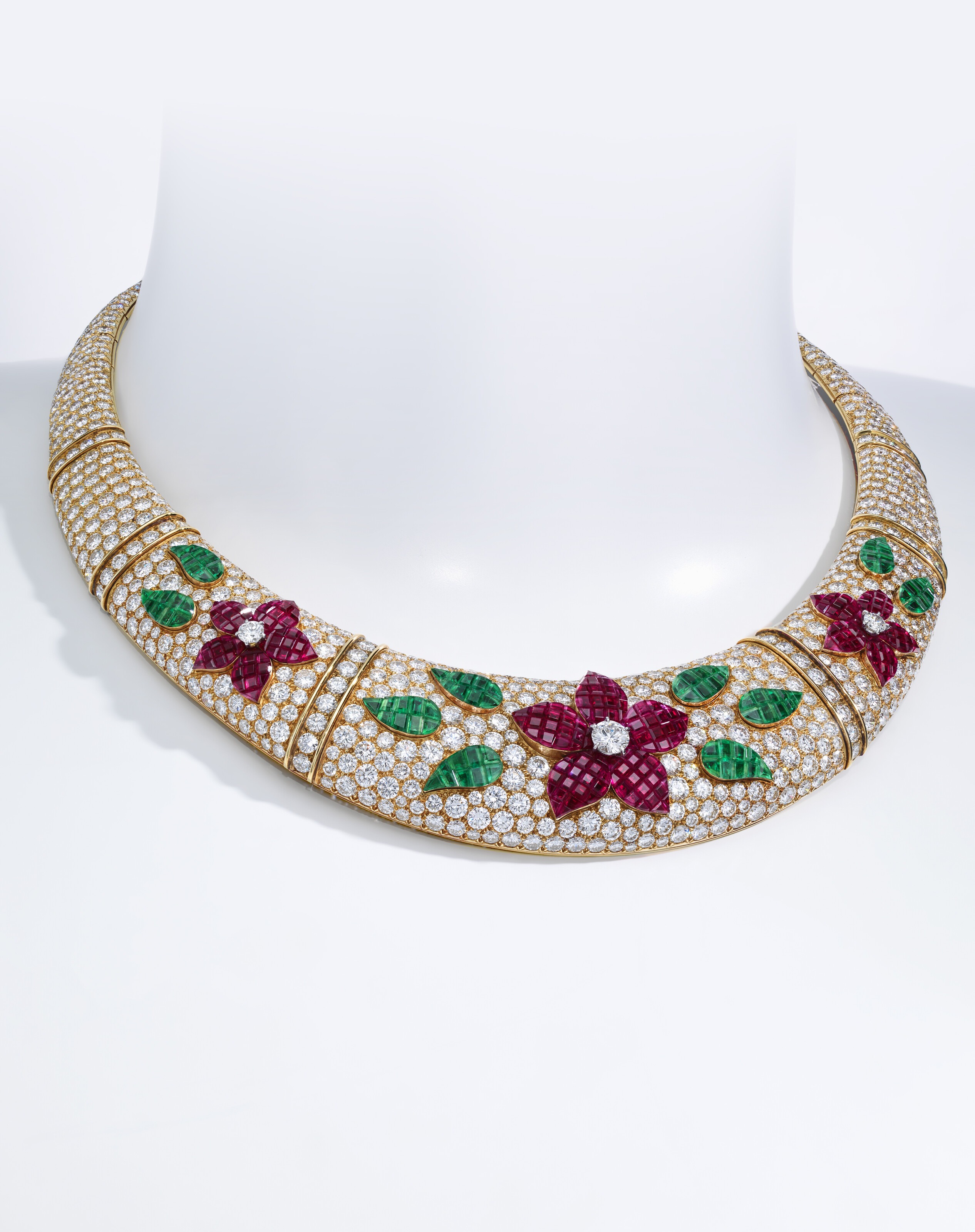
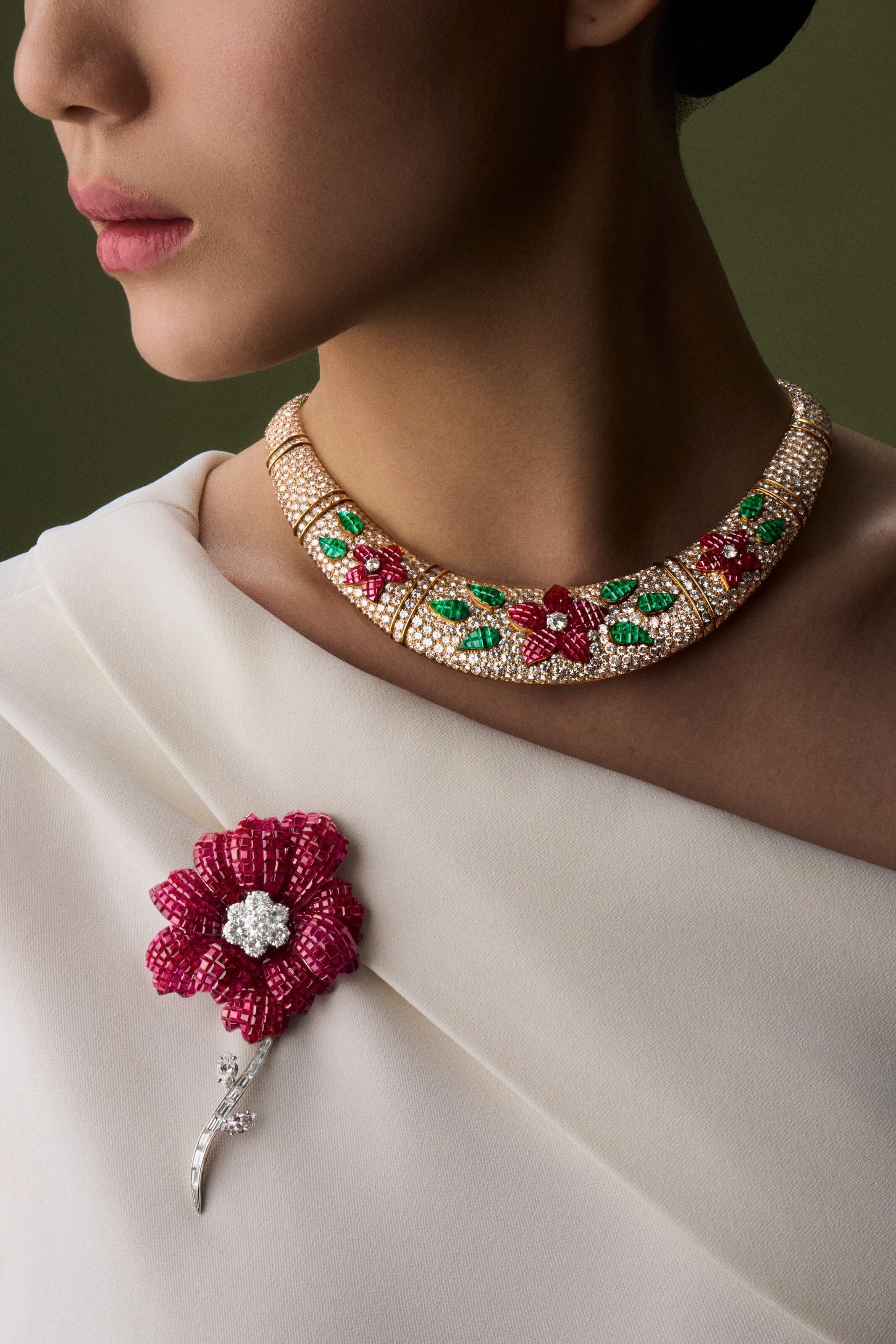
Look at the flowers first, because the flowers are the trick. Across the front of this necklace, rubies form petals and emeralds form leaves, each stone cut to fit its exact place, the colours running into one another in continuous fields of red and green — and nowhere, between any two stones, does a line of metal show. No prongs. No claws. No bezel edges. The settings exist; they are simply underneath, which is the entire point of the technique this necklace is built with, and a large part of why Christie's expects what it expects for it.
On 24 November 2026, at the Magnificent Jewels sale in Hong Kong, the 'Mystery-Set — Sublime' necklace by Van Cleef & Arpels — lot 1915 — carries a pre-sale estimate of HK$6,500,000 to HK$12,000,000, roughly US$830,000 to $1.5 million. An estimate is not a price: it is the house's published expectation, excluding buyer's premium, and the necklace may beat the range, land inside it, miss it, or go unsold. There is no sale yet.
The lot record gives the object its documented shape. Christie's catalogues it as an exquisite ruby, emerald and diamond 'Mystery-Set — Sublime' necklace: calibré-cut rubies and emeralds, round diamonds, gold with a French mark, signed Van Cleef & Arpels with the maison's mark, numbered, approximately 39.0 centimetres in inner circumference and 102.7 grams in gross weight. It is a jewel of the 1980s, per the house's sale material — a floral collar in the bold manner of that decade — and its top estimate puts a workmanship-led piece within sight of the sale's modern headline stones, in a 120-plus-lot sale at The Henderson during Hong Kong Luxury Week. The estimate is carried there not by one giant gem but by the setting. The setting is where that premise is earned.
Mystery Set: the work the estimate is pricing
Van Cleef & Arpels patented the Mystery Set in 1933, and it remains one of the most labour-intensive setting methods in high jewellery. The mechanics, plainly: each coloured stone is calibré-cut — cut individually, to a precise shaped outline dictated by its exact position in the motif, never sorted from standard sizes. The underside of every stone is cut with a fine groove. The stones then slide, one by one, onto a lattice of thin gold rails hidden beneath the surface, locking into a continuous mosaic. The metal is the skeleton of the piece. From above, none of it shows.
Now count what that demands of this necklace. A floral motif in three materials means rubies and emeralds cut to interlock along curved petal boundaries, each stone's colour matched to its neighbours across a surface that cannot tolerate a pale or dark patch — there is no metal line to break the eye's path and forgive a mismatch. Emerald is brittle; ruby is hard but unforgiving of a bad cut. A stone that chips at the groove, or arrives a fraction off its calibré outline, does not get forced.
It gets recut or replaced, and its neighbours' fit is rechecked. The setting is done by a small number of master jewellers — the house has always treated Mystery Set as a signature discipline, passed hand to hand — and pieces are produced in correspondingly small numbers. That is the honest answer to why a necklace of rubies and emeralds is estimated like a diamond: the estimate prices hours and failure risk inside a patented technique. The stones are the material. The setting is the manufacture. Both are in the lot; only one of them photographs — as absence.
What supports the estimate — and what was still paper
An auction estimate is a claim about a future room, and its legs separate by how well each is documented. Documented from the lot record: the house and signature, the numbered piece with its maison's mark, the technique, the materials, the period, the dimensions and weight, and the estimate itself. Documented, too, is the exhibition history the sale material had asserted without names. The lot record names them. This necklace was exhibited in Paris at the Musée des Arts Décoratifs, in 'Van Cleef & Arpels: l'Art de la Haute Joaillerie', from 20 September 2012 to 10 February 2013.
In Kyoto, at the National Museum of Modern Art, in 'Mastery of an Art', from 29 April to 6 August 2017. And in Beijing, at the Today Art Museum, in 'When Elegance Meets Art', from 21 April to 5 August 2018. It is also published: the lot record cites it at page 218 of Évelyne Possémé's 'Van Cleef & Arpels: The Art of High Jewelry' (Musée des Arts Décoratifs, Paris, 2012). A 1980s jewel the house itself chose to exhibit on three continents, and to print in its own retrospective volume, arrives at auction with a documented public life. That is a provenance spine, and it is part of what the room will be bidding on.
What remains genuinely open is narrower, and it is stated rather than smoothed over. The lot text does not state stone counts or carat totals for the rubies, emeralds and diamonds. Condition on a roughly forty-year-old Mystery-Set mosaic is price-relevant — calibré stones can loosen or chip at the rails — and the condition detail sits with the house's sale documentation rather than in the public lot text. And the third leg does not exist yet at all: comparable bidding. There is no fresh result for this necklace to be measured against until its own sale. The first two categories are carried labelled as they are; the third is not allowed to borrow their confidence.
The ordinary Van Cleef, for scale
The same house, the line any reader can walk in and buy: the Vintage Alhambra necklace, ten motifs, mother-of-pearl in 18-karat white gold, retailing at $10,800 in a US retail listing checked in November 2026. Even this necklace's low estimate — HK$6.5 million, about $830,000 — is on the order of 75 times that retail price. The comparison is an entry point, not an equivalence: a production necklace at a fixed boutique price against a one-off 1980s Mystery-Set high jewel at auction. What sits between them is not better clover shapes. It is a patented setting technique executed at exhibition level, a documented history across Paris, Kyoto and Beijing, and a supply of exactly one.
What the estimate includes is only itself: Christie's published range for lot 1915, excluding buyer's premium, taxes and charges. It does not include a result — there is none until 24 November — or any assurance the lot reaches the rostrum as catalogued. On 24 November the estimate gives way to the result: the price realised from Christie's results, or 'unsold' stated just as plainly.
Sources · 5 sources
- Christie's — lot record, sale 24473 lot 1915 (object 6616483), Magnificent Jewels, Hong Kong, 24 November 2026: estimate HK$6,500,000–12,000,000; specification (calibré-cut rubies and emeralds, round diamonds, gold, French mark, signed, numbered); 39.0 cm; 102.7 g; Exhibited — Paris, Musée des Arts Décoratifs, 2012–13; Kyoto, National Museum of Modern Art, 2017; Beijing, Today Art Museum, 2018; Literature — Possémé, 'Van Cleef & Arpels: The Art of High Jewelry' (2012), p. 218
- Christie's — 'A guide to the top luxury jewellery brands' (sale guide): the Sublime necklace and estimate; Mystery Set patented 1933
- Christie's press release, 20 October 2026 — Hong Kong Magnificent Jewels highlights: 1980s design, institutional exhibitions (then unnamed), sale and preview details
- Van Cleef & Arpels — 'Mystery Set specialist, Les Mains d'Or' (official house film): the rail-and-groove technique at the bench
- Gray & Sons coverage, November 2026 — Vintage Alhambra 10-motif necklace, retail $10,800 (counterpart)