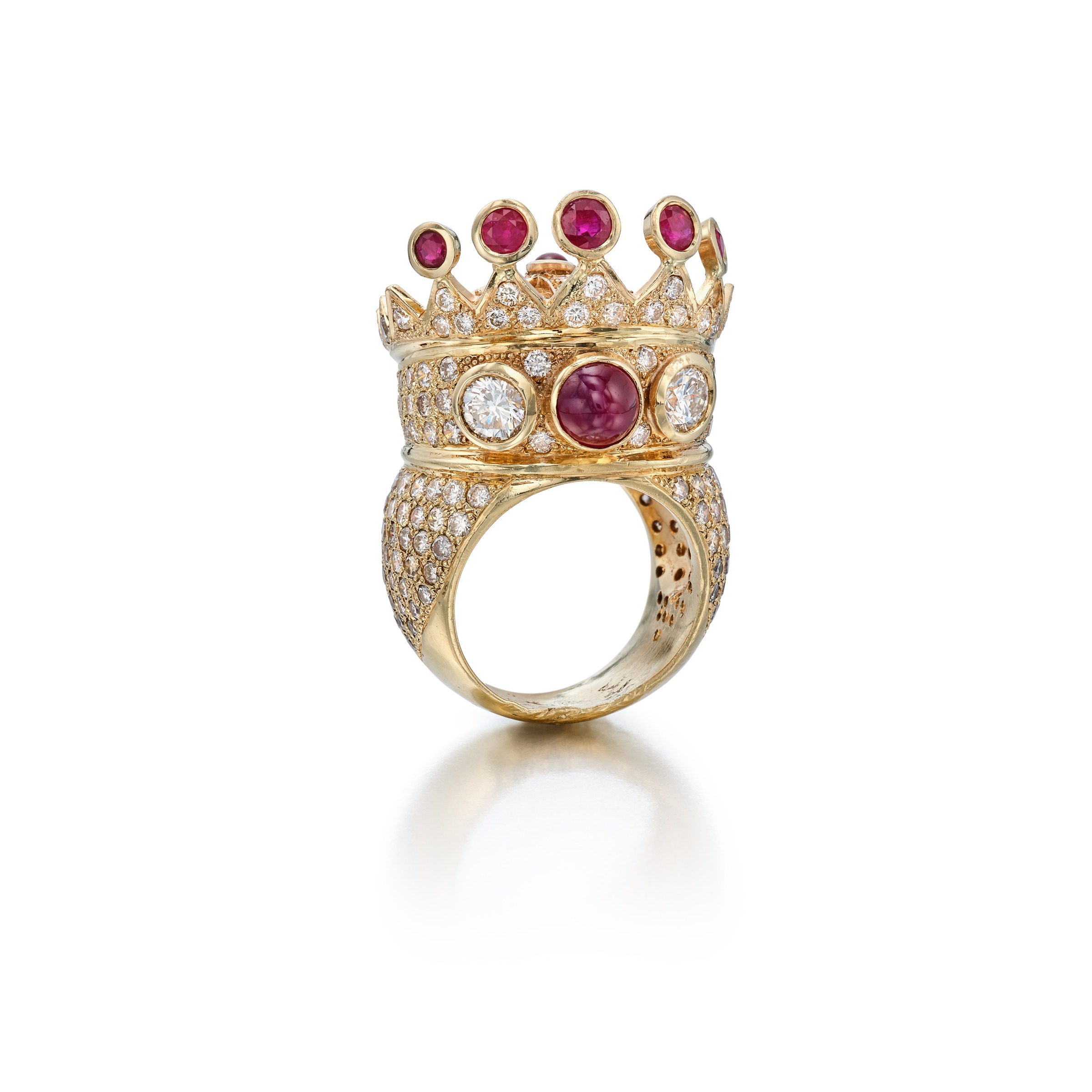
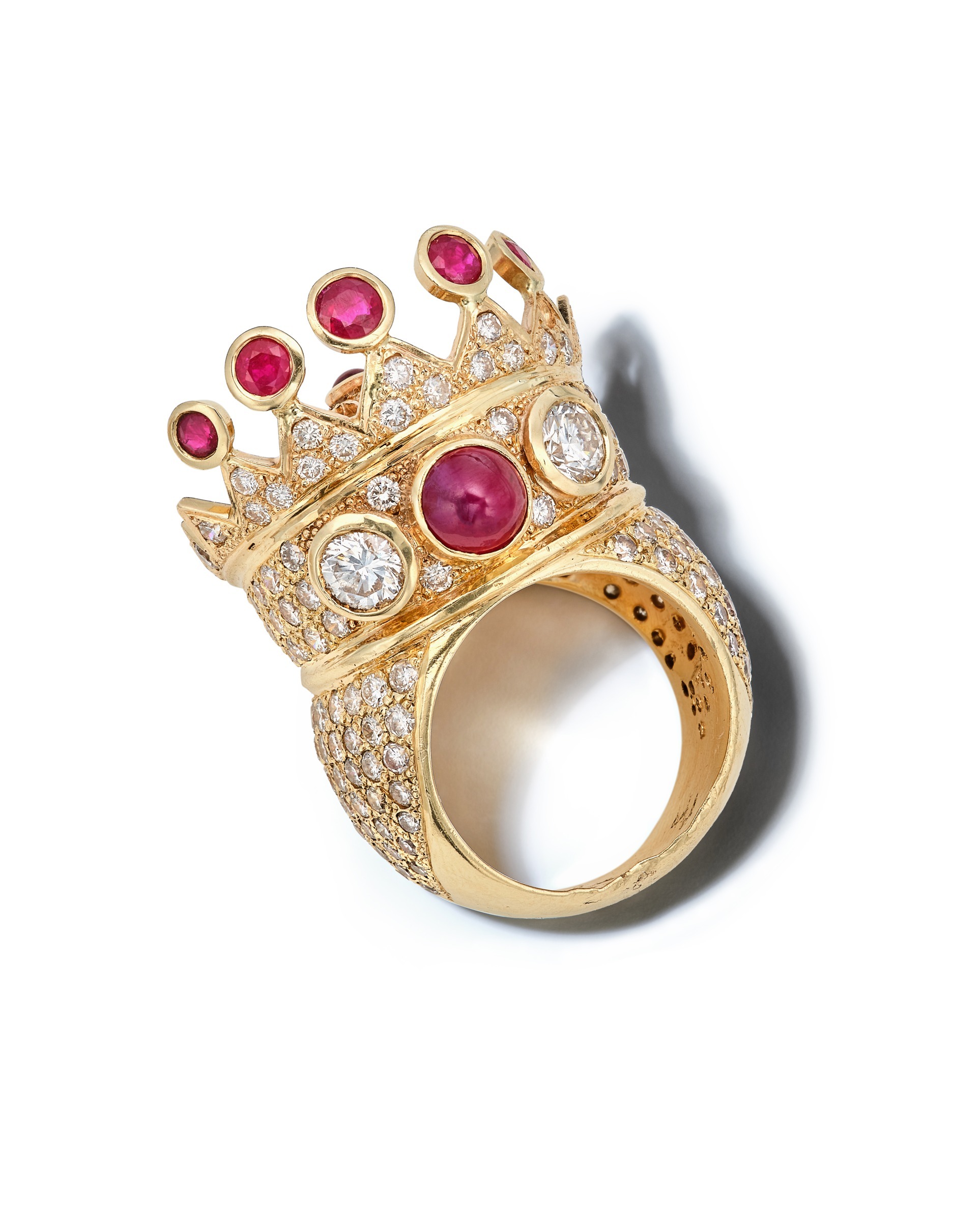
$1,016,000 — the reported sale total, buyer's premium and fees included. Tupac Shakur's gold, ruby and diamond crown ring, Sotheby's Hip Hop sale, New York, closed 25 July 2023. The sale was Sotheby's third dedicated Hip Hop auction, held for the 50th anniversary of hip hop.
Estimate going in: $200,000–$300,000. The result was more than three times the high estimate.
Sotheby's called it, at the time, the most valuable hip-hop artifact ever sold at auction and the only one to cross $1 million. That is a July 2023 claim in the house's own words.
The buyer did not stay anonymous. On 28 July 2023 Drake posted the ring on his Instagram Story, and Sotheby's confirmed he was the buyer.
The consignor was Yaasmyn Fula — Tupac's godmother, advisor and money manager, and the person who shepherded the ring into existence in the first place.
The exact object
Start with what it is, because Tupac designed it himself and the design is the argument.
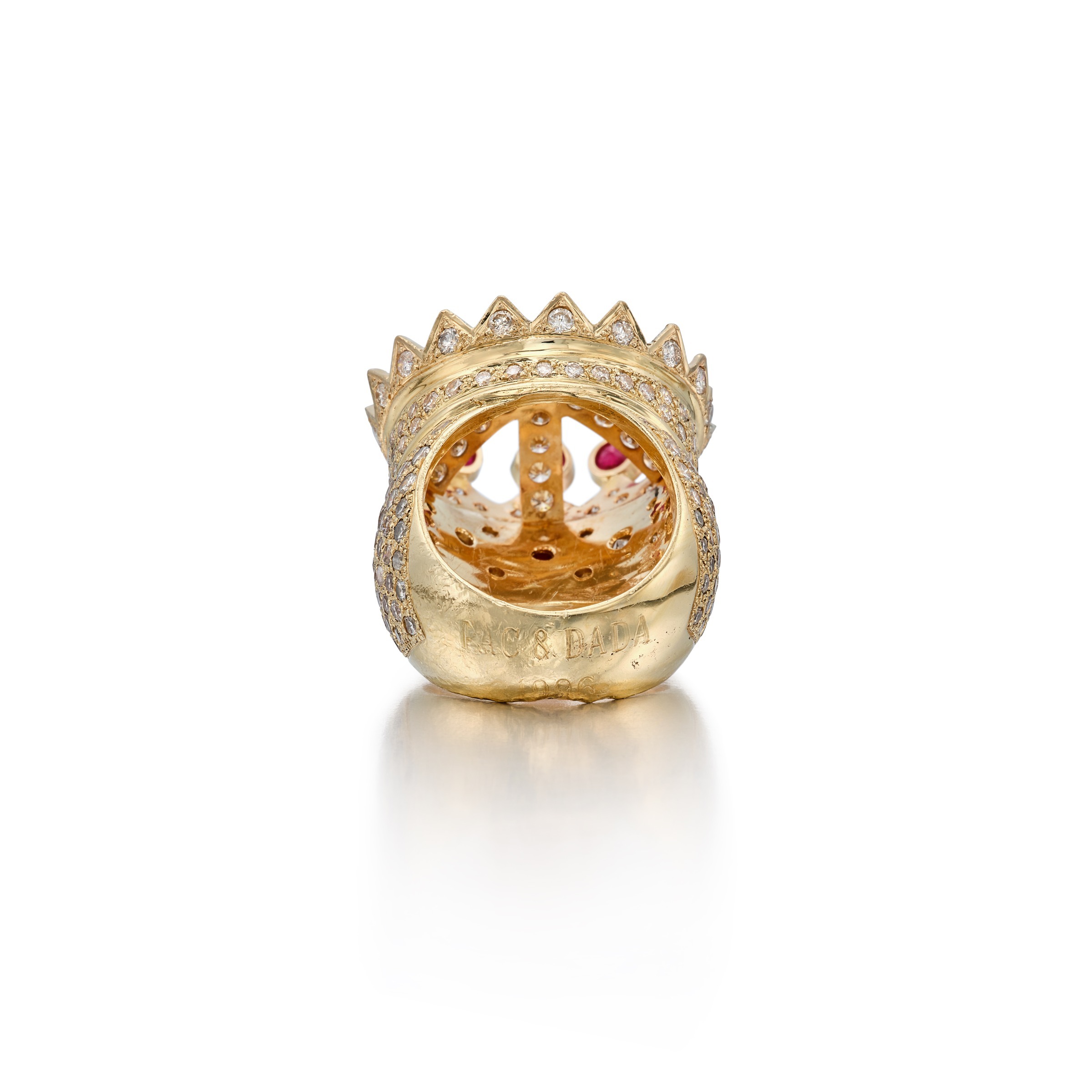
It is a 14-karat yellow gold ring, made in 1996. On top of a diamond-encrusted gold band sits a miniature crown: a gold circlet set with the three largest stones in the piece — a central cabochon ruby flanked by two pavé diamonds. Above the circlet rise 16 rays, or spikes, of descending height; the tallest five are each topped with a round cabochon ruby. Inside the circlet is a six-pronged arch, capped with a cabochon ruby ball — the structure of a European coronation crown, shrunk to fit a finger. Sotheby's catalogue puts the total at 10 carats of cabochon rubies and pavé diamonds across the piece.
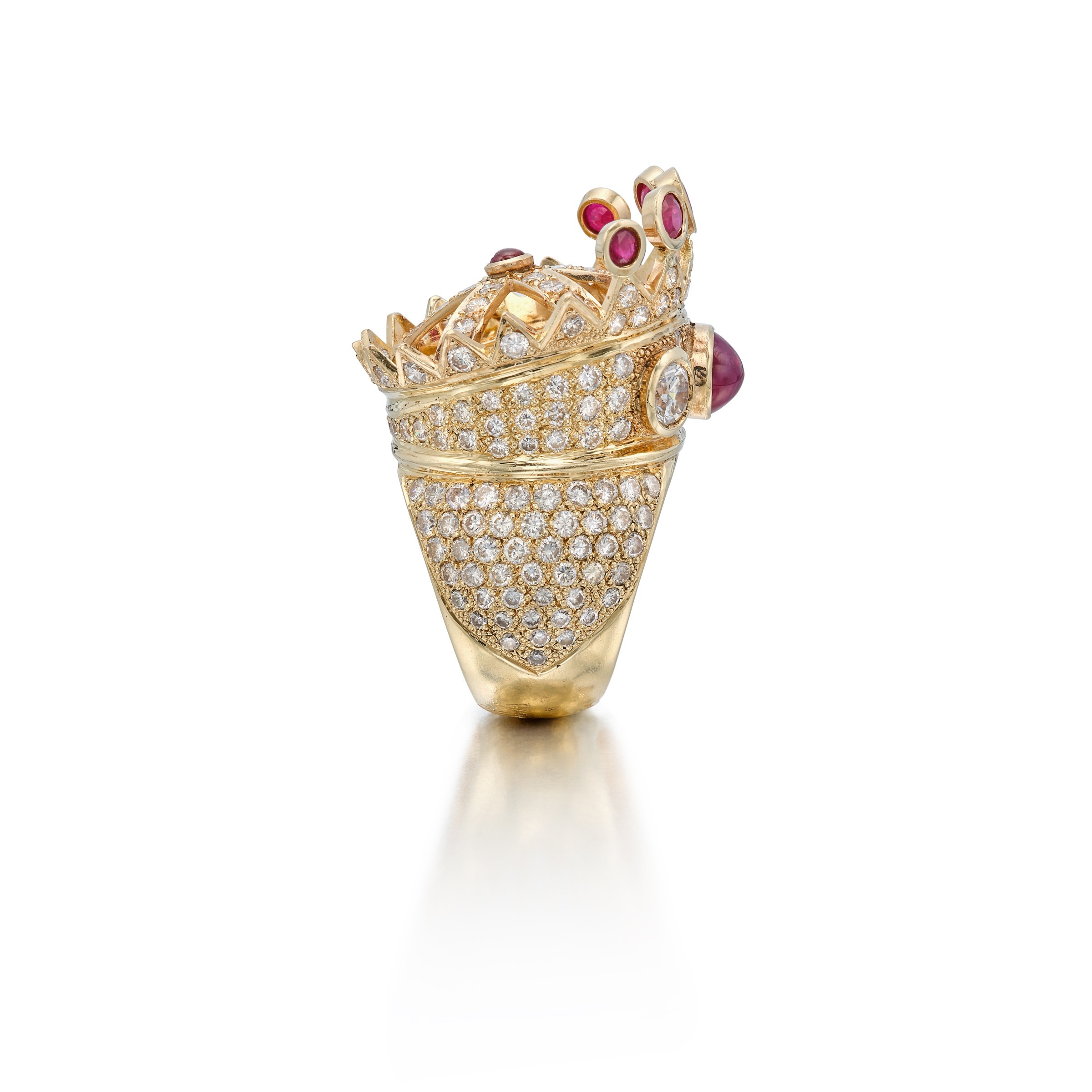
Engraved on the outside of the band, on the palm-facing side where engraving is not usually put, is the inscription: "Pac & Dada 1996." "Dada" is Kidada Jones, to whom Tupac was then engaged. Sotheby's notes that the inscription carries the heaviest wear on the whole ring — "Pac" itself is nearly rubbed back down to the gold. He wore this ring. It was not kept in a box.
He wore it at the MTV Video Music Awards at Radio City Music Hall on 4 September 1996 — his final public appearance, days before he was shot in Las Vegas.
Why a ring he designed brought this number
This is a culture story before it is a jewellery story, and the premium has to be told in that order.
He crowned himself, on purpose, at a turning point. In 1996 Tupac was out of prison, signed to Death Row, and building Euphanasia Incorporated — his planned media company and community organisation, the vehicle for moving past the "Thug Life" persona into an executive and community role. The son of Afeni Shakur, raised around the Black Panther movement, he had read Machiavelli's The Prince while incarcerated and taken "Makaveli" as a name.
Fula describes the ring, modelled on the crowns of medieval European kings, as "an act of self-coronation" — a celebration of surviving a tumultuous year, and a marker for the era he intended to start. Fula also remembers Afeni's mantra to her son: "You are our black prince. You are my miracle, and you will make black people proud." The crown was not a random flex. It was the family sentence, made wearable.
The design labour was his, and it was real work. Over the course of a few months in 1996, Tupac designed two pieces — the Euphanasia medallion and this ring — with Fula flying between him and jewellers in New York, carrying his designs and specifications and having the work tooled and re-tooled until, in Fula's words to Sotheby's, it was "a creation purely from his imagination… until perfect." That makes the ring a piece of his own design work, not merchandise with his name attached. Very little that Tupac designed with his own hand exists in any medium outside the music.
The custody is direct and unbroken in the telling. The ring came to Sotheby's from Fula herself — the woman who commissioned it with him, kept it, and could account for it. Sotheby's catalogue closes on the point: free-and-clear Tupac property with documented direct provenance rarely reaches the market in any category, and to the house's knowledge this was the only piece of his jewellery to come to market with direct provenance, and the only piece designed by him ever offered for sale. For a buyer, that is the difference between an object and an argument about an object. There was no argument here.
Fula put a condition on what it means to wear it. In Sotheby's interview film she says: "That ring is a powerful symbol; whoever wore that ring had to accept that they have a responsibility to have an impact on the world." And: "Tupac thought of himself and his creativity as a tool of expressing injustice and love." Whether or not a buyer signs up to that, it is part of the object's documented meaning — part of what was actually sold.
None of this is in the metal. Fourteen-karat gold, rubies and pavé diamonds are the medium. The million dollars is for authorship, custody, and a final public appearance that fixed the ring in the record nine days before his death.
The ordinary counterpart
What does a jeweller charge today to make you a heavy custom gold ring with rubies and diamonds in it? A specified, priced example:
- TraxNYC, New York — Custom 14K Gold Playing Card Ring: $7,400 (size 8 listing). Solid 14-karat gold, 33.2 grams — a lot of gold on one hand — set with 1.03 carats of round ruby and 0.93 carats of natural diamonds, made to order, ships in 10–15 business days.
Against that price, $1,016,000 is roughly 137 times the cost of commissioning a substantial custom 14-karat gold, ruby and diamond ring from a working New York jeweller today.
The TraxNYC ring is a different design, with a different (and smaller) total stone weight than the crown ring's catalogue figure, and no jeweller's quote can price a one-off crown built to a dead artist's own drawings — that object cannot be commissioned at any price, because the designer is gone. The comparison does one honest job: it shows how little of the $1,016,000 is explained by gold, stones and bench work, and how much is left over for history to explain. No intrinsic metal-and-stone value for Tupac's ring is given here. No such estimate was sourced.
What the price includes — and what it does not
Included in the $1,016,000:
- The crown ring itself, as catalogued by Sotheby's — 14-karat gold, cabochon rubies and pavé diamonds, with the "Pac & Dada 1996" inscription and its wear.
- The buyer's premium and fees — they are already inside the reported total.
Not included / not established:
- The Euphanasia medallion, designed alongside the ring, was not this lot, and the two were not sold as a set.
- No rights in Tupac's name, image or music travel with a piece of jewellery. The buyer bought an object, not an estate asset.
- Taxes, shipping and insurance after the sale are not in the reported total and are not stated in the sale reporting.
- The ring's current display status since Drake's 2023 purchase is not established. He showed it on Instagram in July 2023; nothing beyond that is established.
Sources · 4 sources
- Sotheby's — Hip Hop sale, New York, closed 25 July 2023: Tupac Shakur's gold, ruby and diamond crown ring, reported $1,016,000 including buyer's premium and fees, against a $200,000–$300,000 estimate; catalogue description and inscription as quoted in the article.
- Sotheby's — 'Expert Voices: Yaasmyn Fula & Cassandra Hatton on Tupac's Gold Crown Ring,' the house's film and article for the lot: design history, Fula's custody account, the self-coronation account.
- Sale reporting, July 2023 (including The Art Newspaper, 28 July 2023): Drake revealed as buyer via his Instagram Story of 28 July 2023; Sotheby's confirmed; most valuable hip-hop artifact claim dated to the sale.
- TraxNYC, New York — Custom 14K Gold Playing Card Ring listing, $7,400 (size 8): the specified jeweller counterpart used in the comparison.