
The moon rose over Tórshavn on Friday with a new album named for it. Eivør, the Faroese singer whose voice has carried her from a North Atlantic archipelago of some 54,000 people to festival main stages and video game soundtracks, released Tungl on October 16 through Nuclear Blast Records. The title is the Faroese word for the moon, and the record behaves like its namesake: ten tracks that wax and wane between tenderness and force, pulling old Faroese musical traditions into contact with electronics, strings and a full touring band recorded the old-fashioned way, together in a room.
The release is a milestone in a career that has been building for more than two decades. Tungl is Eivør's first album for Nuclear Blast, the German powerhouse better known for heavy metal than for Nordic folk, and the signing tells its own story about where her audience now lives. Listeners arrived through her soundtrack work on the television series The Last Kingdom and the games God of War and God of War Ragnarök, through the throat-chanted live staple “Trøllabundin,” and through eleven solo albums that have moved across folk, jazz, pop noir, rock and electronica. She has been named Faroese artist of the year at home and received the Nordic Council Music Prize, and none of that quite files her into a genre. Tungl does not try to settle the question. It leans into the strangeness.
A Song for a Sad Moon
The album opens with its release-day video, “Og Mánin Græt / And The Moon Cried,” a track rooted in the centuries-old Faroese chain dance and rebuilt on throbbing electronic architecture. Eivør has described the song as a childhood memory that never left: looking up at the moon as a small girl and wondering why it always looked so sad, her imagination inventing reasons. Speaking about the track, Eivør called it “a faint memory that still lingers, almost like a dream.” The video, directed by Gwenaël Akira, answers that memory with raw nature and a distorted, dreamlike reality, and it sets the visual grammar for the whole record: weather, water, stone and a solitary figure moving through all three.
From there the tracklist travels. “Drekafljóð / Dragon Maiden” and “Verjugarðar / Walls” pair Faroese lyric writing with pulsing synth low end. “Spøkilsir / Revenants” layers beats and disembodied backing vocals over twanging guitar. “Healer,” one of three songs sung in English, builds slowly from doubt into something closer to reclamation, and its companion piece “Eon” opens from bare piano into a full string arrangement. The album's most intimate moment may be “Fangað / Trapped,” featuring her sister Elinborg, which folds throat-singing technique into an almost clubby intensity before the closing “Everyone But Me” lands the record in acceptance. Eivør made the album closely with producer and composer Tróndur Bogason, who contributed arrangements including the strings, and she brought her road band further into the recording than on her previous album, 2024's Enn, wanting the lived-in energy of musicians who had spent years on stage together.
Elemental, by Design
Nuclear Blast presents Tungl as her furthest step into elemental territory: immersive and time-stretched, a record about navigation when the familiar markers give way. Eivør frames it as a cycle record, songs moving between tenderness and heartache, love and loss, with the moon as a guide through darker passages toward resilience and change. That framing fits an artist whose work has always treated the Faroese landscape as an instrument. The wind and sea are not metaphors in her music so much as personnel, and the new songs use them the same way, whether the arrangement is a hide drum and a chant or a synthesizer pulse aimed at a festival field.
The physical release matches the ambition. Tungl is available on CD in jewelcase and artist-exclusive digipack editions, and on gatefold vinyl in crystal clear, white-and-black marbled, and a transparent-and-black marbled edition that adds a bonus 7-inch. It is the kind of format spread usually reserved for metal flagships, which, on Nuclear Blast's roster, is increasingly what she is.
Three Special Nights, Then the World
The album gets a homecoming launch. Eivør plays two consecutive release concerts at the Nordic House in Tórshavn on October 16 and 17, in the islands where the songs began, then travels to Reykjavík on October 23 for a one-off performance in Harpa's Eldborg Hall, one of the Nordic region's most celebrated concert rooms, with special guest musicians joining her. These are billed as intimate presentations of the new material before the machinery of a world tour takes over, and for an artist whose shows depend so heavily on atmosphere, the rooms matter: a cultural house in Tórshavn and a glass harp of a concert hall on Reykjavík's harbour are about as close to the album's weather as architecture gets.
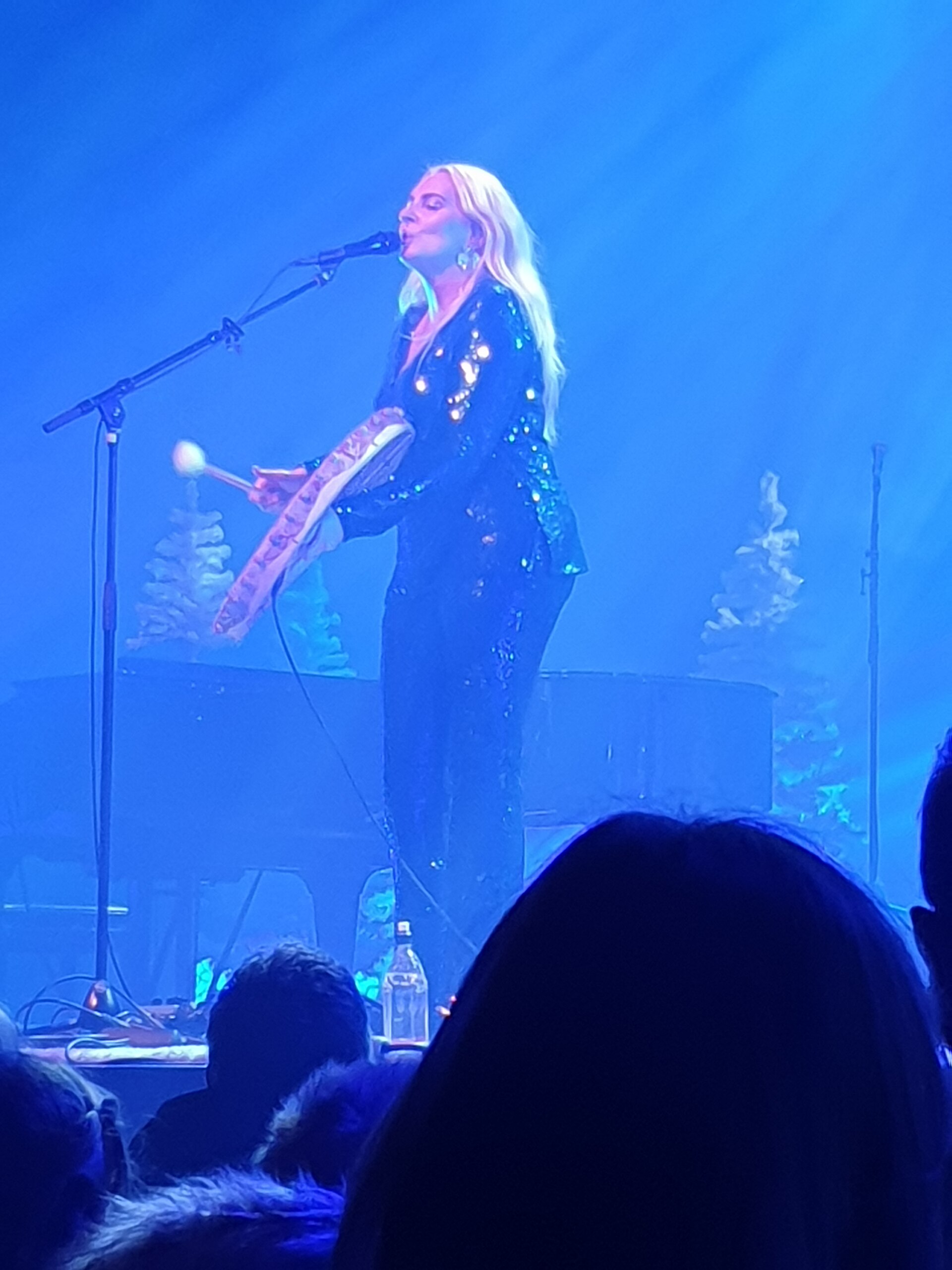
She arrives at release week already road-tested. Her summer run crossed Europe's festival circuit with headline dates woven between festival slots, including Switzerland's Paléo Festival, Czechia's Brutal Assault and Germany's Summer Breeze, with the UK's ArcTanGent and Spain's Sun and Thunder still on the closing stretch of the season. That itinerary, folk-rooted music holding its own on metal festival bills, has become the clearest proof of her crossover: the same set that works in a concert hall works in a field in Jaroměř.
The road then gets much longer. A North American headline tour opens October 28 at Racket in New York and runs through Washington, Montreal, Boston, Chicago and Minneapolis before crossing to Denver, Salt Lake City, Boise, Seattle, Vancouver and Portland, closing on the West Coast with San Francisco on November 20, Los Angeles' Teragram Ballroom on November 21 and San Diego on November 22. Europe and the UK follow in early 2027, from Copenhagen's Store Vega on February 24 through Paris at the Olympia and London's O2 Forum Kentish Town in March, then on through Germany, Switzerland, Italy, Austria, Czechia, Poland, Lithuania, Finland and Sweden. It is a routing that treats her as what the new label clearly believes she is: a headline act on two continents.
For listeners meeting her for the first time, Tungl is a deliberate front door: mostly Faroese, unapologetically atmospheric, and confident enough to let a song about a sad moon open the record. For the audience that found her through a Viking drama or a PlayStation epic, it is the fullest statement yet of the sound they only heard in fragments. Either way, the moon is up. Our wider New Music Friday coverage rounds up the rest of this week's releases, and there is more long-form music storytelling across the Previously news desk and our podcast library.
Sources · 3 sources
- Nuclear Blast Records · nuclearblast.com
- ChaosZine · chaoszine.net
- Kerrang! · kerrang.com