
LOS ANGELES
Ahead of a looming El Niño storm season, Los Angeles County Assessor Jeff Prang's office is renewing its storm-damage tax relief push on a tool many property owners only learn about after disaster has already done its damage: Misfortune & Calamity reassessment — the program that also gives Altadena owners a longer, 24-month filing window, the county process that lowers a property's taxable value when a storm, fire, flood or other calamity cuts its market value — until repairs are complete. The county issued its latest guidance in a news release on October 14, with further guidance reported by Pasadena Now on October 15 and syndicated coverage following on October 20.
The rule itself is simple to state and specific in its threshold. Under Revenue and Taxation Code Section 170, and a State Board of Equalization rule, an owner qualifies when property damage reduces the property's current market value by at least $10,000, as determined by a county appraiser. This is not a self-estimate or a contractor's bid; the $10,000 figure is a loss in market value, and the county's own appraiser makes the determination.
What relief actually means, in dollars, is also specific. A successful claim lowers the property's taxable value until repairs are complete, and it carries refunds of taxes already paid on the higher value. In the most severe case, a destroyed building can receive a full reduction of its improvement value — the value of the structure itself — while the land remains taxable. That last point surprises many owners: reassessment can zero out the building, but it does not erase the land underneath it from the tax roll.
Filing runs through one form: Form ADS-820, the Application for Reassessment of Property Damaged or Destroyed by Misfortune or Calamity. The deadline is within 12 months of the date of the damage, and the Assessor's office accepts online filing. Owners with questions can reach the Misfortune & Calamity Unit directly at (213) 974-8658 or relief@assessor.lacounty.gov. For a county office, that is an unusually direct door — a named unit, a phone number and an email address published in the guidance itself.
Two practical warnings in the Assessor's fact sheet deserve emphasis, because both run against instinct. First, owners must still pay the annual tax bill while a claim is being processed; filing a claim does not pause the bill, and skipping payment while waiting is not part of the program. Second, restoration has a tax consequence of its own: when repairs are complete, the restored value returns, and owners receive a supplemental bill as of the repair date. Relief is a bridge across the repair period, not a permanent reduction.
The program is also broader than the single-family home that dominates most disaster coverage. At the same $10,000 market-value-loss threshold, qualifying property can include commercial buildings, business equipment and fixtures, agricultural groves, aircraft, boats and certain manufactured homes. The exclusions matter too: household furnishings do not qualify, and neither do manufactured homes that are not taxed as property. A business owner whose equipment was destroyed, or a grove owner whose trees were lost, may have a claim that a homeowner-focused news segment would never mention.
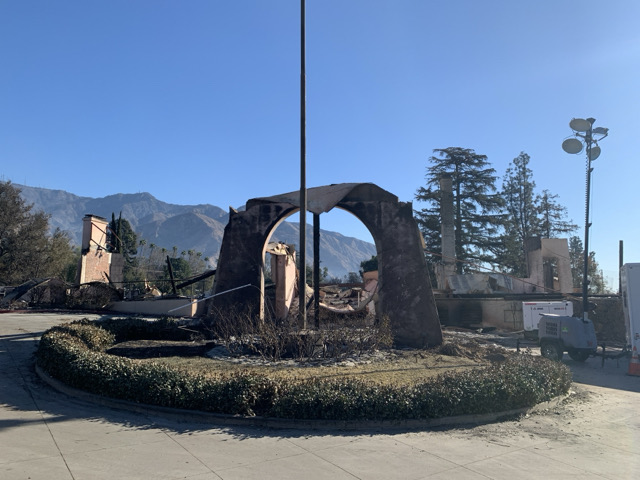
One community carries a significant exception, written into state law. Senate Bill 663, enacted in 2025, gives qualifying Altadena owners affected by the Eaton Fire 24 months from the damage date to file — double the standard window. Altadena is where the fire-year toll was concentrated, and the longer deadline acknowledges a reality anyone who has driven through the burn area understands: for owners still displaced, still fighting insurance claims and still deciding whether to rebuild, twelve months was never a realistic clock. Our earlier coverage of coastal recovery pressure in Malibu, where a landmark restaurant is contending with beach erosion, shows the same pattern from the other side of the county — recovery timelines do not respect administrative ones.
The scale of what Prang's office has already handled explains why it is promoting this program before the storms, not after. In the fire year, according to the Assessor's Office reporting, the office wrote more than $9 billion in taxable value off the rolls for owners whose homes burned in Altadena and Pacific Palisades, and processed 18,000 assessment adjustments in the first 90 days alone. The 2026 assessment roll, even after those write-downs, closed at a record $2.272 trillion. Those numbers describe an office that has run this process at disaster scale — and learned, presumably, how much harder it is when owners file late, file wrong, or never learn the program exists.
That lesson shapes the office's stated approach going forward. Prang's office says it will work to proactively identify eligible properties after disasters rather than waiting for owners to apply — a meaningful shift, because the owners most likely to miss a 12-month deadline are the ones with the most damage and the least capacity to chase paperwork. Proactive identification does not remove the need to file Form ADS-820, but it changes who carries the burden of noticing.
The Assessor's guidance arrives alongside two related tools worth knowing in the same breath. Proposition 19 allows eligible wildfire victims to transfer their base-year property tax value to a replacement home — a separate benefit from calamity reassessment, and for some displaced owners the more valuable one. And the office's free Homeowner Alert service emails owners within 48 hours of a document being recorded against their property, an early-warning system against deed fraud that costs nothing to join. Neither tool requires damage to use; both are the kind of thing that is only useful if you signed up or filed before you needed it.
Finally, a warning officials issued this month, because disaster season is also scam season. A fake "Form 1098-SR" property-tax-freeze offer has been circulating online, dressed up as a federal program. It is not one. In Prang's words: "No legitimate property tax program requires you to file a mysterious federal form you learned about through social media." The real program has a real form — ADS-820 — a real unit, a real phone number, and no presence in anyone's social media feed promising a freeze.
For county health and recovery context, see also our reporting on Clark County's first clade I mpox case — a different county and a different kind of emergency, but the same lesson about acting on official guidance early rather than late. For Los Angeles County owners, the actionable version of this story fits in one paragraph: if a storm this season does $10,000 or more in market-value damage to your property, photograph everything, keep every repair record, file Form ADS-820 within 12 months — 24 if you are a qualifying Altadena owner under SB 663 — keep paying your tax bill while the claim processes, and expect the value, and a supplemental bill, to return when the repairs are done. The relief is real, it is refund-bearing, and it expires. That combination is exactly why the Assessor is talking about it in October, before the rain, instead of in the wreckage afterward.
Sources · 4 sources
- Los Angeles County Assessor's Office news release and Misfortune & Calamity fact sheet, Oct. 14, 2026
- Pasadena Now guidance, Oct. 15, 2026
- The Cool Down via MSN, Oct. 20, 2026
- Altadena Now