From €3,500 per person in a Deluxe Cabin / €4,700 per person in a Suite — one-night itinerary, original 2025 programme, priced on double occupancy. Operator's reservations announcement, June 2024, for the programme that launched in spring 2025 — historical programme starting prices.
Per person is the story. The cabin is sold by the share, not by the room. Two travellers at the Deluxe starting rate pay €3,500 × 2 = €7,000 for the night; at the Suite starting rate, €4,700 × 2 = €9,400 — before anything the fare excludes (see Includes / Excludes). A single traveller does not get the cabin for €3,500 either; single supplements apply on top of the per-person rate.
What 2026 / 2027 actually shows. The operator publishes no price list; every itinerary is quoted inside its booking engine by date and cabin. The signals on the record:
A 2026 route-and-price compilation drawn from the operator's own site, covering departures up to December 2027, still lists Rome → Venice and Venice → Rome, 2 days / 1 night, from €3,500 per person — the 2025 starting point surviving as the one-night floor on that route. The same compilation lists other one-night and longer itineraries both below and above it (Tastes of Tuscan Vineyards, 2 days / 1 night round trip from Rome, from €3,060; Rome → Portofino → Venice, 2 days / 1 night, from €4,160), which is what dynamic pricing looks like: the floor moves by route and date.
A November 2026 comparison of the two Orient Express trains, working from agent quotes for 2027 dates, puts one-night Rome ↔ Venice Deluxe journeys at roughly €3,500–€4,160 per person — consistent with the range above, and explicitly a quote range, not a list.
The ceiling moved, too: the train's first international route, Rome → Istanbul (inaugural departure 22 October 2026, five days), is priced from €20,000 per person on the operator's pages as reported in 2026 coverage.
So the honest current sentence is: one-night Italian itineraries in a Deluxe Cabin still start around €3,060–€3,500 per person for 2026 / 2027 departures, quoted per date in the booking engine. Anything tighter than that would need a dated booking-engine quote for a named departure.
None of these fares is one a reader can transact at by reading it. Every figure carries its date and its basis — the operator publishes no price list, and every itinerary is quoted per date inside its booking engine.
The exact object
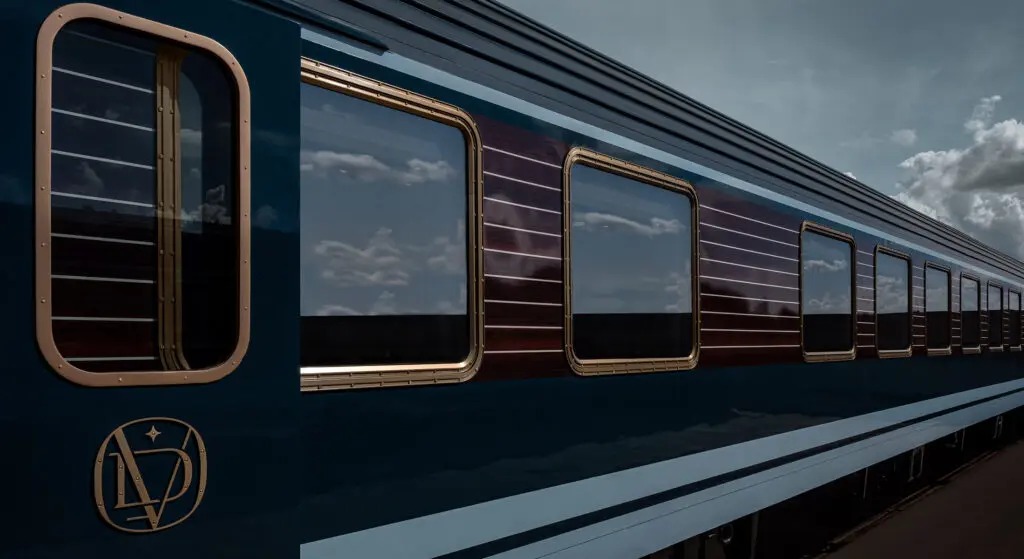
La Dolce Vita Orient Express is a new train wearing a famous name — not a restored 1920s rake. It is operated under Accor's Orient Express brand in partnership with Italian hospitality group Arsenale S.p.A., with FS / Treni Turistici Italiani support, and it entered service on 4 April 2025, when the maiden voyage left Rome Ostiense — where the train has its own departure lounge — for Montalcino on the Tastes of Tuscan Vineyards itinerary.
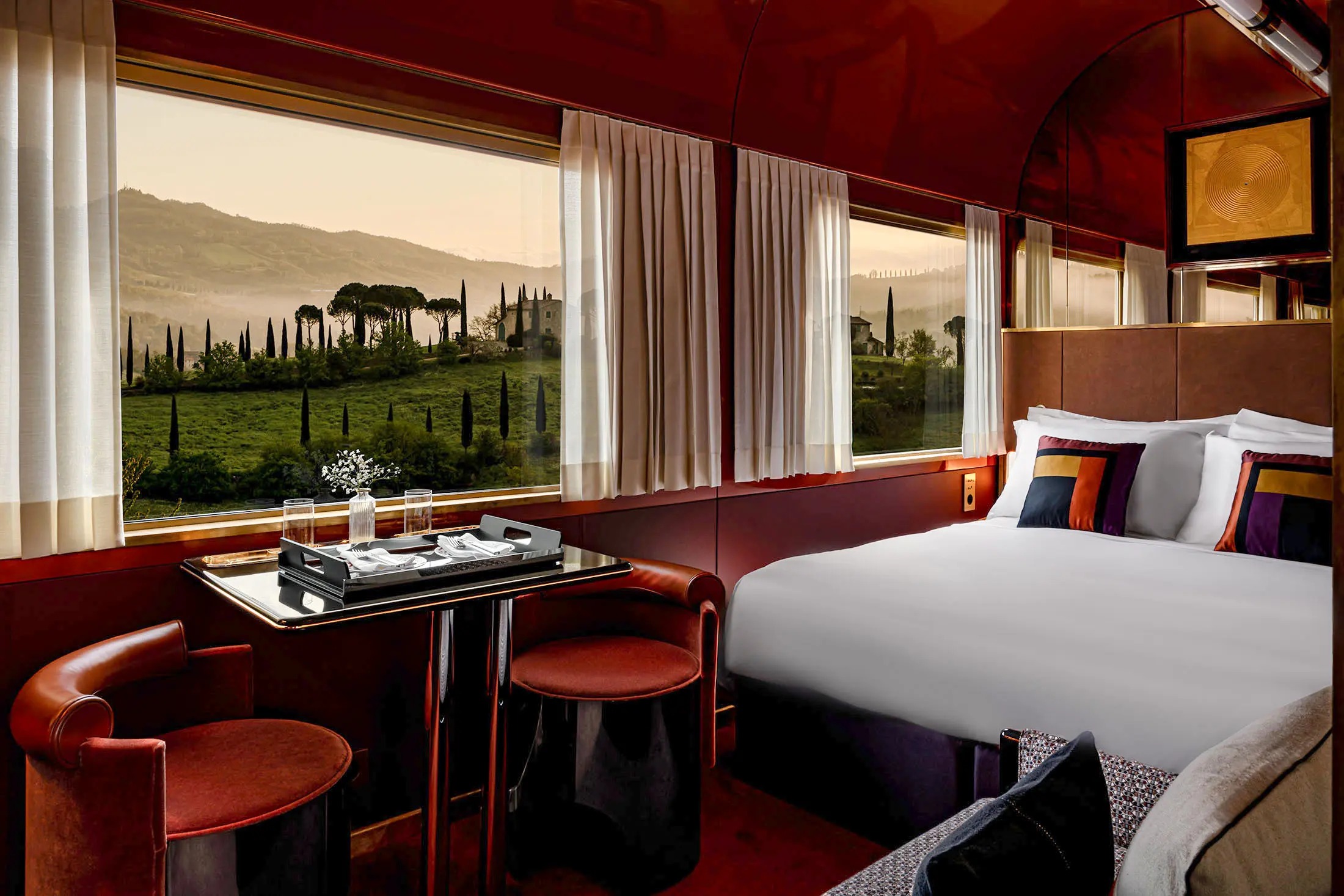
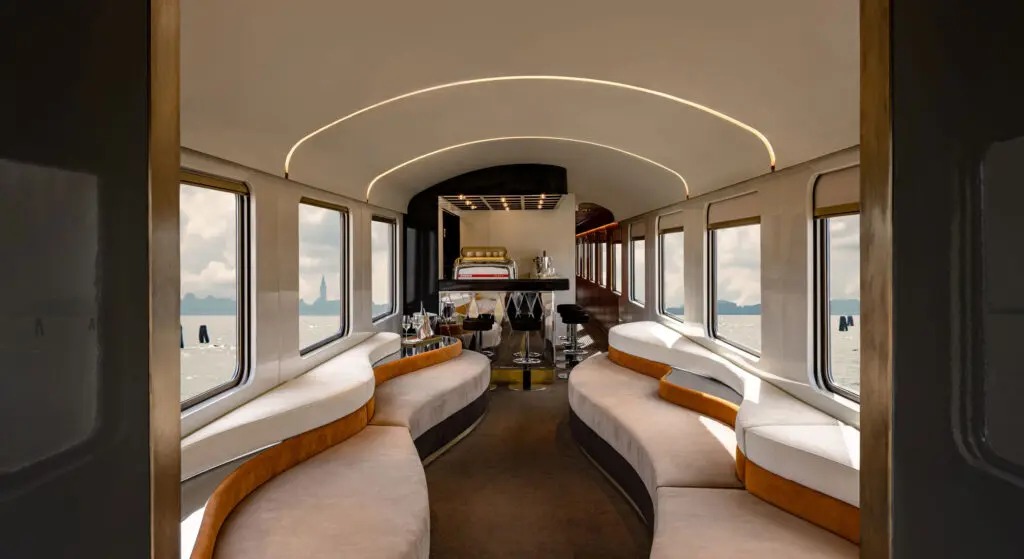
The train is built from 12 carriages (refurbished Z1 cars, restored in Brindisi and Palermo workshops) carrying a maximum of 62 passengers in 31 cabins: 12 Deluxe Cabins, 18 Suites and one La Dolce Vita Suite, every cabin with its own bathroom. There is a restaurant car, a bar car and a lounge.
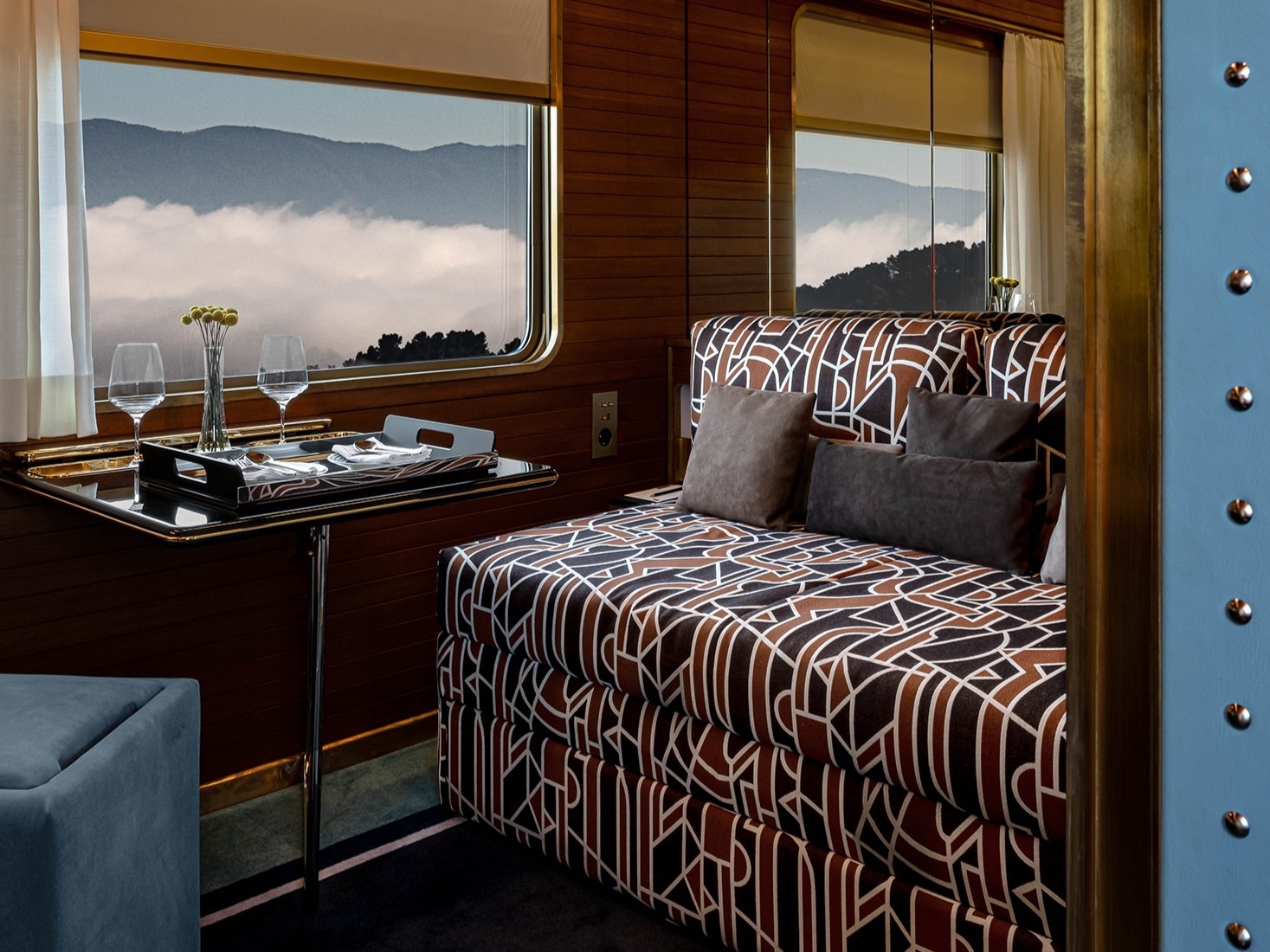
The interiors are the design story: Milan's Dimorestudio (Emiliano Salci and Britt Moran) dressed the train in 1960s–70s Italian design — geometric pattern, lacquer, brass, references to Gio Ponti, Gae Aulenti and their contemporaries. This is mid-century Italy, not Jazz Age Paris — a different train from the Venice Simplon-Orient-Express, and it looks like one.
The dining is the other signature: menus overseen by Heinz Beck, the three-Michelin-star chef of Rome's La Pergola, built around the regions the train is crossing. Routes run from Rome across 14 Italian regions and 131 cities in the operator's network description — Venice, Portofino, Siena and Montalcino in Tuscany, Matera, Sicily — on itineraries of one to three nights, plus the once-a-year Rome → Istanbul run added in October 2026.
The premium, explained concretely
What the fare is actually buying, piece by piece: a private en-suite cabin that is also a hotel room, moving; a restaurant car running a three-Michelin-star chef's regional menus, with the meals inside the fare; a programme of off-train excursions — winery visits in Montalcino, Siena on foot, the Sassi of Matera — that are the itinerary rather than an add-on; and a staff-to-guest ratio built on a hard cap of 62 passengers per departure.
The scarcity is structural. Thirty-one cabins per departure, a limited seasonal calendar, one trainset per route pattern. There is no yield-managed way to add a thirty-second cabin; when a date sells out, the price of the next date is the price.
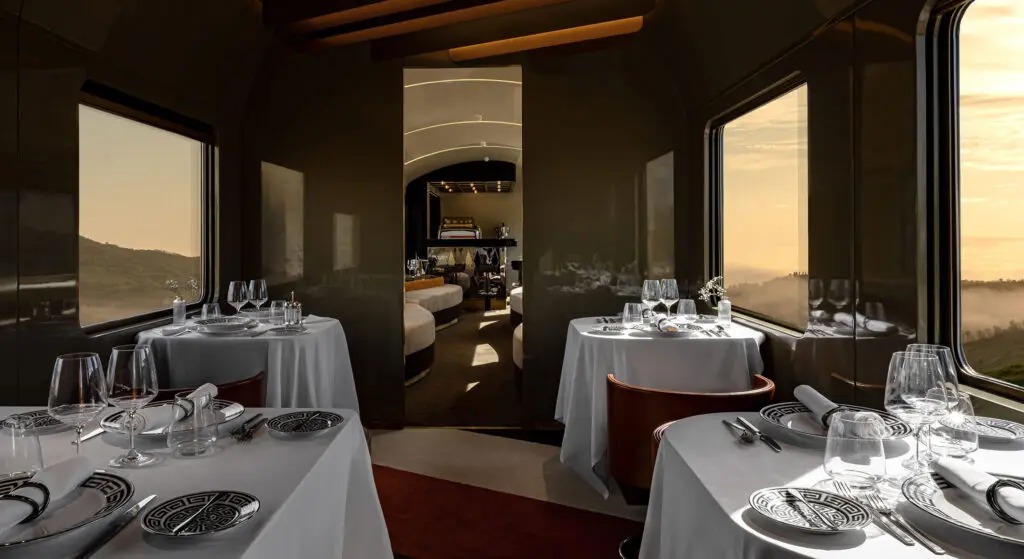
The design and the name. Dimorestudio's interiors and the Orient Express name carry real cost and real licensing weight, and the story says so plainly rather than pretending the fare is all food and track access. Part of €3,500 is a ticket; part of it is a night inside a designed object that happens to move.
What the premium does not buy: speed. Rome to Venice on this train is an overnight journey with a day in Siena built in. The fast train does it in under four hours (see the counterpart). Anyone buying this fare to get to Venice has misunderstood the product — the night is the product.
The ordinary counterpart
The same journey, done ordinarily — and priced as the explicitly different experience it is.
Leg 1 — the train: Trenitalia's Frecciarossa, Roma Termini → Venezia Santa Lucia, direct high-speed, about 3 hours 45 minutes. Frecciarossa Business class — 2+1 seating, welcome service at seat — is typically €55–€120 per person one-way on this route depending on booking timing and flexibility (fare guide compiled from Trenitalia's classes, checked November 2026; Frecciarossa fares are dynamic). For two: €110–€240.
Leg 2 — the night: one night in Venice for two at a named hotel — The Gritti Palace, a Luxury Collection Hotel, Venice, at a typical €1,180 per night (Tripplo's Venice luxury price index, daily-checked, for two adults, November 2026). This is deliberately a grand hotel, not a budget room: the counterpart keeps the trip comfortable and prices the difference honestly.
The arithmetic, for two people:
- Frecciarossa Business for two: €110–€240
- One night, Gritti Palace: €1,180
- Ordinary total: €1,290–€1,420
- La Dolce Vita, Deluxe, two people at the €3,500 starting rate: €7,000
- €7,000 ÷ €1,420 ≈ 4.9; €7,000 ÷ €1,290 ≈ 5.4. The sleeper costs roughly five times the fast-train-plus-grand-hotel version of the same two days.
The differences are the point. The Frecciarossa leaves you in Venice the same afternoon with your evening free; the Gritti night is stationary, in Venice, not rolling through Tuscany. Neither leg includes a Beck-menu dinner, a Siena excursion day, or breakfast in a cabin — the ordinary traveller buys meals separately, and this comparison does not price them, which slightly understates the ordinary total. It also slightly overstates the gap in the other direction: the La Dolce Vita fare includes its meals and excursions (next section). Both effects are stated; the ~5× scale survives either way.
What the price includes — and what it does not
Included in the La Dolce Vita fare (operator / operator-derived listings):
- The cabin — Deluxe or Suite as booked — for the itinerary, with dedicated steward / butler service.
- Table d'hôte meals on board: innovative Italian cuisine under Heinz Beck, including breakfast and afternoon tea served in cabins.
- Selected beverages on board (wines and drinks within the operator's selection).
- Tailored off-train excursions per the itinerary, including meals and offered drinks during excursions — private winery tours, guided Siena / Matera visits on the relevant routes.
- Transfer to the departure station (listed in operator booking summaries; on the Venice → Rome itinerary, the water-taxi / transfer sequence from Venice is part of the described service).
- Live evening entertainment in the bar car.
Excluded / not included:
- Premium wines, rare spirits and à la carte items outside the selected offer — operator summaries list these on the excluded side; the top shelf is extra.
- Optional off-board experiences beyond the included excursion programme on some itineraries. Agent guidance is not perfectly consistent with the operator-derived included list here — excursions are the itinerary on this train, but specific premium experiences can be priced separately. The exact included and excluded excursion list is set per itinerary.
- Travel to Rome / from the arrival city, and any pre- or post-journey hotels. The fare starts at the departure lounge, not at the reader's front door.
- Personal travel insurance and gratuities.
- The cabin for one: the per-person rates assume double occupancy; single supplements are additional and not quantified in the sources checked.
Money terms worth one line: operator booking summaries describe a 15% deposit for bookings made more than 60 days out, with cancellation penalties stepping from 15% to 100% inside 30 days. The operator's current terms govern — terms move.
Sources · 6 sources
- Orient Express — operator reservations announcement, June 2024: one-night journeys from €3,500 per person Deluxe / €4,700 per person Suite, double occupancy (original programme)
- Adventure Chest — 'Orient Express Prices and Routes 2026,' compiled from the operator's own site, departures to December 2027: Rome↔Venice from €3,500, Tastes of Tuscan Vineyards from €3,060, Rome→Istanbul from €20,000, all per person
- Alpina Travels, November 2026 — 2027 one-night Rome↔Venice Deluxe quoted roughly €3,500–€4,160 per person; the operator publishes no price list
- Arsenale Group — La Dolce Vita press kit: 12 cars, 62 passengers, cabin counts, Dimorestudio, Heinz Beck; Jet & Travel — 4 April 2025 maiden voyage from Rome Ostiense
- Luxury Train Club / Luxury Train Tickets — included-in-fare lists (table d'hôte meals, selected beverages, tailored excursions, steward service, transfers)
- RomeVenice.com — Frecciarossa Rome–Venice Business typically €55–€120 (counterpart leg 1); Tripplo Venice luxury index — The Gritti Palace typical €1,180/night (counterpart leg 2)