
The short version: The gates are open in Raleigh. The 158th North Carolina State Fair began Thursday, October 15 and runs through October 25 at the State Fairgrounds — 344 acres off Trinity Road that draw around a million visitors across eleven days. This year's edition arrives with something fairs do not usually offer: genuinely new buildings, including a 32,000-square-foot food hall that Agriculture Commissioner Steve Troxler will formally open with a ribbon-cutting on Friday at 11 a.m.
A fair that predates the car, the plane and the light bulb's best years
Some context for the number 158. The fair was founded in 1853 by the North Carolina State Agricultural Society and is run today by the state Department of Agriculture and Consumer Services. It has survived, with interruptions, through a civil war, two world wars and a pandemic cancellation, and it remains one of the largest and oldest state fairs in the country — 998,926 people attended in 2024, and a typical year brushes a million. The grounds themselves are part of the exhibit: the fair moved to its current Raleigh location in the late 1920s, the fairgrounds' Commercial and Education Buildings date to 1928 and sit on the National Register of Historic Places, and the site approaches its 100th anniversary in 2028. Fair director Kent Yelverton has framed the current construction wave as preparation for exactly that milestone — a working fairgrounds being readied for its second century rather than merely repainted for its next eleven days.
What's new: a food hall, a flower house, and air conditioning
Three projects headline the changes visitors will notice. The new food hall — a 32,000-square-foot, year-round food and meeting facility built north of Dorton Arena — houses five fair-time food vendors this year and, as the Midway Event Center, will host the fair's opening ceremony; unlike most fair buildings, it stays alive the other 354 days of the year. The Flower Show has moved out of the temporary tent it used in 2025 into a newly rebuilt, log-covered building of its own. And the historic Holshouser Building received the renovation its occupants have presumably requested for decades: a new roof and, at last, air conditioning. The Holshouser houses the Village of Yesteryear, the heritage-crafts enclave celebrating its 75th anniversary at this year's fair — which means the artisans demonstrating century-old skills will do so, for the first time, in cooled air. Progress is not always the enemy of tradition; sometimes it is just ventilation.
The midway math: 230 feet up, 80 foods deep
On the carnival side, the skyline has changed too. A Ferris wheel towering 230 feet above Raleigh anchors this year's ride lineup alongside brand-new thrill rides, and the food count — the statistic fair people actually compete on — includes more than 80 new items, in the long and honorable tradition of seeing what can be fried, wrapped, dusted or served on a stick. Around the spectacle sits the fair's older and quieter core, unchanged in purpose since 1853: livestock and agricultural competitions, thousands of animals, garden and craft judging, and demonstrations that connect the state's largest annual party back to the farm economy it was created to promote. That double identity — part midway, part agricultural exposition — is precisely what distinguishes a state fair from a traveling carnival, and Raleigh's has always leaned into both halves at full size.
Dorton Arena and the architecture of a midway
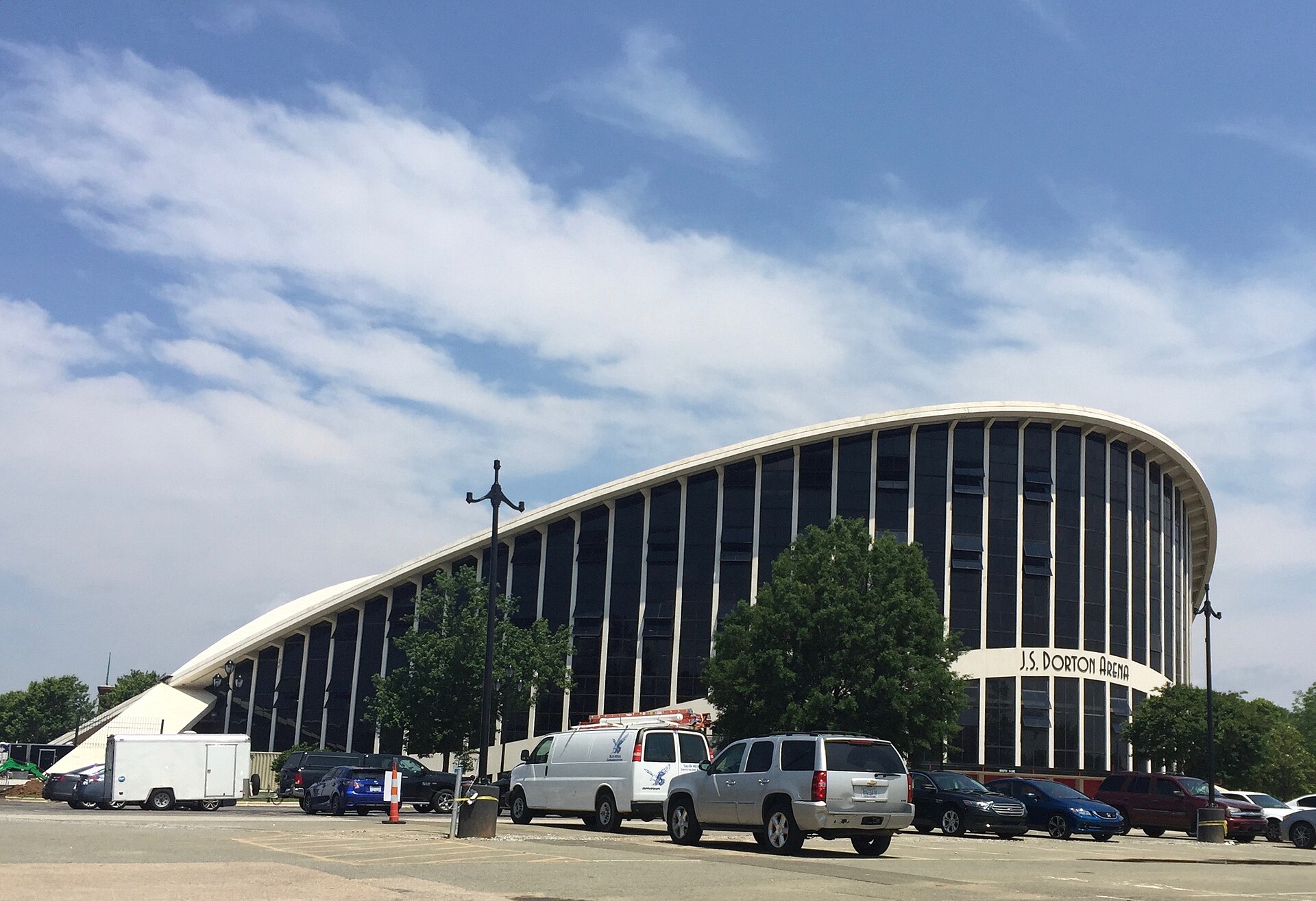
Regulars navigate the fair by its landmarks, and the grounds have accumulated them across a century. Dorton Arena, the saddle-shaped arena that has hosted everything from livestock shows to concerts since the early 1950s, remains the fairgrounds' architectural signature — a building so distinctive it became a landmark of modernist design in its own right. Around it, the fair layers the new against the old in a way few American events manage: a 230-foot wheel turning above a site whose commercial buildings predate the Second World War, a food hall built for the next hundred years standing a short walk from crafts demonstrations older than the state fair movement itself. That layering is not accidental. A fair that stopped changing would become a museum; a fair that changed everything would become a carnival with better parking. The 2026 edition, buildings and all, is the latest negotiated settlement between those two failures.
Eleven days, with a parade in the middle
The run of show stretches to Sunday, October 25, with the usual architecture of special days built in. Wednesday, October 21 is Duke Energy Military Appreciation Day: active and former military and guard members receive free admission with accepted identification, a parade winds from the main midway through Kiddieland and past the Scott Building, and the 440th Army Band performs across the day on the Waterfall Stage alongside a military uniform revue presented by the state Department of Cultural and Natural Resources; a discounted military admission applies on the fair's other days as well. For everyone else, the practical advice is the advice of a century and a half: go on a weekday if you can, arrive early, and treat the new food hall's seating as the strategic asset it is. The 158th edition of anything is, by definition, an institution that has outlasted every prediction about it. This year it also has a new roof, a taller wheel and a food hall with its name on the ceremony — an old fair, still building.
Sources · 3 sources
- 2026 N.C. State Fair opening ceremony is Friday at 11 a.m. at the New Food Hall, N.C. Department of Agriculture and Consumer Services, Oct 14, 2026
- Bigger, Higher, Wilder: What's New at the 2026 N.C. State Fair, Spectacular Magazine, Sep 2026
- North Carolina State Fair (history, attendance, grounds), Wikipedia, 2026; State Fair undergoes construction projects ahead of October opening, WCTI/Fayetteville Newsroom, Aug 2026