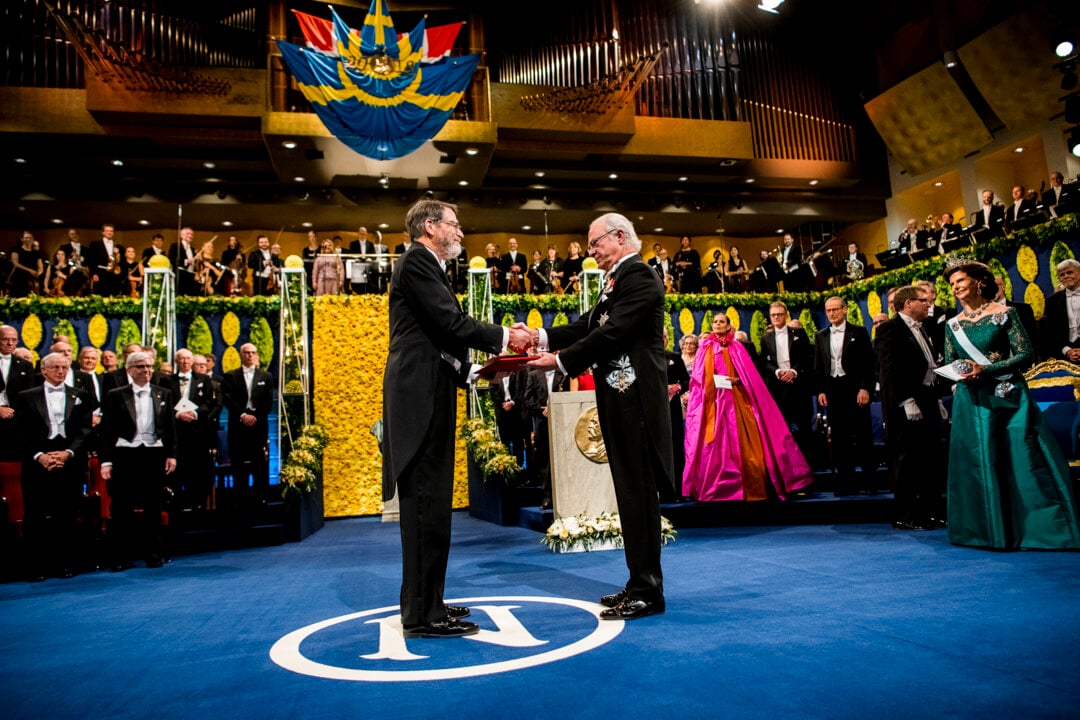

Stockholm in October has a rhythm to it, and Monday brought the final note of this year's Nobel season. The 2026 Sveriges Riksbank Prize in Economic Sciences in Memory of Alfred Nobel — the prize most of the world simply calls the Nobel in economics — was awarded to two American economists, Robert Hall of Stanford University and Michael Woodford of Columbia University, for work that quietly changed how governments and central banks think about keeping an entire economy steady.
Hall is 83. Woodford is in his early 70s. Between them, they will share 12 million Swedish kronor, roughly $1.2 million. Those are the headline numbers, and they are the least interesting part of the story. The interesting part is what the prize committee chose to honor: not a prediction, not a single famous paper the public might recognize, but a way of building economic models — one that starts, patiently, with real people making real decisions, and works upward from there to the fate of nations.
The official citation credits the pair “for microeconomic foundations of macroeconomic stabilisation.” Translated out of academy language, that means this: if you want to understand why an entire economy stalls, surges, or spirals — and if you want any hope of stabilizing it — your model of that economy has to be built from how households and businesses actually behave. How a family decides whether to spend or save when prices jump. How a business sets a price when its costs change and it does not know what its competitors will do. How everyone, at every level, forms expectations about what happens next and acts on those expectations today.
That may sound obvious, and the fact that it sounds obvious is itself a measure of how completely Hall and Woodford's generation won the argument. It was not always how the field worked. The older approach to macroeconomic modeling was more top-down, treating the big aggregates of an economy — total spending, total output, total inflation — as things that could be modeled more or less directly, following relationships observed in the past. Committee member Timo Boppart, in explaining this year's choice, characterized that older framework in effect as a black box: numbers went in, numbers came out, and the machinery inside — the actual decisions of actual people — was not really part of the model. It could work beautifully right up until the world changed, at which point relationships estimated from the old world could break down precisely when policymakers needed them most.
Hall and Woodford helped replace that black box with something sturdier. Build the model from the behavior up, they argued in different ways across long careers, and the model has a chance of holding together when conditions change — because human decision-making, while never perfectly predictable, is more stable ground than a statistical pattern that only described one particular era. Committee chair John Hassler made the practical version of that point in announcing the prize, saying in essence that their work provides a stable theoretical foundation for the models now used by central banks and governments around the world, and that this leaves policymakers better equipped when shocks arrive — an energy crisis, say, or a sudden change in how consumers behave.
Shocks, it turns out, have not been in short supply. The committee's reasoning pointed to the moments when this framework earned its keep. During the 2008 financial crisis, when the usual playbooks were failing in real time, models grounded in household and business behavior gave officials a way to reason about a collapsing economy that top-down tools struggled to describe. The same was true after the inflation surge of 2022, when central banks had to decide how hard to hit the brakes without sending their economies into a ditch. And the work is not a museum piece: central banks are, right now, grappling with an energy shock, making decisions about interest rates under exactly the kind of uncertainty Hall and Woodford's approach was designed for. There is something fitting about honoring the architects of the toolkit while the toolkit is out of the box and in daily use.
Woodford, speaking at a news conference after the announcement, offered what might be the most useful plain-language summary of why all of this matters to people who will never read an economics paper. Stabilization policy, he argued in substance, cannot be treated as officials somewhere pulling levers that move the economy independently of what the people inside that economy understand about the policy itself. The public is not a passenger. Families and businesses listen to what a central bank says, form beliefs about what it will do next, and spend, save, hire, and borrow accordingly — which means the policy and the public's understanding of the policy are inseparable. From that insight flows a practical lesson he emphasized: it matters enormously for a central bank to speak clearly about the future path of interest rates, and that kind of clear communication about what comes next played a real role in how economies were steadied in the response after 2009. In other words, words are a policy tool. Saying what you will do, credibly and clearly, is part of doing it.
Anyone who has watched a Federal Reserve press conference move markets before a single rate decision takes effect has seen that principle in action. A sentence from a central banker can change mortgage rates, stock prices, and hiring plans within the hour, not because money has moved, but because expectations have. Hall and Woodford's work is a large part of why modern policymakers understand that — and why they craft their statements with the care of people defusing something.
A few pieces of context complete the picture. This prize is the youngest of the Nobels by a wide margin: it was established by Sweden's central bank and first awarded in 1969, nearly three-quarters of a century after Alfred Nobel's 1895 will created the original five prizes in physics, chemistry, medicine, literature, and peace. It is awarded alongside them, in the same season and with the same ceremony to come, but its origin is distinct, a detail the Swedish Academy itself is always careful to note. The economics prize also has a demographic pattern that Monday's result continued: a majority of its laureates over the decades have been American, reflecting the long dominance of American universities in the field. And it remains a prize women have rarely won — only three women have ever received it, most recently Claudia Goldin in 2023, whose work on women's labor market outcomes was a reminder of how much of the economy the profession overlooked for generations.
Last year's prize went to Joel Mokyr, Philippe Aghion, and Peter Howitt, honored for work on creative destruction and economic growth — how innovation replaces the old with the new and powers prosperity over the long run. There is a pleasing symmetry in the sequence. Last year, the prize looked at the economy across decades, at the great engine of change. This year, it looks at the economy in the storm — at the question of how you keep the ship steady while the engine is doing whatever it is going to do. Growth and stability are the two oldest problems in economics, and Stockholm has now spent two consecutive Octobers honoring the people who thought hardest about each.
For Hall at 83 and Woodford in his early 70s, the award is a capstone rather than a beginning, recognition of work whose influence has already been absorbed so thoroughly into how central banks operate that it can be hard to see — which is, of course, the fate of truly foundational ideas. Nobody thanks the architect of the bridge while crossing it. But the next time an energy shock hits, or inflation spikes, or consumption suddenly shifts, and officials somewhere open a model to decide what to do before millions of strangers have to live with the consequences, the thinking inside that model will bear Hall and Woodford's fingerprints. On Monday in Stockholm, the field said so out loud.
Follow the rest of the day's developing stories in our news coverage, and catch up on the weekend's results in sports.





