
The first trial over the September 2022 Nord Stream explosions opened Wednesday at Hamburg’s Hanseatic Higher Regional Court. The defendant, identified by German prosecutors as Serhii K., denies involvement, Kyiv denies involvement, and there is no verdict.
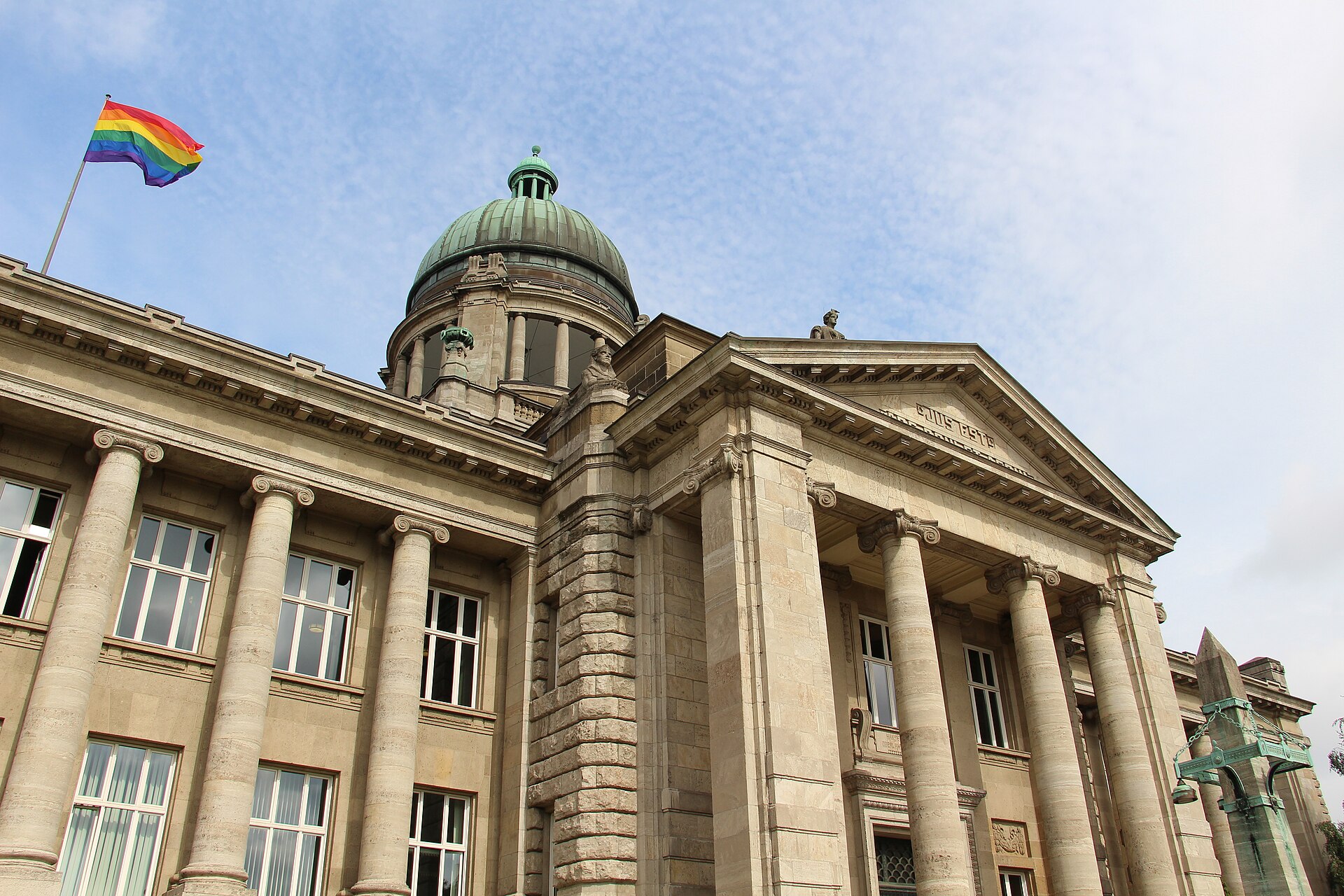
Photo: The Hanseatic Higher Regional Court in Hamburg, via Wikimedia Commons
Four years is a long time to wait for a courtroom to start asking, in public, who blew up a pipeline on the floor of the Baltic Sea. On Wednesday, according to Reuters, BBC News, Le Monde and Al Jazeera, that wait reached a new stage in Hamburg, where a trial opened at the Hanseatic Higher Regional Court. It is, according to those outlets, the first time a suspect has faced a court over the explosions that ruptured the Nord Stream pipelines in September 2022.
That distinction matters, and it needs to be stated plainly at the top. This is a trial, not a verdict. According to Reuters, the defendant denies involvement. According to Reuters and BBC News, the government in Kyiv also denies involvement. Nothing in Wednesday's opening, as reported by those outlets, settles what happened under the Baltic, who ordered it, or whether the man in the Hamburg courtroom did what prosecutors allege.
Who is on trial, according to prosecutors
German prosecutors identify the defendant as Serhii K., a 50-year-old former Ukrainian military officer, according to Reuters and BBC News. German privacy practice commonly shortens surnames in this way, and his fuller surname has appeared in earlier extradition reporting. Previously is using Serhii K. here, matching how prosecutors and the outlets cited in this story primarily identify him.
According to Reuters, prosecutors allege that Serhii K. coordinated a team that included divers and an explosives expert. According to Reuters, prosecutors allege that the team acted on behalf of unidentified Ukrainian state entities. That phrase — unidentified — is part of the allegation as reported by Reuters, and it is important not to stretch it further than the reporting supports. Prosecutors, as described by Reuters, have not publicly named the state entities they mean in the reports cited here.
According to Reuters and earlier German prosecutorial statements reported by BBC News, investigators linked the alleged operation to a yacht called Andromeda, chartered from Rostock. According to those reports, investigators said traces of underwater explosives were found on the yacht. That, too, is an investigative claim reported by the outlets — a claim the trial is now expected to test in open court, rather than a finding a court has already made.
What happened in September 2022
The underlying events are not in dispute in the same way. On September 26, 2022, according to Reuters, BBC News, Le Monde and Al Jazeera, explosions ruptured three of the four Nord Stream pipelines near the Danish island of Bornholm. According to those reports, the blasts released large amounts of methane into the Baltic Sea and the atmosphere.
According to Reuters, Nord Stream 1 had supplied about half of Germany's gas imports before Russia halted flows in August 2022. According to Reuters and BBC News, Nord Stream 2 had been completed but never entered service. In other words, according to the reporting, the pipelines were not delivering gas in the normal way when they were ruptured, but they still mattered enormously — as infrastructure, as a symbol of Europe's pre-war energy dependence on Russia, and as a possible future route that the explosions effectively took off the table.
There is a human tendency, four years on, to treat the Nord Stream story as a mystery with a missing final page. The Hamburg trial is a reminder that courts do something narrower and, in some ways, harder than storytelling. A court has to decide, about one defendant, whether specific charges have been proved to a specific standard, on evidence that can be presented and challenged. Everything else — geopolitics, motive at the level of states, the broader argument about energy and war — sits around that narrower question, pressing on it, but does not replace it.
The charges, as reported
According to Reuters, the charges include attacking civilian targets as a war crime, explosives offences, destruction of infrastructure and disrupting public services. According to Reuters, German prosecutors argue that the alleged actions would amount to a war crime because, in their account, they involved attacking civilian targets and causing explosions that destroyed infrastructure and damaged public services.
That war-crime framing is itself contested. According to reporting by NDR cited in coverage of the case, the defence initially declined to make a statement and challenged the basis for prosecuting the case as a war crime. Previously has not treated that challenge as a ruling; according to the reporting, it is a defence position raised at the start of proceedings. Whether the court's legal framing holds is one of the questions the proceedings, expected to run into February according to Al Jazeera via TBS, will have to work through.
It is worth pausing on how unusual the posture of this case is. Germany remains, according to Reuters, a major supporter of Ukraine. At the same time, according to Reuters, German prosecutors are pursuing a case whose alleged trail points, in their account, toward Ukrainian state entities that they have not identified. Reuters described that tension as diplomatically and politically awkward for Berlin. That is an understatement, but it is the reporting's word — awkward — and it captures something real: allies can support a country against an invasion and still, through their courts, pursue a criminal case that that country denies.
Arrest in Italy, extradition to Germany
According to Reuters and BBC News, Serhii K. was arrested in Italy in August 2025. According to those outlets, he was extradited to Germany in November 2025. According to Reuters, he has denied any involvement in the blasts since that arrest. Previously is repeating that denial in the same prominence as the allegation because, in a case with no verdict, that is not a footnote. It is half the story as it stands today.
According to Reuters, President Volodymyr Zelenskyy has said Ukraine had nothing to do with the blasts, and Kyiv has denied involvement. According to Reuters, Russia said on Monday that it expected a just verdict. Previously is paraphrasing that Russian statement here rather than treating any government's expectation as evidence. Governments have said a great many things about Nord Stream since 2022. A court is supposed to be the place where statements stop being the whole currency.
Why Denmark and Sweden are not holding this trial
According to Reuters and BBC News, Denmark and Sweden each opened their own investigations after the explosions, because the ruptures occurred near Bornholm and within the region those countries were examining. According to those outlets, Denmark and Sweden later closed their investigations. That left Germany's investigation, according to Reuters, as the one that produced this Hamburg case.
That path helps explain why a pipeline running between Russia and Germany, damaged near a Danish island, is now being argued about in a Hamburg courtroom. According to German reporting on the investigation, the pipelines terminate in Germany and their destruction affected German energy security — a basis German authorities have used for jurisdiction in the wider investigation. The trial, as reported by Le Monde and Al Jazeera as well as Reuters and BBC News, is therefore both a criminal proceeding and a test of how far one country's courts will go to answer an attack that happened in international waters.
What to watch as proceedings run into February
According to Al Jazeera via TBS, proceedings are expected to run into February. That timetable, if it holds, means Wednesday was an opening, not a climax. The evidence prosecutors say they gathered over years — about the yacht, about explosives traces, about the alleged team of divers and an explosives expert, all according to Reuters and BBC News — will now have to survive the ordinary, unglamorous tests of a trial: Who collected it? How was it preserved? What does it actually prove about this defendant, as opposed to proving that something terrible happened to a pipeline?
For readers who have followed every twist of the Nord Stream argument online, that may sound almost disappointingly procedural. It should not. The most important thing that happened on Wednesday, according to the reporting from Reuters, BBC News, Le Monde and Al Jazeera, is not that a mystery was solved. It is that a mystery was finally put in front of judges, with a defendant who, according to Reuters, denies involvement, a government in Kyiv that, according to Reuters, also denies involvement, prosecutors who, according to Reuters, allege coordination on behalf of unidentified Ukrainian state entities, and no verdict yet entered by anyone.
Previously will follow the Hamburg proceedings as they continue. When the court hears evidence, we will report what was actually presented and attributed. When there is a verdict — and only when there is one — we will say so. Until then, the honest headline is the one we started with: a trial has opened, an allegation is being tested, and a denial is on the record beside it.
Sources · 5 sources
- Reuters · Ukrainian ex-officer stands trial in Germany over Nord Stream bombing
- Le Monde · Former Ukrainian officer stands trial in Germany over Nord Stream sabotage
- Al Jazeera · reporting via TBS News — Trial opens in Germany over 2022 Nord Stream pipeline sabotage
- BBC News · reporting on the Hamburg Nord Stream trial opening, October 14, 2026
- NDR · reporting on the defence position, cited in coverage of the case