
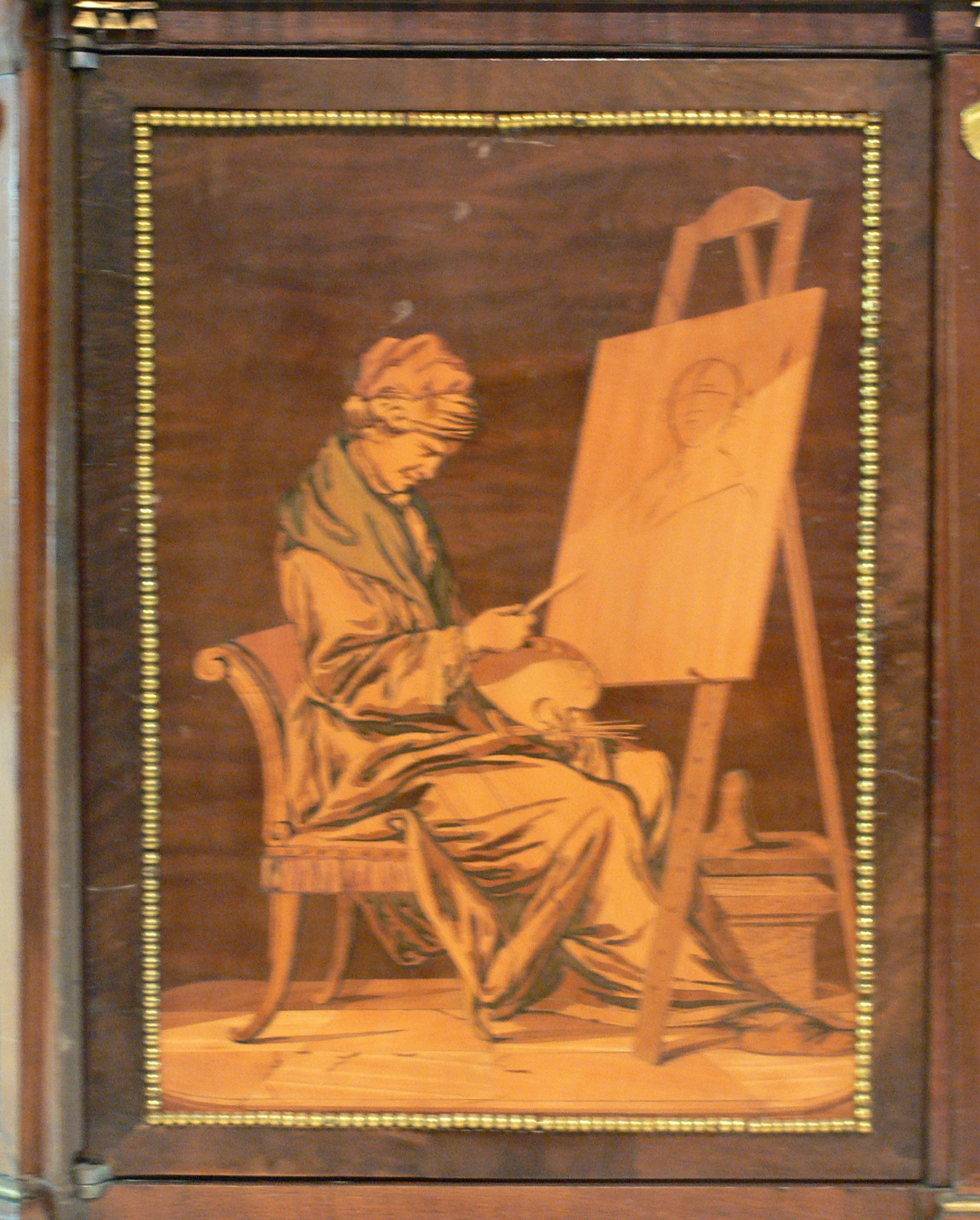
The portrait is easy to miss from a distance. In the central panel of the Berlin Secretary Cabinet, Frederick William II appears inside a carefully worked wooden world. Elsewhere, marquetry depicts an artist at an easel. Before anything moves, the cabinet has already linked its royal owner with the arts and the people who practise them.[1]
Known in Berlin as the Neuwieder Kabinett, the object belongs to the Kunstgewerbemuseum, inventory O-1962,24. The holding museum dates its construction to 1777–79; the Metropolitan Museum’s exhibition record gives 1778–79 and 1786. These records place the cabinet’s history across more than a single moment. It is an object made in the late 1770s with later work recorded, rather than a newly discovered mechanical novelty.[2][3]
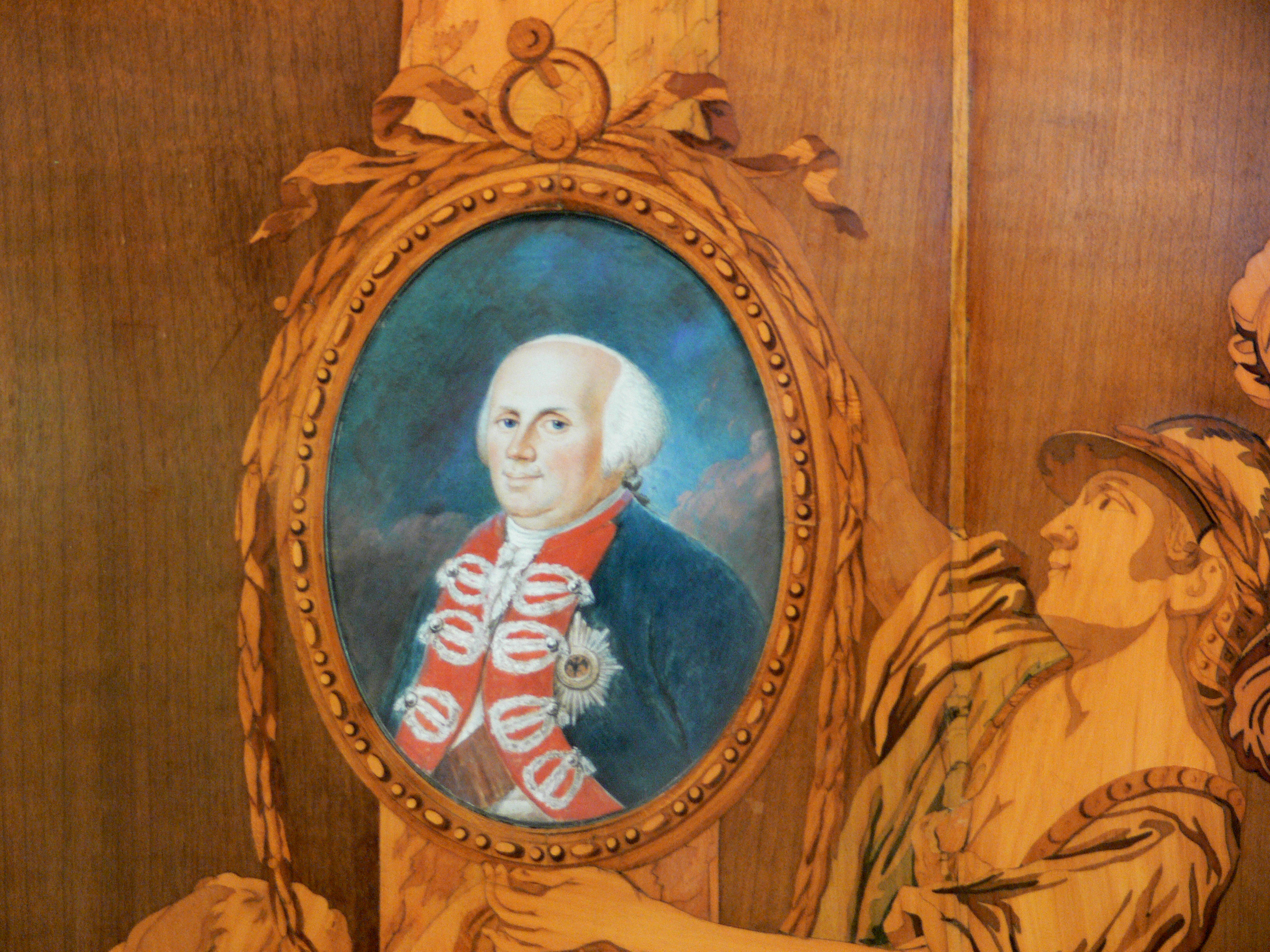
At 359 centimetres high, it has a scale that obliges the viewer to look up. The Berlin museum describes doors, drawers, writing surfaces and concealed compartments opening at a button’s touch, with music from flutes and chimes. David Roentgen’s workshop made three versions with differences between them; the Berlin example reached the Prussian crown prince in 1779. He would become King Frederick William II.[2]
Such mechanisms make practical functions conspicuous by delaying their appearance. A writing surface is useful, but a writing surface that arrives unexpectedly also gives its owner an audience. The museum interprets the cabinet as a representation of absolutist power. The person able to command the object could make a complicated world respond to an apparently simple action.[2]
The physical system behind that effect was considerably less simple. A 2022 research newsletter from the Stiftung Preußischer Kulturbesitz identifies springs, lead weights and cables in its concealed mechanism. It notes the system’s sensitivity and suggests that the cabinet was probably admired and demonstrated more often than it was used for writing.[4]
That observation changes how to read its refinement. The marquetry is visible evidence of skilled work; the mechanism keeps another body of skilled work hidden until needed. One invites inspection, the other produces surprise.
To care for the cabinet is therefore to preserve more than an impressive exterior. Its meaning also resides in relationships between parts, in movement and in the difference between an action and the labour that makes the action possible. The royal portrait supplies a face for that authority; the workshop supplied its means.
The details
The cabinet stands 359 cm tall and was delivered to the crown prince in 1779. Its openings work by button, and the mechanism — springs, lead weights and cables — also plays flute and chime music in three variations.
Sources · 4 sources
- Wikimedia Commons — Neuwieder Kabinett — photograph and file record
- Staatliche Museen zu Berlin — Secretary cabinet — collection object record
- The Metropolitan Museum of Art — Extravagant Inventions: the Roentgen exhibition — video
- Stiftung Preußischer Kulturbesitz — Research document on the cabinet (PDF)
Photography
Photographs: Sailko / Wikimedia Commons / CC BY 3.0 · FA2010 / Wikimedia Commons / public-domain release by photographer
- The full Berlin Secretary Cabinet, also called the Neuwieder Kabinett, photographed in 2018.
- Portrait of Frederick William II within the central marquetry panel of the Berlin Secretary Cabinet, photographed in 2009.
- A marquetry scene of a painter on the Berlin Secretary Cabinet, photographed in 2009.