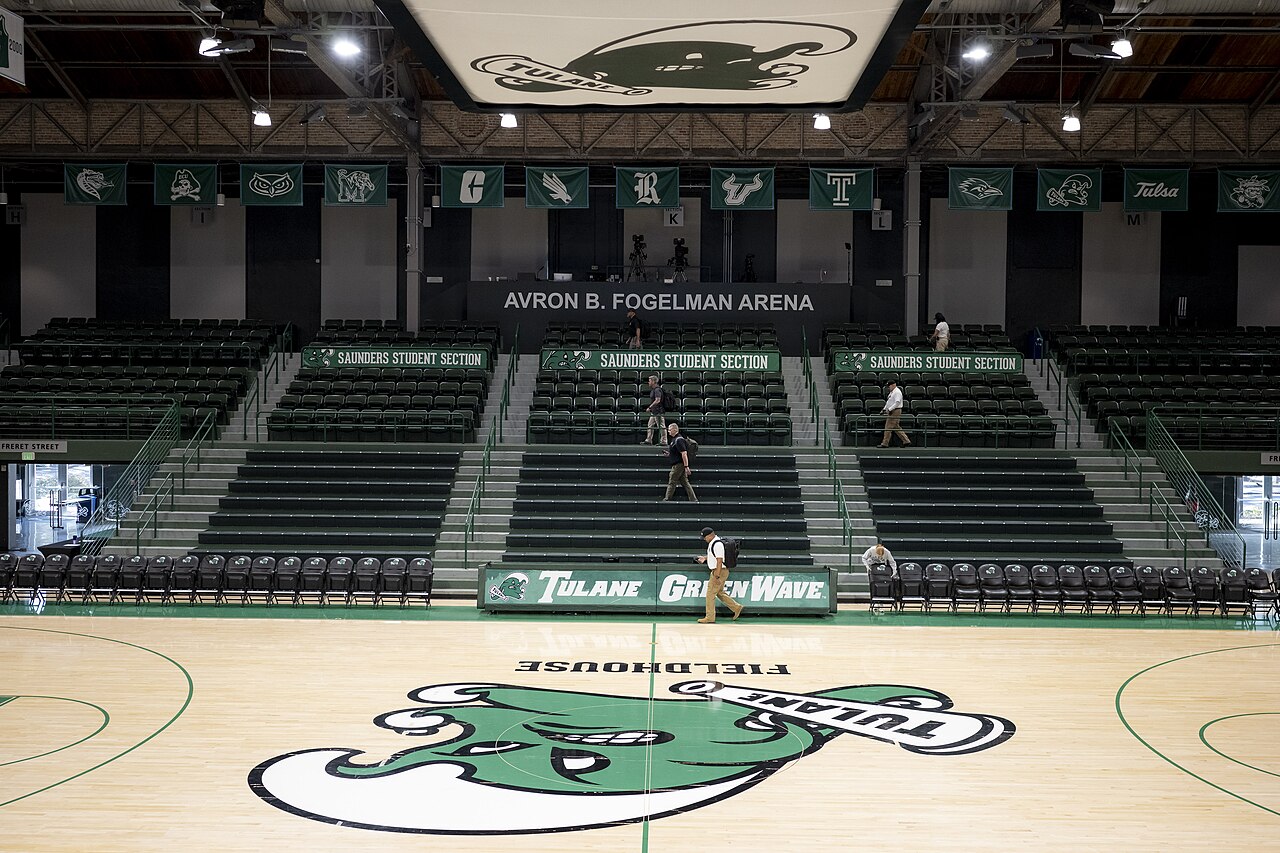
For Tulane basketball, the 2026-27 season arrives with a rare and precious thing: momentum. The Green Wave are coming off a 19-15 campaign — a 12-6 mark in the American Conference, a fourth-place finish, and the program's first postseason appearance since 2014, a trip to the inaugural College Basketball Crown. Head coach Ron Hunter, entering his seventh season in New Orleans with an 89-89 record at the school, has said it plainly: he isn't worried about preseason rankings. He's focused on winning the American and playing in March. "We are good enough to do that," Hunter says. After last spring, it's getting harder to argue.
Last season's breakthrough was the payoff for a slow, methodical build. Tulane won at Devlin's successor — the gleaming, renovated Avron B. Fogelman Arena — defended its home floor, and played its way into the league's top tier behind all-conference guards Rowan Brumbaugh and Asher Woods. The 19 wins were the program's most under Hunter, and the Crown invitation ended a twelve-year postseason drought. For a fan base that has waited three decades for the next chapter after the 1990s peak, it felt like the corner being turned.
The 1990s remain the program's golden age, and they were glorious. Under Perry Clark, Tulane danced in 1992, 1993, and 1995 — three NCAA tournament trips in four years — with the 1992 team reaching the second round. Clark's up-tempo Wave played joyful, beautiful basketball, and Uptown New Orleans fell in love. For a generation of fans, March meant Green Wave basketball the way it means Mardi Gras Indians mean spring: woven into the city's rhythm.
The Metro Conference wars of that era forged the program's identity. Tulane held its own against Louisville, Memphis, Southern Miss, and Florida State — heavyweight programs with heavyweight budgets — and won its share of the battles. Anthony Reed, the program's all-time leading scorer, starred on the tournament teams; "Hot Rod" Williams and Jerald Honeycutt carried the torch into NBA careers. Those banners still hang in Fogelman, proof of the ceiling.
The decades since have been the long climb. Tulane's reality is the underdog's reality: a small private university in a football-obsessed region, playing in a league where Memphis, Wichita State, and South Florida spend more and draw more. LSU owns the state's imagination. What Tulane has instead is character — a bandbox arena, a loyal core of Uptown faithful, and teams that play with a chip, smart and tough and unafraid of anybody's brand name.
Hunter, hired in 2019 from Georgia State, has built the modern program around exactly that edge. His best teams guard and grind, win the possession battle, and get career years out of overlooked players. The 2025-26 squad was the blueprint made real: Brumbaugh, the Washington, D.C. guard with All-American Conference honors, running the show; Woods, the senior from Atlanta, providing scoring punch and senior steadiness; Percy Daniels and 7-footer Davion Bradford anchoring the middle. It was a team with no lottery picks and no shortcuts — and it won 19 games.
This season's roster keeps the engine. Brumbaugh returns for his redshirt-junior year as one of the league's premier guards, and Woods is back for his senior season. Daniels, the Baton Rouge center, and Bradford, the 7-foot, 265-pound St. Louis native, give Tulane one of the most physical frontcourts in the American. Around them: Luke Rasmussen and Tyler Ringgold, developing sophomores with size; KJ Greene, Jake Shapiro, and Joseph Teich in the backcourt rotation; Oral Roberts transfer JoJo Moore adding backcourt scoring; Curtis Williams Jr. bringing high-major experience; and intriguing freshmen in Robert Moore and 6-foot-9 Bosnian forward Vasilije Kuridza. It's a deep, veteran group — exactly what wins in this league.
The subtractions are real, though. Kam Williams — the electric freshman wing who became one of Tulane's best players by season's end, shooting 41.2 percent from three — transferred to Kentucky. He was the kind of late-season supernova that changes a team's geometry. Sharpshooter Scotty Middleton, who led the Wave in three-point percentage, moved on to San José State, and Kaleb Banks departed as well. Hunter's staff has bet that the returning core plus internal development covers it.
The staff itself got a jolt. R.J. Hunter — Ron's son, the former NBA and G League guard — is a full-time assistant after two volunteer seasons in which he helped develop four all-conference honorees. A Tulane Athletics Hall of Famer and member of the 1991-92 tournament team rejoined the staff, bringing the program's history into the locker room, and associate head coach Ray McCallum — the former Detroit head coach and NBA guard — provides one of the most experienced benches in the mid-majors. Hunter has credited the staff continuity as the engine of the rebuild.
The American around them is a gauntlet. Wichita State sits atop the preseason power rankings with most of a NIT quarterfinal roster back; Memphis reloaded as always; South Florida starts over under a new coach; and Tulsa — the league's best story — went from 13 wins to 30 and an NIT championship game appearance. There are no nights off in this league, and Tulane's path to the top of it runs through all of them.
The home floor matters more than ever. The renovated Fogelman — 4,100 seats tucked into the Uptown campus, with the Green Wave logo splashed across the court and the old arena's bones under the new skin — is one of college basketball's great intimate rooms when it's full. Last year's crowds sensed something building. This year, with expectations attached for the first time in a generation, the building should be loud from November.
There is a larger question hanging over all of it: can Tulane win in March again? The drought dates to 1995 — more than thirty years, an entire generation of New Orleans kids who grew up never seeing the Wave in the bracket. Hunter's teams have been knocking: 20-win pace, conference contention, the Crown breakthrough. The next step is the one that ends the drought, and the roster — veteran, physical, deep — is built to take it.
The program's soul has always been Uptown. Tulane basketball is second-line basketball: resilient, joyful, communal, a little defiant. It is the university on St. Charles Avenue, the students in the Saunders section, the old-timers who remember Perry Clark's teams running the Metro. The 2026-27 Green Wave carry all of it — the history, the wait, the hunger. As Hunter says, they're good enough. This is the season to prove it.