The full story
The premise
THE GHOST IN THE SHELL is Science SARU’s brand-new television adaptation of Masamune Shirow’s landmark manga — the fourth full animated continuity in a franchise that has been reinterpreted for over three decades, and the first to go straight back to Shirow’s pages as its visual and tonal foundation. The ten-episode first season aired from July 7 to September 8, 2026, on the Ka-Anival!! programming block across FNS affiliates including Kansai TV and Fuji TV, with Prime Video streaming the series worldwide (holding an exclusive early-release window in Japan; China, Russia, and Vietnam excepted).
The story is the classic setup: in a near-future Japan where cybernetic augmentation is commonplace, Major Motoko Kusanagi leads Public Security Section 9 — an aggressive tactical unit investigating cybercrime and terrorism — as its operations draw it toward a mysterious unidentified hacker known as the Puppet Master, who can infiltrate cybernetic minds and turn people into unwitting agents. What distinguishes this telling is its fidelity to Shirow’s manga rather than to any previous screen version: Science SARU leans into the vivid, saturated colors of the original artwork — combined with darker lighting and deep areas of shadow — and presents a Motoko closer to her manga characterization: energetic, expressive, and comedic, rather than the restrained, philosophical figure familiar from Mamoru Oshii’s 1995 film or Stand Alone Complex.
The production made headlines at the 2026 Annecy International Animation Film Festival, where the series premiered on June 22 with a 90-minute special event, “Dive into Ghost in the Shell.” There, director Moko-chan told the crowd the show was made with zero generative AI — down to the hand-designed cityscapes. When real signage became too much work, the team invented what Moko-chan called “worm-like lettering that looks like kanji but is actually gibberish,” faked by hand rather than prompted from a machine. The first two episodes also screened theatrically in the UK and Ireland on June 26 and at Anime Expo in Los Angeles on July 5, ahead of the broadcast premiere.
The cast and crew
Maaya Sakamoto voices Motoko Kusanagi, returning to the role after Ghost in the Shell: ARISE — a casting choice that bridges the continuities for longtime fans. She is joined by Hiroki Yasumoto as Batou, Kazuhiro Yamaji as Daisuke Aramaki, Yuichi Nakamura as Togusa, Kousuke Goto as Ishikawa, Toru Nara as Saito, Marie Oi as the Operator, Tomoko Kaneda as the Fuchikoma, Kenichi Ogata as Colonel Tonoda, and Masashi Ebara as the cyberbrain Hanka Precision. The English dub features Suzie Yeung as Motoko, SungWon Cho as Aramaki, Bill Butts as Batou, Nick Apostolides as Togusa, John Bentley as Ishikawa, and Tony Weaver Jr. as Saito, among others.
Behind the scenes, the series marks the directorial debut of Moko-chan (Toma Kimura), with series composition and scripts by novelist EnJoe Toh, character designs and chief animation direction by Shuhei Handa, and music by Taisei Iwasaki alongside Ryo Konishi and YUKI KANESAKA. The production committee unites Science SARU with Bandai Namco Filmworks, Kodansha, and Production I.G — the studio that defined the franchise’s earlier eras, now a partner in its reinvention. The project was first announced in May 2024 under the tentative title The Ghost in the Shell, with a full key visual and preview video following on January 30, 2026.
The music is a statement in itself: the opening theme, “GO GHOST,” is performed by J-rock phenomenon King Gnu — the band behind the chart-topping Jujutsu Kaisen openings “SPECIALZ” and “AIZO” — fusing their signature alternative-rock edge with futuristic electronic synth motifs. The ending theme, “Blue,” comes from Millennium Parade, featuring Saya Gray and Daniel Caesar, and received its own formal music video after the season wrapped.
The season
Season one’s ten episodes constitute the complete story told so far, and the rollout was built for event status: festival premiere, theatrical previews on two continents, then a weekly broadcast-and-streaming run through the summer anime season. No second season had been announced as of early October 2026, but the home-video pipeline is already in motion: Bandai Namco has scheduled a Japanese Blu-ray box set for December 23, 2026 — a three-disc set (one disc devoted entirely to extras: non-credit opening and ending videos, six promotional videos, a Moko-chan-directed special PV, trailers, a making-of feature, plus a booklet and a storyboard book), priced at ¥35,000, with English subtitles and the English dub included.
Critical reception
The series entered 2026 as one of the year’s most anticipated anime launches, and the conversation around it has been defined less by controversy than by craft. The manga-faithful approach — the saturated palette, the livelier Motoko, the episodic, chaotic energy of Shirow’s original — has been widely framed as the show’s defining gamble: where Oshii made a moody art film and Kamiyama made prestige television, Science SARU made a comic-book adaptation that trusts the comic book. The no-generative-AI pledge, delivered straight from the Annecy stage, landed as a genuine industry statement in a year when the question of AI in animation has only gotten louder.
Purists will always argue about which Ghost in the Shell is the real one — the franchise now spans four separate animated continuities plus a live-action film — but the new series has been received as a legitimate fourth pillar rather than a footnote: a version that finally lets Shirow’s playful, dense, deeply weird manga speak in its own voice. It holds an 8.2 on TMDB, and the speed with which the Blu-ray box was scheduled suggests Bandai Namco agrees the audience is there.
Cultural impact
THE GHOST IN THE SHELL is, among other things, a referendum on what the franchise is for. For thirty years, the screen versions have orbited Oshii’s 1995 film — its rain, its stillness, its existential dread — while the manga’s mischief got sanded down. By returning to Shirow and handing the material to Science SARU, the studio of Devilman Crybaby and Scott Pilgrim Takes Off, the 2026 series argues that Ghost in the Shell was always a pulpy, kinetic, funny cyberpunk comic first and a philosophy seminar second. That argument, made with hand-drawn cityscapes and gibberish kanji, is also a quiet rebuke to the industry’s AI moment: craft as content.
The global rollout tells its own story about anime in 2026 — an Annecy premiere, same-season worldwide streaming on Prime Video, a King Gnu opening engineered for the charts — and the show now sits at the center of the franchise’s future. Whatever comes next, this version has already done something no previous adaptation quite managed: it made Motoko Kusanagi fun again, and reminded everyone that the Major was laughing before she was brooding.
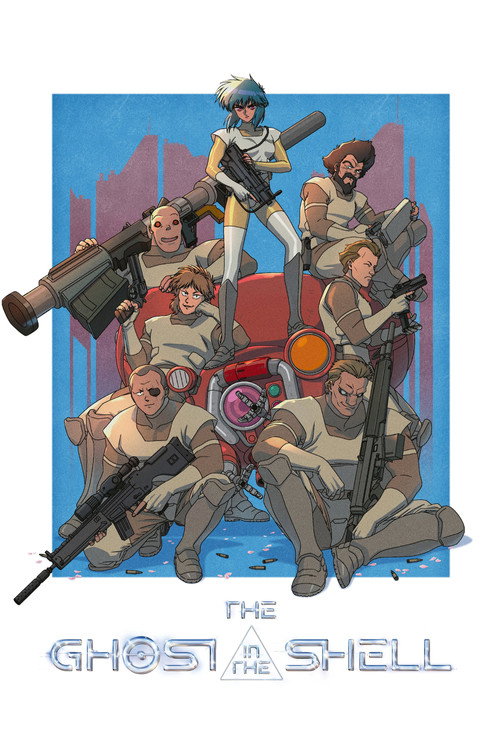
THE GHOST IN THE SHELL (2026)
2029, a near-future Japan. The full cyborg Motoko Kusanagi envisions a task force that preemptively strikes emerging threats. She and her team are scouted by Daisuke Aramaki as Public Security Section 9, AKA the “Shell Squad.” An international conspiracy hints at a hacker known as The “Puppet Master.” What fate awaits Kusanagi? What is the hacker's endgame?
The Take
2029. A full-cyborg Kusanagi. Section 9 — the “Shell Squad.” And the Puppet Master is back. Cyberpunk's crown jewel returns.
Read more▾
The hook
The year is 2029 in the fiction and 2026 outside it, and the timing has never been more loaded: the full cyborg Motoko Kusanagi envisions a task force that strikes emerging threats before they emerge, gets scouted with her team by Daisuke Aramaki into Public Security Section 9 — the “Shell Squad” — and walks straight into an international conspiracy orbiting a hacker known as the Puppet Master. THE GHOST IN THE SHELL returns to the franchise's greatest-hits setup — Kusanagi, Section 9, the Puppet Master — and the 8.2 audience score says this isn't a nostalgia play. It's a statement.
It matters because cyberpunk stopped being speculative fiction and started being the news. A series about hacked minds, preemptive task forces, and what counts as human lands differently when the audience is living inside the questions.
The deep cut
What works is the reverence with teeth. The show isn't remaking the past; it's re-entering it — same iconography, new craft, and a premise (preemptive strikes on emerging threats) that updates the franchise's paranoia for an era of predictive everything. Kusanagi remains one of fiction's great protagonists precisely because she's a question in a combat chassis: if the body is replaceable and the mind is networked, what's the ghost? The Puppet Master's return gives that question its perfect antagonist — the hacker as philosopher-king.
What doesn't is the shadow. Three decades of Ghost in the Shell is a long shadow, and every new entry gets measured against the most influential anime film ever made — an unwinnable comparison the show wisely doesn't try to win. It aims for worthy successor, and an 8.2 from the most demanding audience in animation says it lands.
Who it's for: the cyberpunk faithful, philosophy majors who like gunfights, and newcomers who want to know what the fuss was about.
Cultural context
Few franchises have earned the right to keep going like this one. Ghost in the Shell didn't just define cyberpunk on screen — it predicted the anxieties (identity, surveillance, the networked self) that now structure daily life. Each generation's version is really a diagnostic of its moment, and this one's preemptive-task-force framing reads as pure 2026: security as prediction, threats as data points, the future as something to be policed before it happens.
The anime remake-and-revisit era has been hit or miss, but the hits share a trait: they trust the material enough to let it breathe. This one breathes.