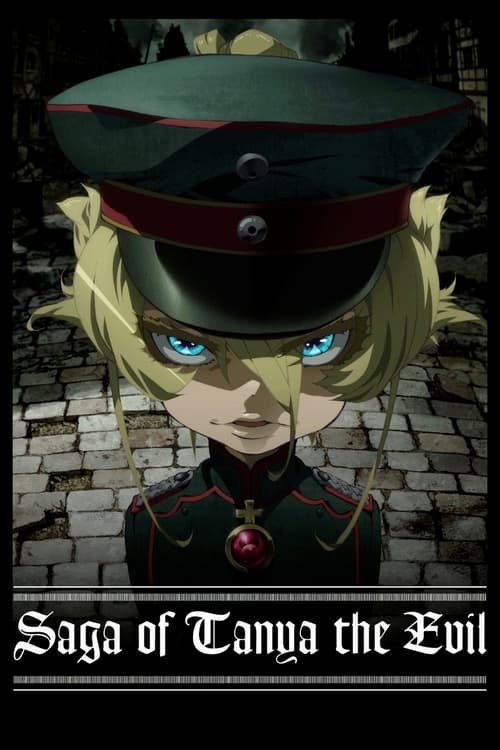
Saga of Tanya the Evil (2017)
On the front lines of the war, Tanya Degurechaff, blond hair, blue eyes, and porcelain white skin, commands her squad with lisping voice. Actually, she is one of Japan's most elite salary men, reborn as a little girl into a world of magical warfare after angering a mysterious being who calls himself God.
The Take
A ruthless salaryman, reborn as a little girl, waging magical trench warfare to spite God. The most gloriously deranged premise in anime — and it still slaps.
Read more▾
The hook
A ruthless Japanese salaryman is murdered by a vengeful ex-employee, meets God, calls God incompetent to His face — and is reincarnated as a nine-year-old girl on the front lines of a magical alternate World War I. That sentence is the whole show, and the show knows it. Saga of Tanya the Evil is the meanest, funniest, most philosophically loaded war story anime has ever produced: a workplace satire wearing a military uniform, starring a protagonist who treats total war as a career optimization problem.
Tanya Degurechaff doesn't want to fight. She wants a safe desk job, a pension, and a quiet life. Every scheme she hatches to get off the battlefield backfires so spectacularly that she gets promoted instead — closer to the front, closer to death, closer to the godlike Being X she refuses to worship. It is the most elegant doom loop in anime.

The premise
The Empire is a powerful military nation on a continent that looks much like early 20th-century Europe — except magic is real, and aerial mages duel like fighter pilots with rifles and computation orbs. Into this world is thrown our protagonist: a cold, hyper-rational salaryman, murdered in 2013 Tokyo, reincarnated by the spiteful entity known as Being X into the body of an orphan girl. Being X's terms are explicit — die without ever finding faith, and there will be no third life. So Tanya does what any good middle manager would do: she games the system.
She volunteers for the military at age nine, reasoning that officer training is safer than the trenches. Her brilliance gets her fast-tracked into the Imperial Army's mage corps instead. She masters the dangerously unstable Type-95 computation orb — a prototype that only works when she prays, a detail that enrages her — and builds the 203rd Aerial Mage Battalion into the Empire's most feared unit. Every victory is a defeat: the better she performs, the more indispensable she becomes to a war machine that keeps expanding. The show's genius is structural. Tanya is never wrong about the logic of her situation, and the logic is a trap.
Cast & characters
Aoi Yuki's performance as Tanya is the engine of the entire franchise — she switches in a single breath from a salaryman's flat corporate cadence to a little girl's battlefield shriek of ecstatic violence, and the whiplash is the point. Saori Hayami plays Viktoriya "Visha" Serebryakova, Tanya's loyal adjutant, the show's soft heart and the one person who sees something human in her commander. Shin-ichiro Miki is the weary staff officer Erich von Rerugen, who correctly identifies Tanya as a monster and can do nothing about it. Hochu Otsuka and Tessyo Genda play the grand strategists Hans von Zettour and Kurt von Rudersdorf — old lions conducting a war they know is unwinnable. The second season added Tomokazu Sugita, Yōko Hikasa, and Eiji Hanawa to the roster.
Season by season
Season one (2017, twelve episodes) was the debut production of studio NUT, directed by Yutaka Uemura from scripts by Kenta Ihara, and it covers Tanya's rise from orphanage to the Rhine front — ending with the Empire triumphant and terrified, having scared the entire world into coalition against it. The 2019 theatrical film (February 8, 2019, ¥400 million at the Japanese box office) continues directly, pitting Tanya against the multinational mage ace Mary Sioux in a duel the series had been building toward. The long-awaited second season — greenlit in June 2021, finally premiering July 8, 2026, and running twelve episodes through September 23 — adapts the "Dum Spiro, Spero" arc from Carlo Zen's light novels, shipping the newly promoted Lieutenant Colonel Degurechaff to the brutal Eastern Front with her Salamander Kampfgruppe. Takayuki Yamamoto took over directing, with Ihara and the core creative team returning for continuity. The franchise is based on Zen's light novel series (illustrated by Shinobu Shinotsuki, fourteen volumes and counting, published in English by Yen Press), which began life as a web novel in 2010.
Critical reception
The 2017 season was a genuine breakout: a debut studio delivering muscular aerial combat animation, a protagonist unlike anything in the medium, and a script that treated military logistics with the seriousness of a Tom Clancy novel. Critics and fans praised the show's commitment to its bit — it never winks, never softens Tanya, never lets the war be anything but ugly. The film was both a critical and commercial success, and the nine-year wait for season two only deepened the cult. Season two's reception has been more divided — some critics argue the show's refusal to let Tanya face real consequences has curdled from feature to bug — but even the skeptics concede NUT's battle animation remains top-tier, and the dramatic irony of Tanya's self-defeating brilliance still lands.
Cultural impact
Saga of Tanya the Evil helped detonate the "evil protagonist" wave in isekai — the understanding that the genre's power fantasy works even better when the fantasy is held by someone terrible. Tanya became an instant icon: the salaryman in a little girl's body, the "Devil of the Rhine," a meme template for ruthless corporate logic applied to literally everything. More substantially, the show proved that isekai could do genuine military science fiction — supply lines, staff work, combined-arms doctrine — and find an audience for it. It remains the gold standard for the dark isekai: a show about a monster the audience can't stop rooting for, in a war nobody can win, against a god she refuses to respect.