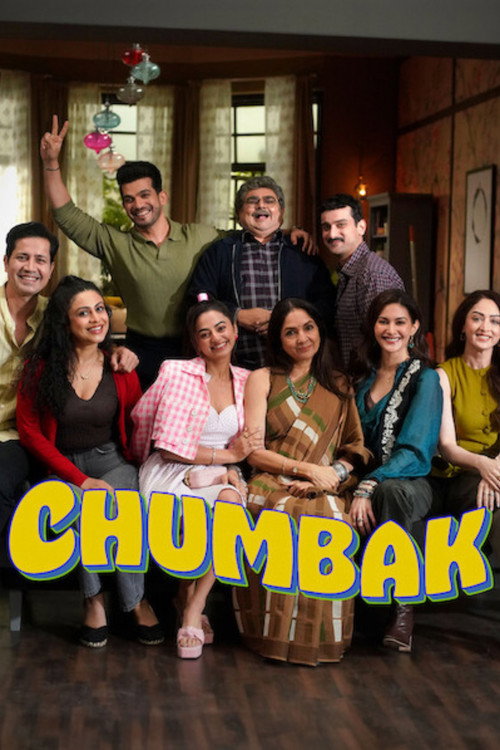
Chumbak (2026)
Five quirky families navigate life as neighbors in Chumbak Colony, where chaotic conflicts and hilarious antics turn each day into a new chapter.
Five families. One Mumbai row-house colony. A young author, a quirky support group, and neighbors who laugh, cry, eat, drink, and share everything together — that's the world of Chumbak, the Hindi-language family comedy from the creative team behind Sarabhai vs Sarabhai and Khichdi. Written and directed by Aatish Kapadia and produced by Jamnadas "JD" Majethia for Netflix under Hats Off Productions, the 16-episode first season premiered on September 10, 2026, with Part 2 following on October 1, 2026.
Premise
Chumbak is set in the fictional Chumbak Colony in Chembur, Mumbai, where five families live shoulder to shoulder in a row-house settlement. Their interconnected lives generate a steady churn of comedy, family drama, relationship problems, and neighborhood chaos. The series taps a deliberate nostalgia for an era when neighbors regularly visited each other's homes, borrowing sugar or household items was normal, family celebrations became neighborhood celebrations, personal problems quickly became community problems, gossip traveled faster than official news — and neighbors could become as close as relatives.
At the center of the Part 1 story are Rajni Merchant (Neena Gupta) and Kuku Merchant (Deven Bhojani), the anchor couple of the colony's everyday madness. Around them, the ensemble churns through weddings, children's mischief, parental memories, gossip tsunamis, and daily hungama. Part 2 picks up after Part 1's cliffhanger with secrets coming into the open and relationships being tested — the creators promising more chaos, more heart, and a colony that becomes even more unpredictable once hidden things start surfacing.
Cast
The series assembles a genuine all-star cast of Hindi television comedy. Neena Gupta plays Rajni Merchant and Deven Bhojani — remembered as Dushyant in Sarabhai vs Sarabhai — plays Kuku Merchant. Around them: Manasi Parekh as Priyanka Khanna, Sumeet Vyas as Aditya Khanna, Sumeet Raghavan as Dharmendra Kejriwal, Sandeepa Dhar as Kiran Kejriwal, Anant V. Joshi as Freddy Taraporewala, Amyra Dastur as Hutoxi Taraporewala, Arjun Bijlani as Micky Oberoi, Helly Shah as Twinkle Oberoi, Delnaaz Irani as Gulshan Taraporewala — a loud, outspoken, fiercely protective Parsi mother-in-law who became one of the show's breakout characters — and Atul Kumar, among others. The multi-camera format and roughly 24-minute episode runtime keep it firmly in classic sitcom territory.
Production
Behind the camera, the reunion is the story. Aatish Kapadia writes and directs; Jamnadas Majethia showruns and produces through Hats Off Productions, the house behind Khichdi and Sarabhai vs Sarabhai — two of the most beloved Hindi television comedies of the 2000s. Deven Bhojani has spoken about the second part as "nothing short of entertaining, in true JD & Aatish style," and Neena Gupta has said the show took her back to her own childhood, "to a time when neighbours were practically family." Cinematography is by Sanket Shah, and the show was shot in the multi-camera setup that gives it the stage-play energy of its sitcom lineage.
Critical reception
Reception has leaned warm, particularly for the ensemble chemistry and the show's clean, family-watchable comedy. Press coverage around the teaser and trailer framed it as a slapstick ride built on old-Mumbai neighborhood life, and the Part 2 announcement played up the show's success — Netflix India teasing fans with "Chumbak abhi khatam nahi hui hai, be ready for more pagalpan." Delnaaz Irani has argued that the show's strength is its simplicity: "you don't need to force humour or make things overly complicated. Sometimes the funniest stories are the ones that come from everyday life." The format — 16 episodes split into two parts, roughly 25–30 minutes each — fits the binge-plus-anticipation model Netflix has used for several of its Indian comedies.
Cultural context
Chumbak arrives at an interesting moment for Hindi streaming comedy. The Kapadia–Majethia brand carries enormous goodwill from the golden age of Indian television sitcoms, and the show deliberately revives that grammar — multi-camera setups, ensemble bickering, the neighborhood as a character — for a streaming audience that has mostly been fed darker, grittier originals. In that sense it's a throwback with a strategy: the feel-good, watch-with-family sitcom never really died, it just lost shelf space. Chumbak is a bid to take it back, with the same creative duo who helped define it two decades ago. The row-house colony is also a specific piece of Mumbai urban history — Chembur's post-independence housing colonies housed the city's middle-class boom — and the show mines that setting for both authenticity and comedy.
Where to watch
Chumbak is streaming on Netflix worldwide. Season 1 spans 16 episodes released in two parts — Part 1 on September 10, 2026, and Part 2 on October 1, 2026.
Why it matters
The Hats Off Productions signature is the real draw here. In the 2000s, Khichdi and Sarabhai vs Sarabhai didn't just dominate Hindi television comedy — they defined a grammar of it: the ensemble as family, the apartment or colony as stage, bickering as a love language. That grammar went quiet for a decade while streaming chased prestige crime and thriller originals. Chumbak is the reunion tour with the band intact — Kapadia writing and directing, Majethia producing, Bhojani and Raghavan in the cast — and its two-part, 16-episode rollout is Netflix betting that the audience for clean, multi-generational comedy never went away. It just needed someone to make it again.
The Take
Five families. One colony. Infinite chaos. The neighborhood ensemble comedy is the oldest engine in television — and it's still running.
Read more▾
The hook
The setup is as old as the sitcom itself and just as reliable: five quirky families sharing life as neighbors in Chumbak Colony, where every day's small conflict — the noise, the borrowing, the boundary violations — detonates into chaotic, hilarious fallout. No high concept. No mythology. Just people living too close together, which has been a bottomless well of comedy since the first apartment building met the first television camera.
It matters because the hangout ensemble is television's comfort food, and comfort food never goes out of style — it just waits for the next kitchen. A brand-new colony of characters is a bet that audiences still want a place to visit every week, and history says that bet usually pays.
The deep cut
What works — in the premise, which is all we can grade on while the audience score is still blank — is the math. Five families is the sweet spot: enough combinations for fresh friction, few enough that viewers can learn everybody's name. “Chaotic conflicts and hilarious antics turn each day into a new chapter” promises the episodic engine at its purest: no homework, no lore bible, just drop in and laugh. That accessibility is the whole game for family comedy.
What doesn't, yet, is everything unproven. Ensemble comedies live or die on chemistry and joke density, and neither can be assessed from a logline. The risk with “quirky families” as a descriptor is quirk without character — chaos is only funny when you care who's causing it. The show's job in its first stretch is simple: make us pick favorites fast.
Who it's for: family-viewing crowds, anyone who rewatches their comfort sitcom on loop, and viewers who want comedy without a content warning.
Cultural context
The neighborhood ensemble is one of television's great traveling formats — every TV culture on earth has its version of the building, the street, or the colony where everybody knows everybody's business. The form endures because the underlying truth endures: proximity breeds comedy. Your neighbors are the cast you didn't audition.
There's also a real appetite right now for low-stakes television. After years of prestige TV demanding emotional labor, the gentle chaos of a colony comedy — conflicts that resolve in twenty-two minutes, antics with no body count — feels less like a retreat and more like a restoration.