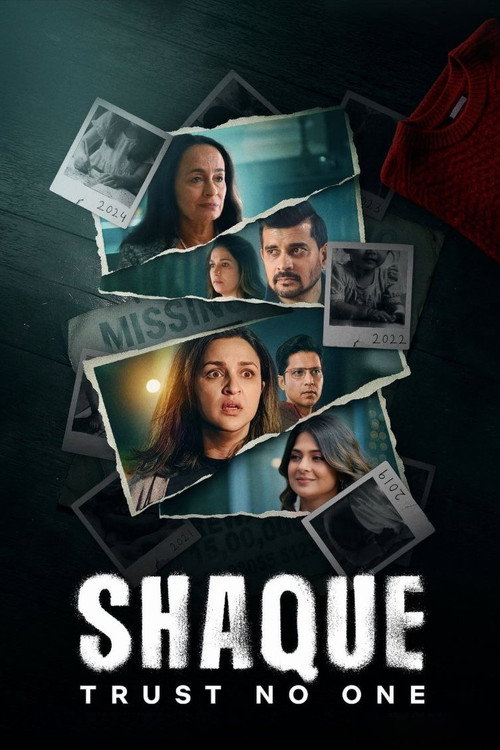
Shaque: Trust No One (2026)
A mother receives yearly photos of her missing child. After nine years of searching, she discovers the truth about the abduction lies not far away, but hidden among her closest circle.
The Take
Once a year, a photo arrives of a child who never came home. Nine years later, the truth is closer than anyone dared to look.
Read more▾
The premise
This is the cruelest hook in the mystery playbook, and Shaque: Trust No One wields it without flinching. Anvita Dutt's newborn daughter, Apeksha, is abducted from her hospital room just hours after birth. Nine years later, Anvita is still searching — and every year, on the day of her daughter's birthday, an anonymous package arrives: a new photograph of Apeksha, growing up somewhere out of reach. Not a ransom note. Not a demand. Just proof of life, delivered like a holiday card from hell. When a new lead finally surfaces, Anvita begins uncovering a web of lies inside her small town and her own inner circle, and the show's thesis becomes literal: the truth she has been hunting for nine years isn't in some far-off place. It's buried deep within the secrets of the people she trusts most.
There is a reason this premise grabs you by the throat. Most missing-person stories are about the search outward; this one is about the rot inward. The horror isn't that a stranger took a child — it's that the answer was sitting at her table the whole time.
The cast
The headline is Parineeti Chopra, making her streaming-series debut as Anvita — a genuine event in the Indian entertainment press, and the performance the whole show is built around. Chopra (The Girl on the Train, Hasee Toh Phasee) has spent her film career playing warmth with an edge; here the edge is all that's left, and she plays nine years of grief as a kind of permanent weather system. Around her, a strong ensemble built for suspicion: Jennifer Winget as Sakshi, the friend whose steadiness gives Anvita's paranoia its necessary counterweight; Tahir Raj Bhasin, one of Hindi cinema's best young character actors; Soni Razdan and Anup Soni as the older generation with the longest memories and the most to hide; plus Sumeet Vyas, Harleen Sethi, and Dhruv Chaudhary. In a show where the title is the instruction manual, every familiar face is a suspect — which means the casting had to make every familiar face feel like family first.
The season
Seven episodes, forty-five to fifty-five minutes each, released on Netflix on September 24, 2026. Created by Rensil D'Silva and Siddharth P. Malhotra, directed by D'Silva — who previously directed the Indian adaptation of 24 and knows his way around a ticking clock — and produced by Alchemy Filmz (Siddharth P. Malhotra and Sapna Malhotra). The series had a quiet identity crisis before it ever aired: Netflix first announced it as Talaash: A Mother's Search, then renamed it in late August 2026 with no official explanation. The smart money says the old title was too crowded — several films and at least one series already answer to Talaash — and the new one is simply better marketing. Talaash told you what the show was about. Shaque: Trust No One tells you how to watch it.
The seven-episode shape matters. This is a miniseries, not an open-ended drama — it has an ending, and the ending is the whole point. The yearly-photo ritual gives the show its structure: a countdown, a wound that reopens on schedule, and a final episode where every kindness gets re-read as camouflage.
The reception
Critics have been respectful but not swept away — which, for this genre, is practically a rave with caveats. The MovieUnit review landed at 6.5/10, praising the deadliest-betrayal setup while asking whether the truth proves as compelling as the mystery. India's INVC went 3/5, calling it one of the most emotionally charged Indian thrillers of the year on the strength of the premise and Chopra's debut. The recurring notes across reviews are consistent: the missing-child premise is genuinely strong, the early suspense is well built from concealed evidence, and the paranoia compounds the way good domestic noir should. The knocks are just as consistent: convenient confessions, investigative decisions that strain credibility, and grief increasingly deployed as a twist-delivery mechanism rather than an emotion.
But here's the number that matters more than any review: within days of release, Shaque quietly became one of the most-watched shows in the world on Netflix, sitting on the global charts just behind Monster: The Lizzie Borden Story and Not a Stranger. Audiences, it turns out, will forgive a multitude of contrivances for a premise this nasty and a final act this committed. The 6.7 audience rating tells the same story the reviews do: a series that earns its tension more often than it coasts on it, without entirely escaping the genre's gravity.
Cultural context
We are living through the golden age of distrust-as-entertainment. True crime trained a generation to treat every neighbor as a potential suspect, and the domestic thriller — the marriage with a secret, the friend with a past — became the defining suspense mode of the streaming era. Shaque slots directly into that anxiety: it's not about monsters, it's about the people who bring casseroles. The show is also part of Netflix India's maturing slate — no longer just importing global formats, but building Hindi-language thrillers with local texture and global-chart ambitions.
The yearly-photo ritual taps something older and sadder, too — the real-world agony of long-term missing-person cases, where hope itself becomes the tormentor. The show is smart enough to let that ache sit underneath the twists. And the title change, from a mother's search to a warning, reflects the era's understanding of its audience: we don't watch mysteries to feel safe. We watch them to practice not feeling safe.