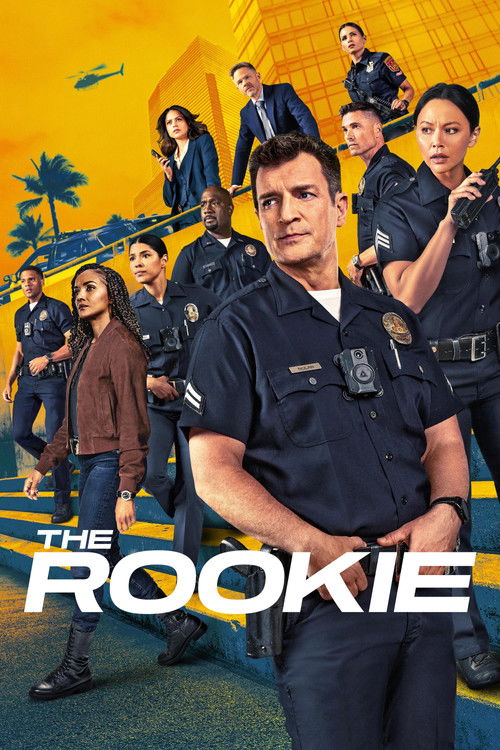
The Rookie (2018)
Starting over isn't easy, especially for small-town guy John Nolan who, after a life-altering incident, is pursuing his dream of being an LAPD officer. As the force's oldest rookie, he's met with skepticism from some higher-ups who see him as just a walking midlife crisis.
The Take
The elevator pitch that shouldn't have worked — a 40-something rookie cop — became network TV's most durable comfort watch.
Read more▾
The hook
What if you blew up your comfortable life at 45 and became a rookie cop — the oldest rookie in the LAPD, taking orders from training officers half your age? That's the elevator pitch, and it's a great one: a midlife crisis with a badge. But The Rookie's real trick is what it became after the pitch wore off — the warmest, most reliably entertaining ensemble procedural on network television, a show that survived eight seasons by understanding that viewers don't tune in for the cases. They tune in for the people.
Created by Alexi Hawley and built around Nathan Fillion's considerable charm, the show took one of TV's oldest formats — the cop procedural — and gave it a beating human heart. It's comfort television with genuine stakes, and in the streaming era, that turned out to be a superpower.

The premise
John Nolan is a 45-year-old divorced construction company owner from a small Pennsylvania town whose life detonates — a bank robbery he helps stop, a divorce finalized — and who decides, against all advice, to chase the dream he shelved decades ago: becoming a police officer. The LAPD takes him, barely, and assigns him to the Mid-Wilshire Division, where his training officer treats him as a walking midlife crisis and his fellow rookies — Lucy Chen and Jackson West, both half his age — have their own mountains to climb.
The premise is inspired by the real story of William Norcross, who joined the LAPD in his forties, and the show honors that inspiration by taking Nolan's age seriously. He's not a joke; he's a man whose life experience is both his superpower and his liability. He de-escalates where younger cops escalate. He parents his rookie classmates. And he makes the kind of mistakes only a man who has lived a whole other life first could make. Around him, the show built a true ensemble: Chen's climb from rookie to undercover operative, Lopez's ferocious competence, Bradford's slow thaw, Harper's unorthodox brilliance.
Cast & characters
Nathan Fillion is the sun the show orbits — his Nolan is decent, funny, stubborn, and quietly heroic, the rare leading man whose superpower is kindness. Fillion, who has said he wants to play Nolan for another decade, anchors every scene he's in. Melissa O'Neil's Lucy Chen has grown from rookie to one of the show's most compelling characters, her undercover work and her slow-burn relationship with Tim Bradford (Eric Winter) — "Chenford," to the fans — forming the show's emotional core. Alyssa Diaz is terrific as Detective Angela Lopez, Richard T. Jones brings gravitas as Sergeant Wade Grey, and Mekia Cox's Nyla Harper — the ex-undercover detective turned training officer — steals every scene with her controlled chaos.
The bench runs deep: Shawn Ashmore as Wesley Evers, Jenna Dewan as firefighter Bailey Nune (Nolan's wife), Lisseth Chavez as rookie Celina Juarez, Deric Augustine as Miles Penn, Tru Valentino as Aaron Thorsen, Bridget Regan as the deliciously villainous Monica Stevens, and Patrick Keleher as the troubled Seth Ridley. Earlier seasons featured Titus Makin Jr. as Jackson West — whose shocking season-four exit remains the show's gutsiest narrative swing — and Afton Williamson as Talia Bishop.
Season by season
Season one (2018–19, twenty episodes) is the rookie year: Nolan, Chen, and West versus their training officers and their own inexperience. Season two (2019–20, twenty episodes) deepens the ensemble and the danger. Season three (2021, fourteen episodes) brings La Fiera, the Guatemalan crime boss played by Camille Guaty, into Lopez's orbit. Season four (2021–22, twenty-two episodes) delivers the West tragedy and Nolan's evolution. Season five (2022–23, twenty-two episodes) makes Nolan a training officer himself — the student becomes the teacher — and introduces Celina Juarez. Season six (2024, ten episodes) and season seven (2025, eighteen episodes) push the characters into bigger, more serialized threats. Season eight (2026, eighteen episodes, premiering January 6) opened with the show's first-ever international shoot — the premiere filmed in Prague — and has included everything from a crossover with Dropout's comedy series Game Changer to Nolan mentoring a new generation. Across eight seasons the show has passed 140 episodes, a genuine network-TV marathon.
Critical reception
The Rookie was never a critics' darling in the prestige-TV sense — it sits around 68% on Rotten Tomatoes for the series overall — but it has been something arguably more valuable: a critics'-respect, audience-loved workhorse. Reviews consistently praise Fillion's warmth, the ensemble's chemistry, and the show's deft tonal balance of humor, action, and heart. The season-eight premiere drew some of the show's best reviews in years, with critics calling it "masterclass network storytelling." Viewers have been even kinder: the show routinely posts strong audience scores and has become one of Hulu's most-watched series, regularly topping the streamer's charts years after its broadcast premiere. In an era when network procedurals were supposed to be dying, The Rookie became proof of their durability.
Cultural impact
The Rookie's real legacy is as the last great network procedural success story — the show that proved the format could thrive in the streaming age by being exactly what it is: reliable, humane, and fun. It launched a franchise attempt with The Rookie: Feds (2022–23), starring Niecy Nash-Betts, which ran one season, and a second spinoff, The Rookie: North, is in development. It gave us "Chenford," one of TV's most beloved slow burns. And it gave Nathan Fillion — already a cult hero from Firefly and Castle — his longest-running and most-watched role, the part he'll likely play into his sixties. In a television landscape obsessed with darkness, The Rookie bet on decency. Eight seasons in, the bet is paying off.