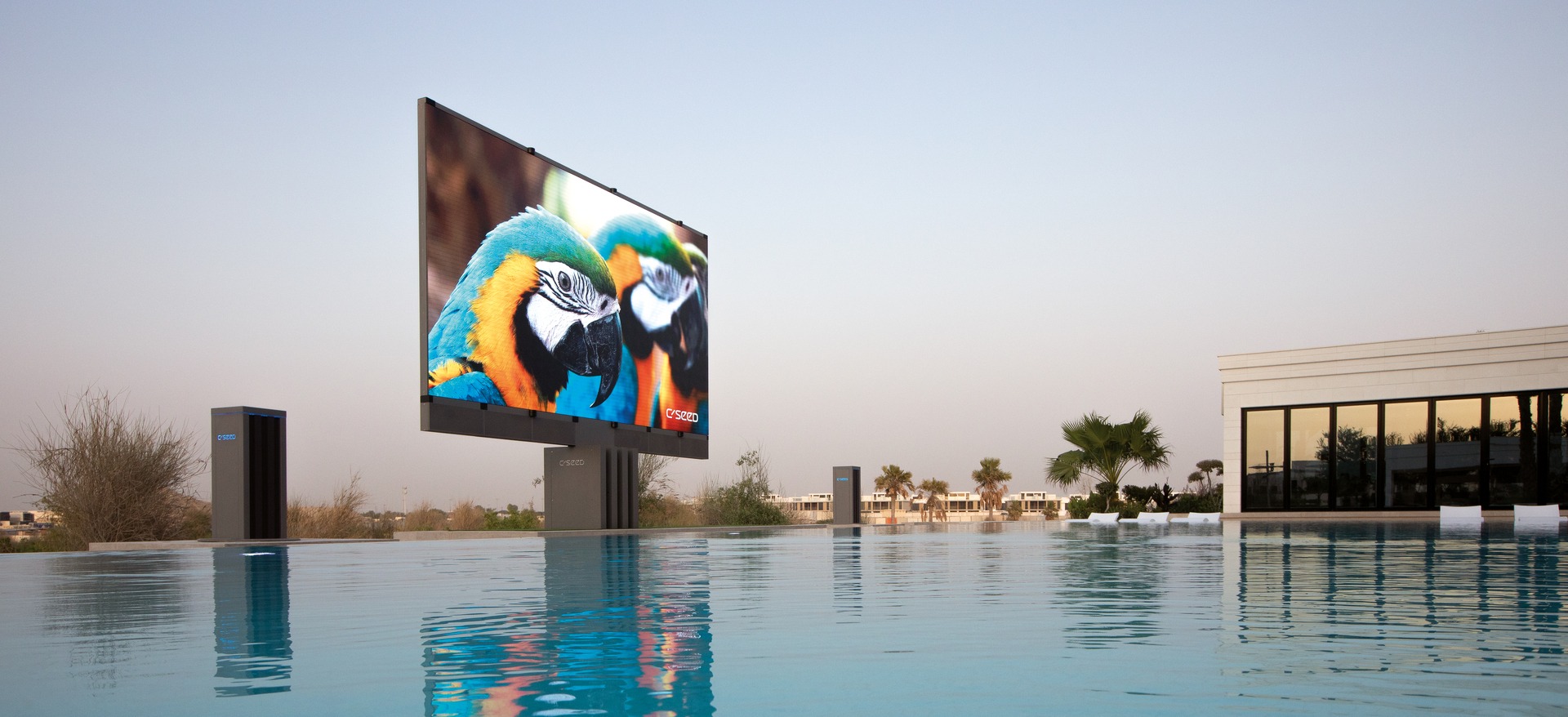
€314,000–€539,000 — French dealer HifiLink's listing range for the C SEED HLR outdoor TV, across its 144-inch and 201-inch versions. That is the whole money basis of this story: one dealer's range, covering two sizes, checked for this slate in November 2026.
The range excludes delivery and installation. The dealer's terms put both outside the price. What a finished, working installation costs on top is not published — the breakdown of what the price covers is below.
The figures map to the sizes: €314,000 is the 144-inch, €539,000 the 201-inch. The mapping was confirmed during this slate's research after the listing itself presented only the range; the numbers stay attached to the dealer either way — this is HifiLink's range, not a maker's published list.
For scale, not as a second price: when the HLR system launched, a 2022 dealer report put the 144-inch from €289,000, installation and project management not included. The current HifiLink range sits above that launch floor, consistent with price movement since 2022 — the 2022 figure is the launch floor, not today's price.
This is a dealer listing range, not a maker's published list price and not a completed sale. C SEED sells this class of product by quotation.
The exact object
The C SEED HLR TV, made by C SEED Entertainment Systems of Vienna. Two sizes share one idea: the television lives underground, in a compartment box, until somebody presses the remote.
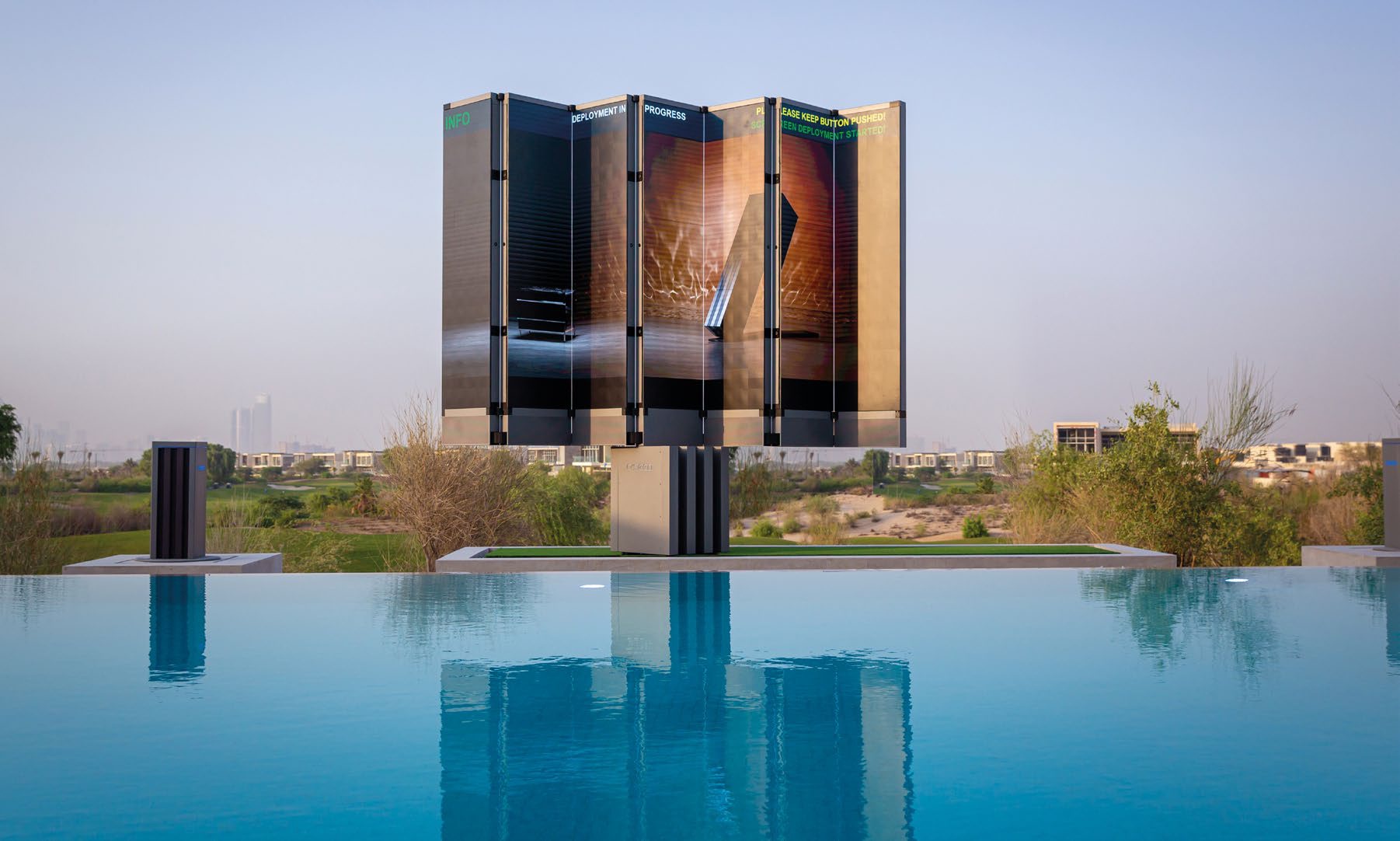
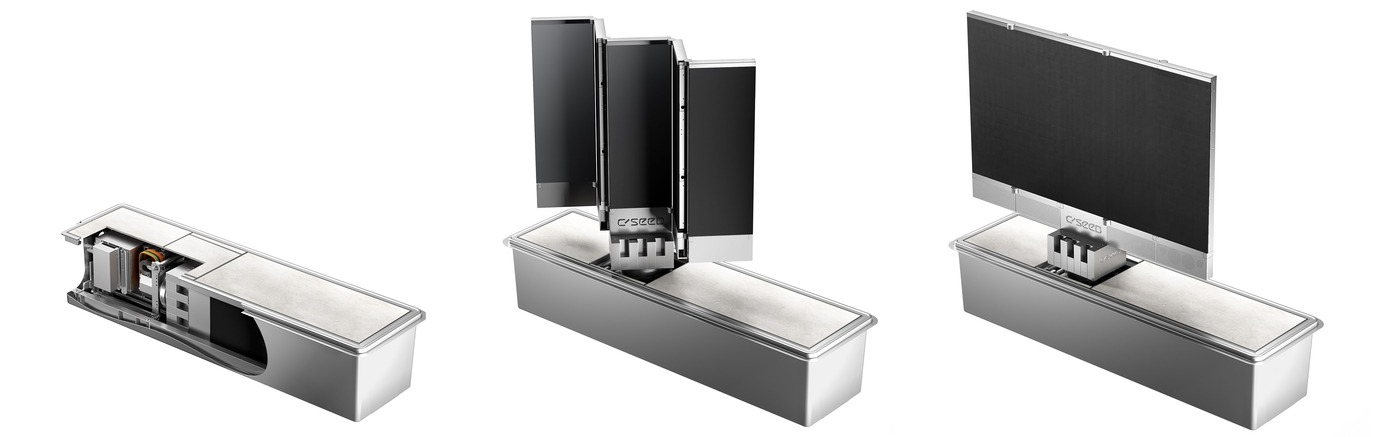
The box is the engineering tell. C SEED's own HLR page describes a compact, shallow compartment box of only 85 cm (33.4 inches), worked by a horizontal lifting mechanism. Press the remote and the sequence runs itself: the screen rises from the compartment in about 30 seconds, then five massive MicroLED panels (144-inch) or seven (201-inch) unfold, silently, over the next 45 seconds, into one seamless outdoor screen. The finished display rotates 90° left and right, or 180° in a single direction.
The panel itself, from C SEED's technical data: UHD MicroLED, 4,000 nits of brightness — the figure that matters outdoors, because the screen is meant to hold a picture in direct daylight — with a 3,840 Hz refresh rate, 16-bit-per-colour processing, a 7,000:1 contrast ratio and a rated lifespan of 100,000 hours. The 201-inch screen measures 5,105 mm on the diagonal; the 144 measures 3,658 mm. Sound is built into the system rather than bolted on: dealer and brochure material describes six coaxial speakers with an optional subwoofer — the exact configuration varies by system.
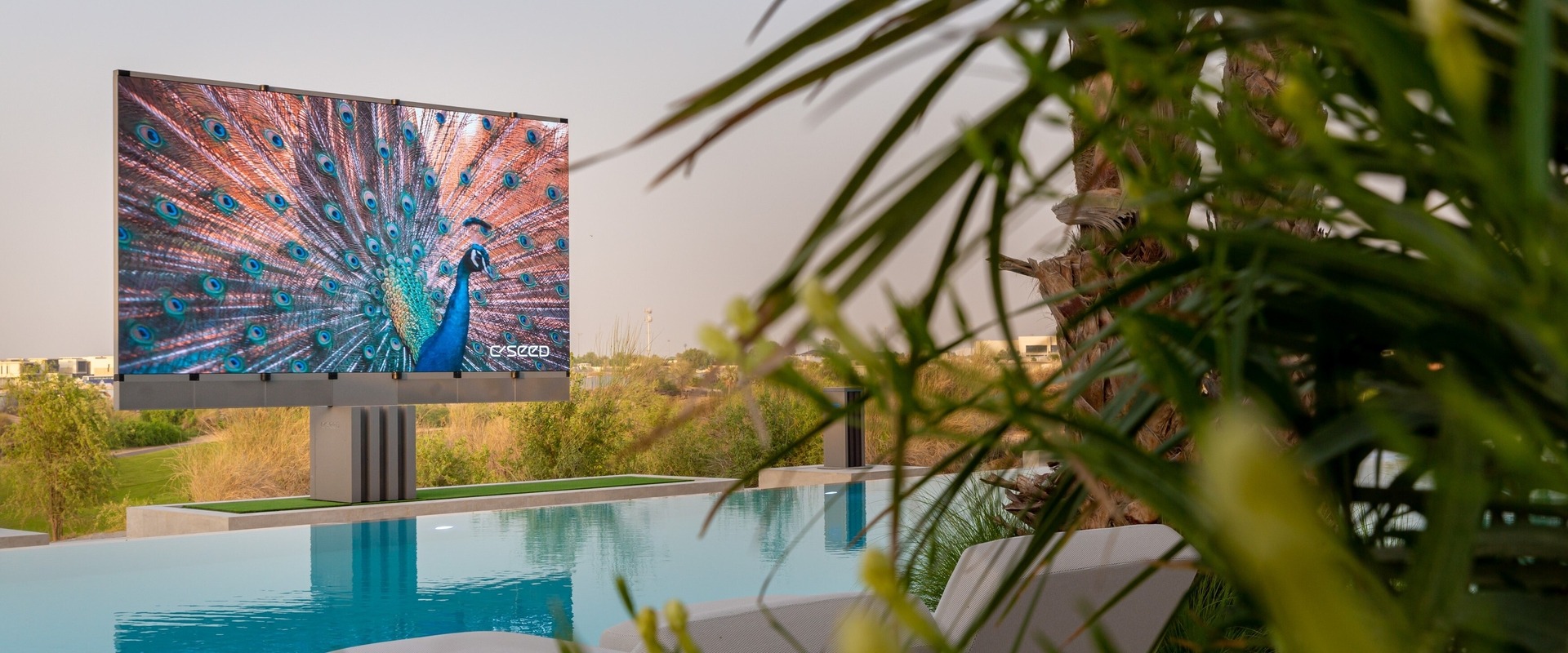
The setting gives it away: a flat lawn, terrace or pool deck; a long compartment lid at ground level; the column rising; panels fanning out into a single wall of screen. And no visible television when it's off. That vanishing act is the object.
The premium, explained concretely
Three premiums are stacked here, and the story keeps them separate.
The display premium. A 144- or 201-inch MicroLED wall that works at 4,000 nits in full sun is not a bigger version of a patio TV. MicroLED at this scale is built from millions of individual emitters — C SEED's data counts 2,200,000 MicroLEDs in the 144 and 2,963,520 in the 201 — assembled into panels that have to read as one seamless surface after folding and unfolding, repeatedly, outdoors, in weather.
The kinetic premium. The screen folds. Five or seven rigid panels hinge, stow, rise and deploy on a lifting mechanism, then have to align as a single picture. That mechanism — not the diagonal — is what separates this from every fixed outdoor screen on the market, and it is the part a photograph or the video has to show moving.
The disappearance premium. When the show ends, the television leaves. The garden, terrace or pool deck goes back to being a garden, terrace or pool deck, with no screen wall standing in it. Buyers at this level are paying for the absence as much as the presence — the same logic as a safe that sinks into a floor, applied to a cinema.
What the premium does not buy is a measured picture-quality verdict: no independent measurement of this exact system is on record, and the specifications in this story are the maker's own, reported as the maker's.
The ordinary counterpart
A conventional premium outdoor TV, priced live in euros: the Samsung The Terrace, 75-inch (QE75LST7) — Samsung's weatherised QLED outdoor line, IP-rated for outdoor use, designed to mount on a wall or stand in partial shade. Luxembourg retailer HIFI International lists the 75-inch Terrace at €6,499 (checked November 2026).
- €314,000 ÷ €6,499 ≈ 48. The bottom of the C SEED range buys about forty-eight 75-inch Terraces.
- €539,000 ÷ €6,499 ≈ 83. The top of the range buys about eighty-three.
Label the comparison honestly. It is a scale comparison, not an equivalent: the Terrace is a 75-inch fixed screen — less than half the 144's diagonal, a fraction of its area — built for shaded or partially shaded mounting, not for disappearing into the ground or for 4,000-nit full-sun work. Nobody cross-shops these two objects; the Terrace exists in this story to give the reader a real, priced anchor for what "outdoor TV" normally means.
And one limit that cuts the other way: the Terrace's €6,499 is also a product-only price. Mounting, outdoor cabling and installation sit on top of it too — smaller numbers, same structure. The honest difference is not that one price is complete and the other is not; it is that the C SEED's excluded works are civil works, and the Terrace's are a bracket and an electrician.
What the price includes — and what it does not
Included at €314,000–€539,000 (per the dealer listing):
- The C SEED HLR TV system in the selected version — the compartment and lifting mechanism, the folding MicroLED screen and the system's built-in audio as specified. The listing does not break its contents down further by configuration.
Explicitly excluded:
- Delivery.
- Installation. Both exclusions are stated in the dealer listing itself.
Not included / not established — the construction project:
- This is where the story lives. Before the television can rise, the site has to receive it: excavation and groundworks for the compartment, the housing and its foundations, drainage so the compartment does not become a sump, and a power supply sized for the lifting mechanism and the screen. One C SEED retailer describes HLR installation as 4 to 5 days with minimal groundwork — "minimal" is a retailer's word for a job that still starts with digging a hole roughly the length of the screen.
- No total installed cost exists as a sourced figure. The price of the television is known; the price of the hole is a quotation, not a number.
- Taxes / VAT treatment on the dealer range: not stated in the listing.
Sources · 5 sources
- HifiLink (FR) — C SEED HLR TV Outdoor listing: €314,000–€539,000 across the 144 / 201 versions, delivery and installation excluded (slate research, November 2026; size mapping confirmed in the slate's upgrade hunt)
- C SEED — official HLR 144 / 201 page and technical data: 85 cm compartment, ~30-second rise, five / seven panels unfolding in ~45 seconds, 4,000 nits, 3,840 Hz, 7,000:1, 100,000-hour lifespan
- C SEED — 'The Unfolding TV' brochure (2025): system and sound description (six coaxial speakers, optional subwoofer)
- Cinema Architects (C SEED retailer) — installation time 4 to 5 days with minimal groundwork
- HIFI International (LU) — Samsung The Terrace QE75LST7 75-inch at €6,499 (counterpart, November 2026)