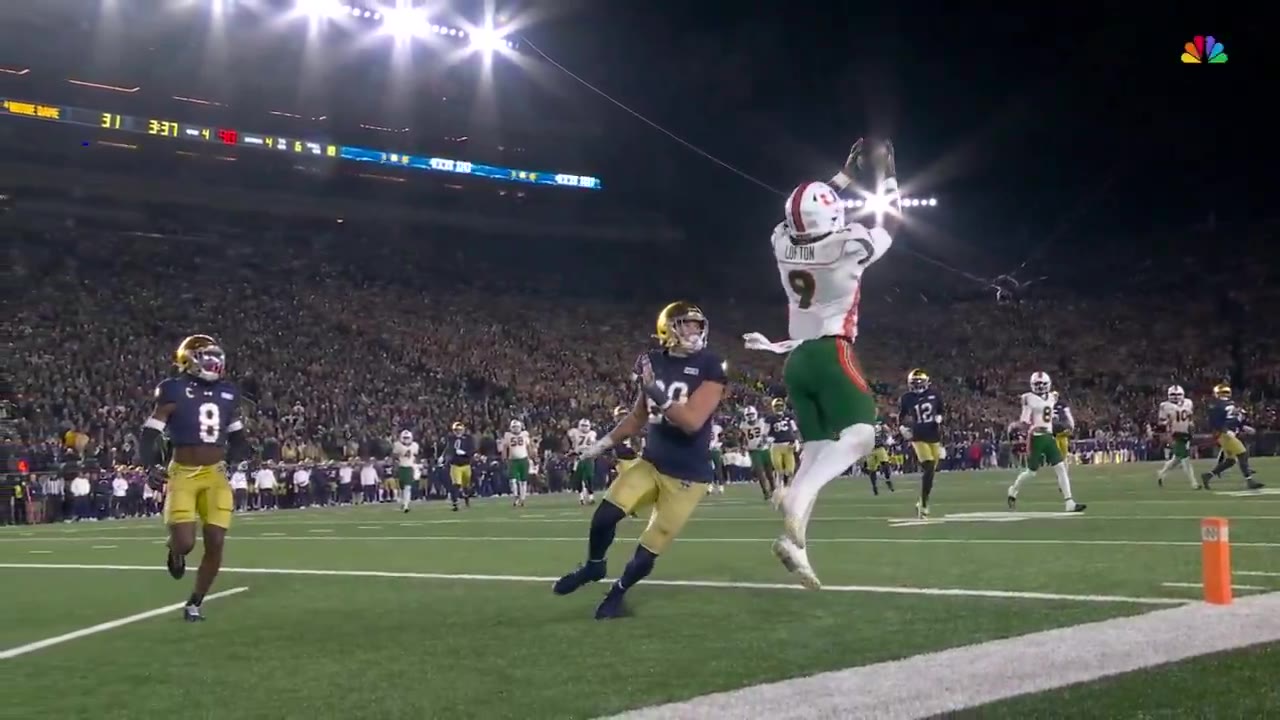

With 3:36 left in South Bend, Darian Mensah floated one toward the corner of the end zone, Elija Lofton got two hands on it and both feet down, and the ball still ended up loose — ruled incomplete on the field and upheld after a long review, with a touchdown that would have pulled Miami within one point, and the kick to tie it, riding on the call. Notre Dame 31, No. 1 Miami 24 became final anyway — the Hurricanes got one more possession after the call and could not cash it — and a perfect season turned on one question nobody in the building could answer the same way twice: when is a catch actually finished?
Fourth-and-6, From the 18
Miami had no business still being alive, and then it was all the way alive. The Hurricanes trailed 24–3 early in the third quarter and spent the rest of the night climbing out of that hole, drive by drive, until the comeback sat 18 yards from complete — the whole climb is in the full game story.
The two quarterbacks had traded punch for punch all night. CJ Carr went 29-of-40 for 319 yards, three touchdowns and no interceptions for Notre Dame. Mensah answered with 24-of-43 for 276 yards, three touchdowns and one interception — close enough that one play, one call, was always going to separate them.
That play started with Lofton himself. Earlier in the same drive, Mensah found him short right and Lofton turned it into a 41-yard catch-and-run to the Notre Dame 22 — the play that dragged Miami out of its own end of the field and into range. A short run moved it to the 18. Two throws fell incomplete. Fourth-and-6, season on the line.
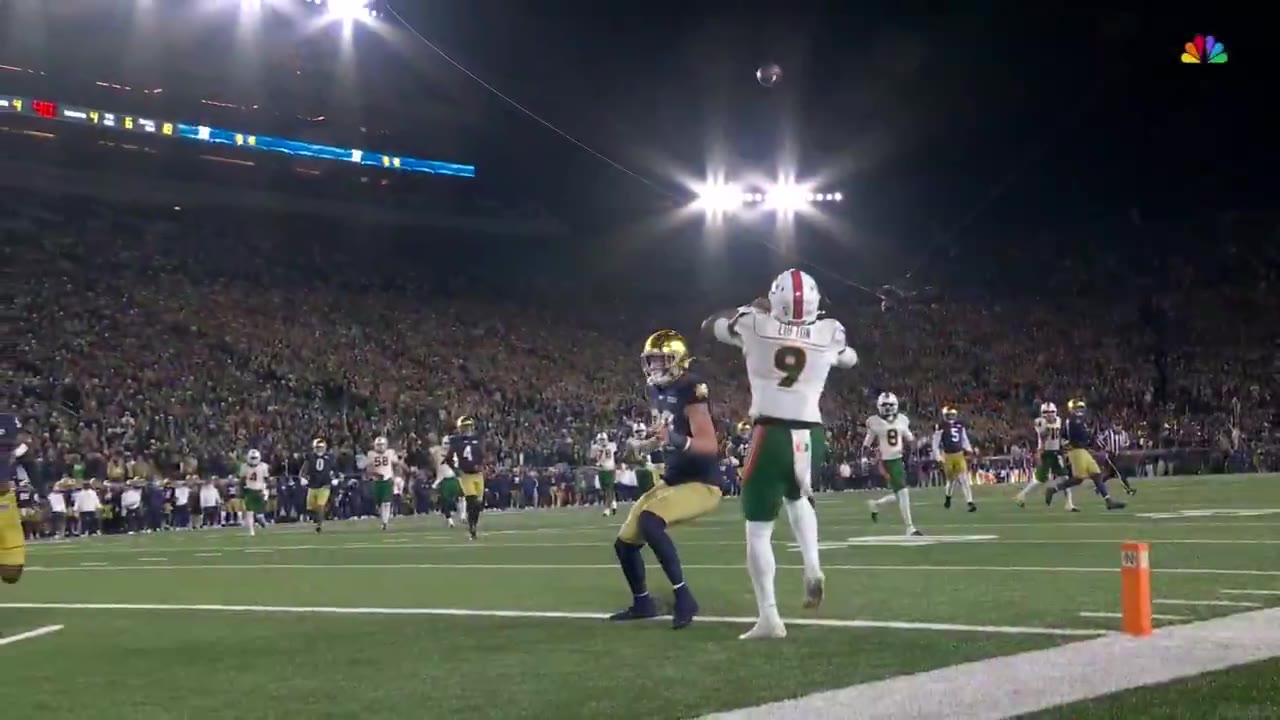
Mensah escaped pressure and put the ball up short left for Lofton in the end zone. Lofton went up with two hands, secured it, got both feet down in bounds, and turned. Notre Dame safety Luke Talich, playing through his hands the way defensive backs are taught, knocked the ball loose. Incomplete, the official ruled. The play went to automatic review. The review changed nothing: call upheld, turnover on downs.
Lofton finished with seven catches for 113 yards and a touchdown. None of the seven will be remembered like the one that never counted.
Full linescore and play-by-play: Game Center — Miami at Notre Dame.
Two Hands and Two Feet Were Never the Fight
The NCAA rulebook — Rule 2, Section 4, Article 3 — never uses the phrase “football move.” Here is what it actually asks. To catch a ball, a player:
1. Secures firm control with the hand(s) or arm(s) of a live ball in flight before the ball touches the ground, and
2. Touches the ground in bounds with any part of his body, and then
3. Maintains control of the ball long enough to enable him to perform an act common to the game, i.e., long enough to pitch or hand the ball, advance it, avoid or ward off an opponent, etc., and
4. Satisfies paragraphs b, c, and d below.
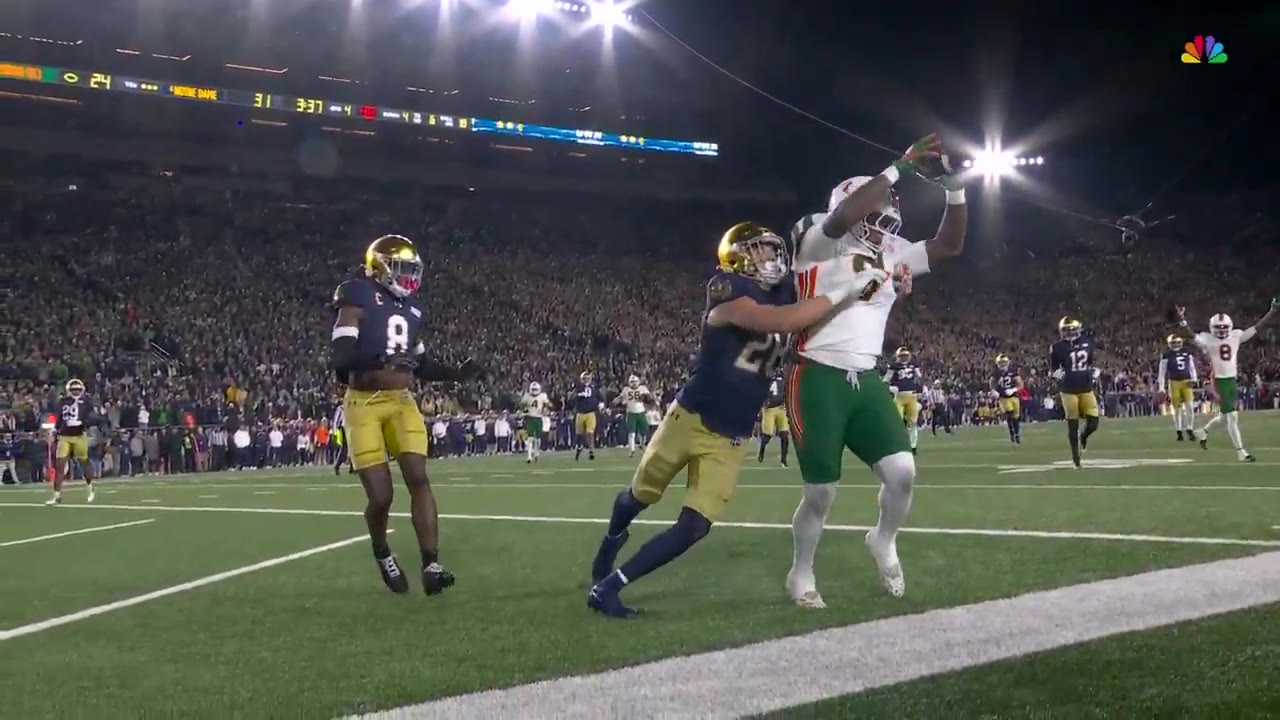
Elements one and two are not the argument. Lofton secured the ball with two hands, and college ball does not even ask for two feet — any part of the body in bounds does it. He gave them two feet anyway. Nobody serious is fighting over the first two lines of the rule.
The fight lives in element three, and in paragraph b:
If a player goes to the ground in the act of catching a pass (with or without contact by an opponent) he must maintain complete and continuous control of the ball throughout the process of contacting the ground, whether in the field of play or in the end zone.
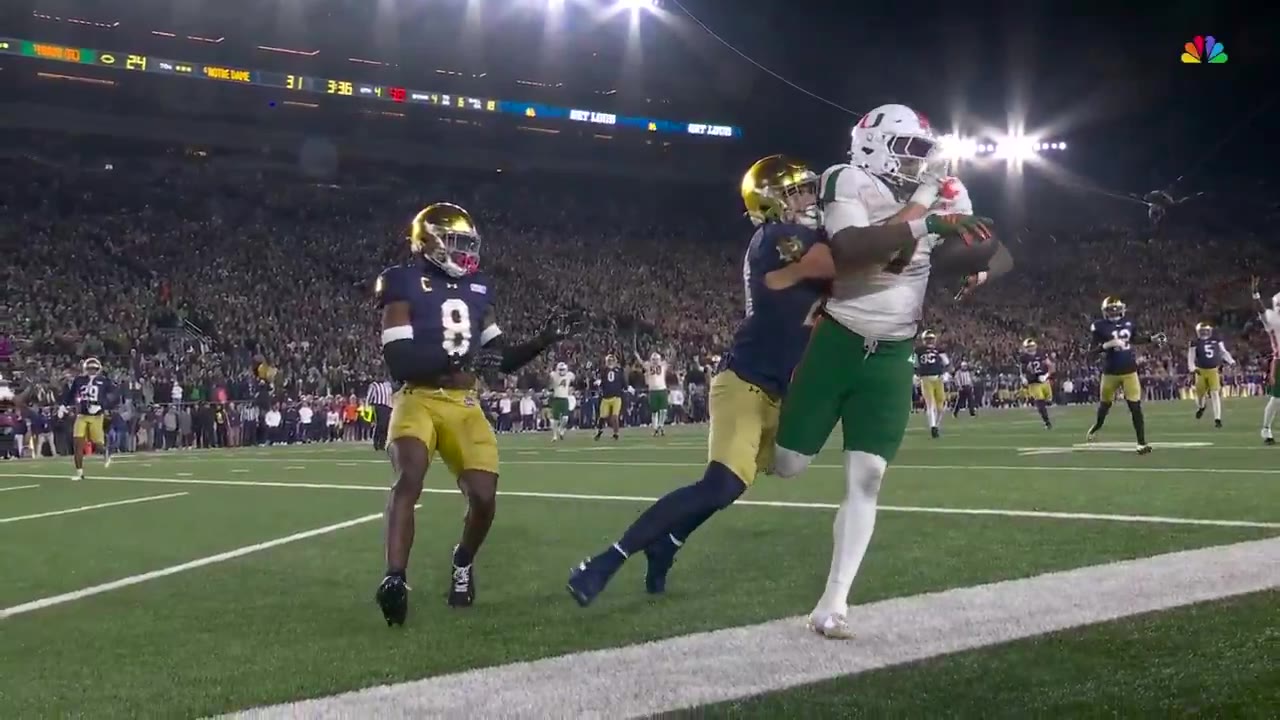
Miami’s case is the turn. Lofton caught it, landed, and turned his body — and turning upfield sure looks like advancing it, avoiding an opponent, doing the next thing a ball carrier does. The strongest sentence Miami has comes from Terry McAulay himself, the NBC rules analyst, in his published doctrine from a prior catch controversy: “The third element is ‘performing an act common to the game.’ An ‘additional step’ and ‘tucking the ball away’ are both noted as acts common to the game. Time may be a factor but is superseded if an actual act common to the game is performed.”
The other side reads the same rule and stops one beat earlier. According to theScore, the slow-motion read from the officials’ side is that Lofton caught the ball and got both feet in bounds, but did not perform an act common to the game while maintaining control — because Talich’s hand arrived before the process ever completed, and the ball came out.
Miami’s best paragraph in the book might be paragraph c: “a slight movement of the ball, even if it touches the ground, will not be considered a loss of possession; he must lose control of the ball in order for there to be a loss of possession.” Movement is not losing it. The whole argument compresses into one distinction — did Lofton lose control, or did a defender have to take it from a man who had already caught it?
Called Incomplete, It Stayed Incomplete
Here is the part that actually decided the game, and it is not in Rule 2 at all. It is in Rule 12, the replay rule:
The instant replay process operates under the fundamental assumption that the ruling on the field is correct. The replay official may reverse a ruling if and only if the video evidence convinces him beyond all doubt that the ruling on the field was incorrect. Without such indisputable video evidence, the replay official must allow the ruling to stand.
Beyond all doubt. That is the whole ballgame. A genuine 50/50 play — and this one split every comment section in America straight down the middle — cannot clear that bar by definition. If the official on the goal line raises his arms for a touchdown in real time, the same mountain of doubt protects Miami’s score. He waved it incomplete instead, and from that second, replay was never going to save the Hurricanes. The longest review in the world still ends at the same place: not beyond all doubt, ruling stands.
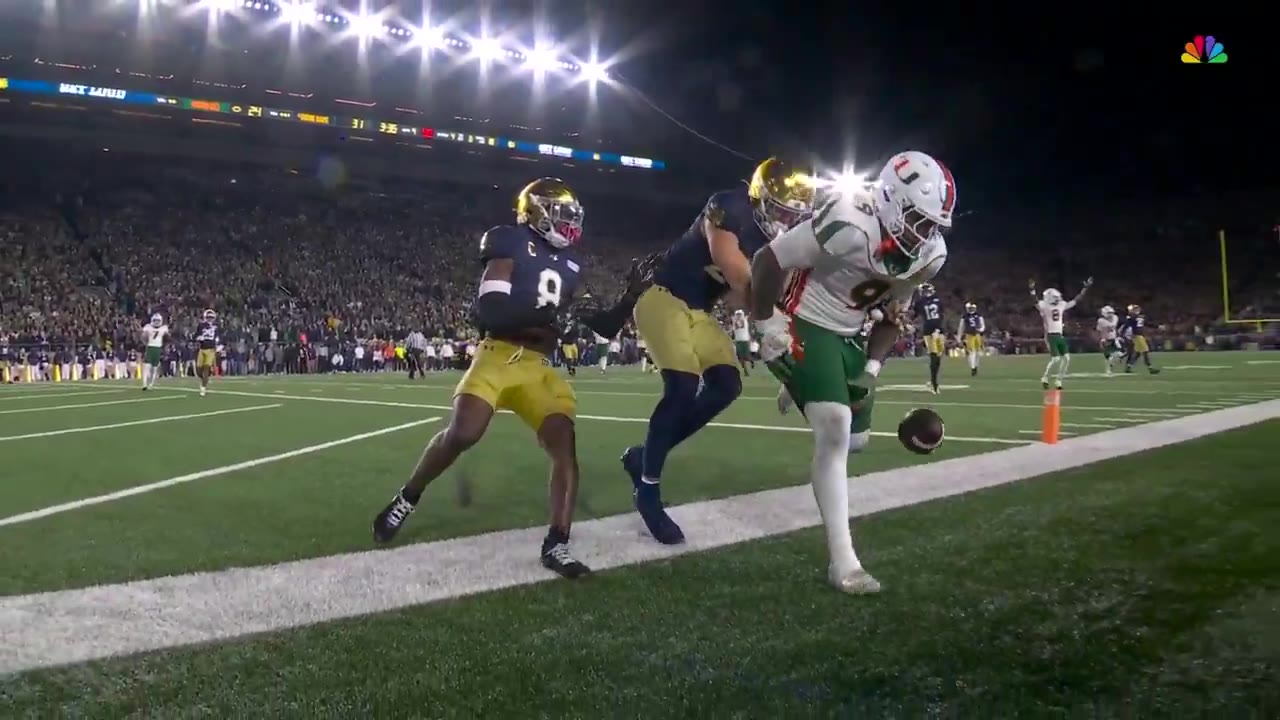
So the season did not turn on a camera angle. It turned on one man’s first instinct, in real time, at full speed. Everything after that was just the rulebook explaining why his instinct could not be undone.
Detroit and Green Bay Already Lived This
College fans reached for the same two names all night, and for good reason. In 2010, Calvin Johnson outjumped a Chicago defender in the end zone for what was ruled the go-ahead Detroit touchdown on the field — then replay took it away because Johnson, going to the ground in the act of the catch, put the ball on the turf and never kept control through the entire process. The play was so infamous it got his name attached to a rule.
Five years later, Dez Bryant did everything the eye test asks for in a playoff game at Green Bay: two feet, another step, the ball tucked, a lunge for the goal line on fourth down. Ruled a catch at the 1 on the field. Overturned on review anyway, because the ball came loose as he hit the ground. The outrage from those two plays eventually forced the NFL to rewrite its catch rule in 2018 — and the league acknowledged Bryant’s play would be a catch under the new one.
Lofton’s is the mirror image. Johnson and Bryant were catches on the field that replay erased. Lofton was an incompletion on the field that replay could not rescue. Same rule family, opposite burden — and it is the burden, not the hands, that buries you.
One Room Said Touchdown. The Other Said No Catch.
Miami’s head coach did not hide. “Really disappointed that they negated Elija Lofton’s touchdown with two hands on the ball and two feet in-bounds,” Mario Cristobal said afterward. Asked what explanation the officials gave him, he said: “Zero.”
Mensah backed his tight end. “I thought it was a touchdown,” he said.
Talich, the man whose hand ended it, said Notre Dame’s backs are taught to play through the hands and finish the play — which, on the film, is exactly what he did.
On NBC’s broadcast, rules analyst Terry McAulay backed the call on air, immediately — according to USA TODAY, he supported the officials’ ruling of no catch. CBS Sports writer Tom Fornelli landed in the same place from a different angle, posting on X: “This was an incredible job to evade pressure followed by a great throw from Mensah. Lofton just couldn’t hold on.” The argument split even inside the studios breaking it down — one analyst called it absolutely a catch, another said there is no planet where it is one. Both were looking at the same frames.
No. 1 Falls in South Bend
The honest cost comes first: the call did not end the game by itself. Miami got the ball back one last time, with 57 seconds left, and the last chance died on a hook-and-ladder that fell short. The Hurricanes had a second chance after the review. They did not convert it.
What the call took was the score itself. Six points makes it 31–30. The kick ties it 31–31. A two-point try could have put Miami in front. All of that lived inside one ruling, and the ruling went the other way.
So No. 1 falls. Miami is the fourth AP No. 1 team to lose this season, its perfect record is gone, and its road through the College Football Playoff picture just got a lot narrower — whatever number the next poll puts next to its name. Notre Dame, meanwhile, owns its first win over a No. 1 team since it beat Clemson in 2020 — the kind of win that hardens a playoff case all by itself.
Cristobal knew the danger before his team ever left Miami. He told them not to put the game in somebody else’s hands. Saturday night, on fourth-and-6 with the season in the air, the game landed in those hands anyway — and the hands let it drop.
“do not leave it in the hands of the officials.”
Sources · 6 sources
- NBC Sports — Miami at Notre Dame broadcast and highlights (November 7, 2026); rules analyst Terry McAulay's on-air breakdown of the play
- USA Today — Mario Cristobal calls out officials over the negated Lofton touchdown (November 8, 2026)
- theScore — Did the refs get it right negating Miami's possible game-tying TD? (November 8, 2026)
- NCAA.com — College football Week 10 live updates, recaps and scores (November 7, 2026)
- ESPN — Miami at Notre Dame box score, event 401858291 (Carr, Mensah and Lofton lines)
- NCAA Football Rules — Rule 2, Section 4, Article 3 (catch) and Rule 12 (instant replay philosophy and criterion for overturn)