
France woke up on Wednesday to a number it has not seen in 24 years. The country's 10-year government bond yield touched 5.002% at 0914 GMT, the first time the benchmark borrowing cost has reached 5% since July 10, 2002, Reuters reported. Just as telling was the gap between France and Germany: the spread between French and German 10-year yields reached roughly 157 basis points, Reuters reported, closing in on levels last seen in 2011, at the height of the euro-area debt crisis. Bond markets are usually the quietest room in finance. On Wednesday, the French corner of that room was making a noise nobody could ignore.
Some brief translation for the non-bond-market reader, because these numbers matter far beyond the trading desks that quote them. A bond yield is, in plain terms, the price investors charge a government to borrow their money. When the yield rises, the government's borrowing gets more expensive — and, over time, so does everything priced off it, from mortgages to business loans. The spread over Germany matters because German bonds are the eurozone's benchmark for safety: the wider the spread, the more investors are effectively fining France for the risk of lending to it instead. A fine of 157 basis points — 1.57 percentage points — is not a rounding error. It is a verdict.
The spread tells the story
The most useful way to understand Wednesday's milestone is as the latest step in a two-year climb, and Le Monde laid out the staircase in its report on the move. According to the French newspaper, the gap between French and German borrowing costs stood at roughly 50 basis points in May 2024. It widened to about 80 basis points a month later, after the dissolution of the National Assembly plunged French politics into turmoil. It then stayed stuck at elevated levels for nearly two years before lurching higher this autumn: 100 basis points on September 21, 120 on September 30, 140 on October 2, and now roughly 157 to 160, Le Monde reported.
Le Monde also supplied the historical frame that makes traders sit up. A spread this wide, the paper noted, has been reached only once before in the history of the euro — briefly, in 2011, when the eurozone's debt crisis had investors openly wondering whether the currency itself would survive. Before that, you have to go back to 1990. France is not being priced like a country in a currency crisis, exactly. But for the first time in a generation, it is being priced in the same neighborhood as one, and the direction of travel is unmistakably wrong.
Why investors are charging France more
Reuters pointed to a cluster of domestic causes. The French government has been weakened and is struggling to pass a budget and reduce a high public deficit, according to Reuters. Uncertainty hangs over a hotly contested election scheduled for next year. And widespread protests across France have added to the sense of a country whose politics cannot currently produce the decisions its finances require. None of those factors is mysterious, and none arrived overnight. What changed on Wednesday is simply that investors' patience, measured in basis points, reached another round number — the kind that makes headlines, embarrasses finance ministries and stiffens the resolve of everyone demanding the budget be fixed.
There is an uncomfortable feedback loop in stories like this, and it is worth naming. Higher yields make the deficit harder to close, because the state pays more to service its debt. A larger deficit makes investors demand higher yields. Governments escape the loop with growth, with credible budget plans, or with political stability that makes those plans believable — and Reuters' account suggests markets currently doubt France can produce the third, which is the ingredient that makes the first two possible.
'A self-inflicted sanction'
The sharpest summary of the moment came from Le Monde, which called the rise above 5% "a self-inflicted sanction." The paper's argument, as it framed the day's move, is that the damage is largely domestic — the product of a budgetary and political crisis — rather than the result of an international shock hitting France from outside. No foreign army, no collapsing bank, no pandemic. The bill arriving in the bond market was, on Le Monde's telling, written in Paris.
That framing cuts both ways, and it is the closest thing to good news in this story. Wounds inflicted from outside can only be endured; wounds inflicted by your own politics can, in principle, be healed by your own politics. A budget that passes, a deficit path that creditors believe, an election that produces a governable majority — any of these would give the spread a reason to narrow. The market is not saying France cannot pay. It is saying France has not yet shown how it will, and charging interest on the uncertainty in the meantime.
The rest of the world is not helping
Domestic politics may be the main author of France's problem, but the global backdrop is an unsympathetic editor. Reuters reported that government bond yields have risen around the world this year, as surging energy prices prompted central banks to raise interest rates — an environment in which every borrower's costs drift upward, and weak credits drift fastest. On Wednesday, Brent crude crossed $110 a barrel, Reuters reported, adding fresh pressure to the energy side of the equation. When oil is above $110 and central banks are in hiking mode, a finance ministry trying to convince markets of its discipline is arguing uphill, whatever flag flies over the building.
The strangest contrast of the day came from equity markets, which were having a perfectly pleasant time of it. Reuters noted that with 13% of S&P 500 companies having reported results, 86% had beaten estimates, according to LSEG data — a strong start to earnings season that supported stocks even as French bonds sold off, a mood reflected in Wall Street's third straight gain on Wednesday. Stock investors, in other words, were reading corporate America's numbers and smiling. Bond investors were reading France's numbers and reaching for a bigger risk premium. Both can be rational at once; only one of them sends a finance minister's phone buzzing at breakfast.
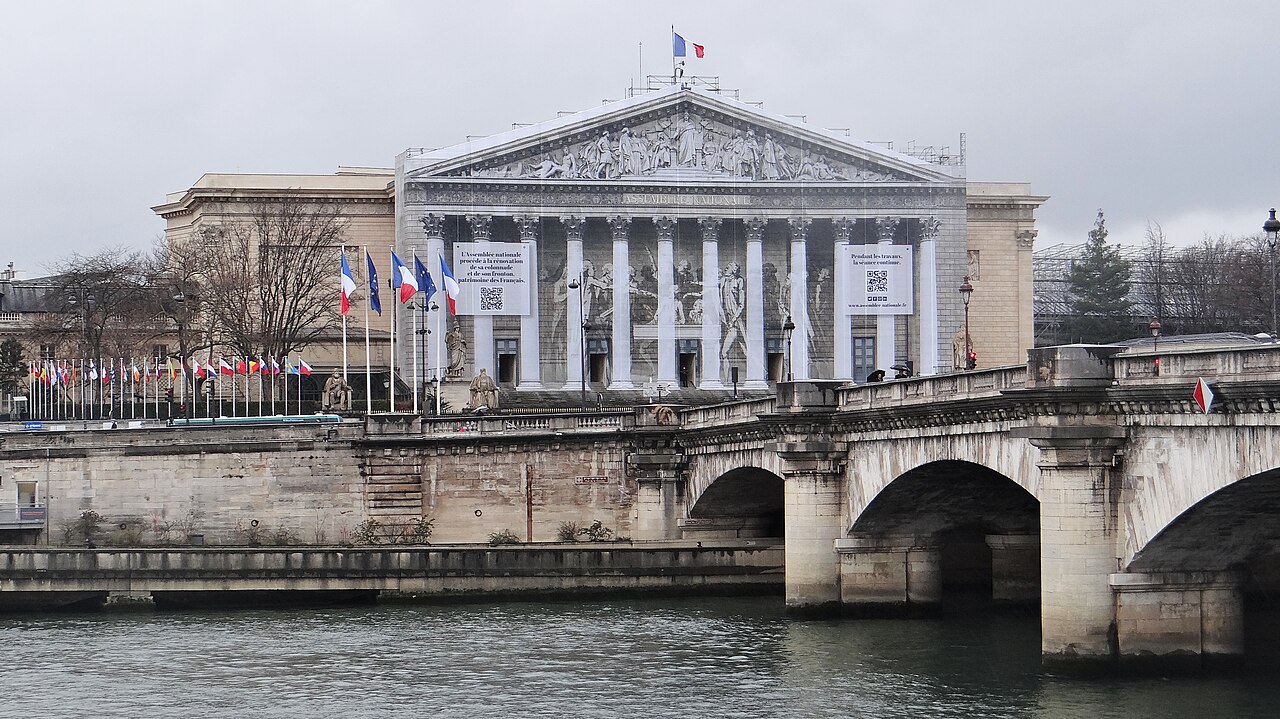
What happens next will be decided in the chamber pictured at the top of this story — the National Assembly at the Palais Bourbon, where France's budget fight will either produce a plan markets believe or another season of drift. The 5% yield is not a catastrophe. It is a meter running: every week the spread stays at crisis-era levels, the interest bill grows and the eventual fix gets more expensive. France has been here rarely enough that the date — July 10, 2002 — is worth remembering. The last time its borrowing cost touched 5%, the euro was three years old and the iPhone did not exist. The country that casually carried that rate then is wealthier, older and considerably deeper in debt now, and the market has noticed. Follow the continuing story at the Previously news hub.