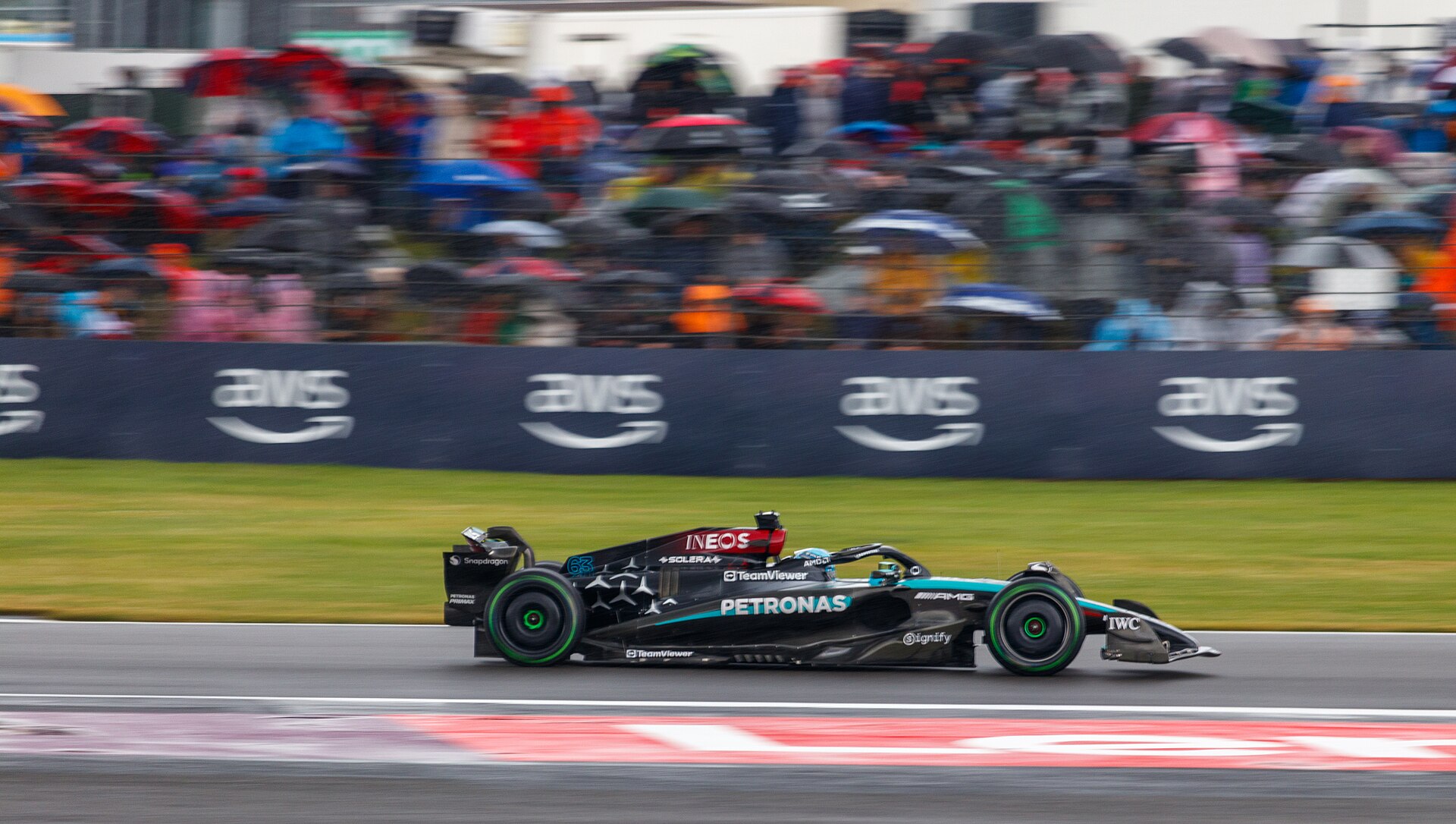

Most grid penalties are an apology. George Russell's next engine penalty is different: it is a comeback built on purpose. The Mercedes driver has told Sky Sports F1 that the upgraded power-unit element his team is preparing — a part that will send him toward the back of the grid wherever he takes it — will most likely be bolted in at the Las Vegas Grand Prix, three rounds later than originally expected, because if you have to start last somewhere, you start last somewhere you can pass. The plans have changed, and Las Vegas is the reason.
The original schedule had the new element arriving at the United States Grand Prix in Austin on October 23-25. Russell now says the timing has moved, with Las Vegas — race weekend November 19-21, under the lights on Saturday, November 21 at 8 p.m. local — the probable venue instead. His reasoning, in essence, was that the team now gets to choose its moment, and it intends to choose a circuit where overtaking is comparatively easy. That is not a hope. It is a description of the Las Vegas Strip Circuit.
How a Failure in Malaysia Rewrote the Calendar
To understand the delay, rewind two stops. A power-unit failure late in the race in Malaysia left Russell short of engine parts for the rest of the season, and the replacement unit fitted for Singapore pushed him beyond his permitted allocation — which is why he started that race from 19th, at the back of the field. What he did next is the entire argument for the Vegas plan: he drove through the field to finish ninth, salvaging points from a weekend that should have produced none.
That recovery also bought Mercedes options. Stacking a second penalty immediately, at the very next opportunity, would have meant consecutive weekends spent fighting through traffic with a championship already slipping away. Spreading the pain out lets the team pick its circuit, manage the remaining engine pool with some care, and give Russell the upgraded hardware at a track where its extra performance can actually be converted into overtaking moves rather than burned up in a midfield queue.

The Upgrade, the Rule and the Argument Behind It
The new element exists because of a mechanism with an unlovely name and very real consequences: ADUO, the FIA's Additional Development and Upgrade Opportunities system, which allows a manufacturer to homologate extra power-unit updates. For Mercedes, that means a newer specification can be introduced mid-cycle rather than waiting for the next full reset. The catch, for a driver already over his allocation, is that taking the part means taking the penalty with it.
Not everyone in the paddock accepts the basis on which Mercedes earned that opportunity. Red Bull has disputed the performance ranking that underpins the ADUO allowance — the measurement, in other words, of who is actually behind and therefore entitled to catch up. That argument will not be settled in Las Vegas, but it does add spice to the sight of a Mercedes starting at the back with a fresher, stronger engine than the cars in front of it.
Meanwhile, the rest of the car moves on without waiting. Mercedes deputy team principal Bradley Lord has said both cars should run the team's newer aerodynamic specification in Austin, so Russell's Texas weekend is not a write-off — he will have the updated aero, a title fight to influence even if he can no longer win it, and no engine penalty to serve. The hardware split is deliberate: aero now, engine later, penalty where it hurts least.
A Title Fight He Is Watching, Not Chasing
The standings explain the freedom. Russell trails his teammate Kimi Antonelli by 102 points with six rounds remaining — a gap that, realistically, ends his championship hopes for this season. Antonelli, by contrast, could settle the title as early as Austin if the results fall a particular way there. When your own campaign is effectively over, the rational move is exactly the one Russell is making: stop protecting weekends that no longer matter in the standings and optimize the ones that remain for points, data and pride.
Russell has been open that his focus for the run-in is helping Mercedes understand and improve a car whose recent upgrade package has proved troublesome, while Red Bull's form has surged. A penalty weekend in Las Vegas fits that brief neatly — a long, fast laboratory at night, with a driver who has already proved this season, in Singapore, that a back-row start is a problem he knows how to solve.

Why Vegas, Specifically
Street circuits are supposed to be processions. Las Vegas is the exception that makes strategists greedy. The Strip Circuit measures 6.2 kilometres — 3.8 miles — with 17 turns, but its character is defined by speed: average lap speeds in Monza territory, a long blast down the Strip itself, and heavy braking zones that invite lunges and reward a car with fresh power and strong traction. Add a Saturday night start, cool desert air and a field that tends to bunch up, and you have the rare street track where starting position is a handicap rather than a verdict.
Russell knows the evidence firsthand, because he generated it. Singapore is a far less forgiving overtaking circuit than Las Vegas, and he still turned 19th into ninth there. Put the same driver, in an upgraded car, on a track built around a straight more than a mile long, and a points finish from the back is not optimism — it is the baseline expectation, with a top-six charge as the genuine upside. It is also, not incidentally, the kind of drive that steals a show on the sport's most theatrical weekend. For more on how the run-in is shaping up, see our guide to the season-finale stretch through Las Vegas, Qatar and Abu Dhabi, browse the Sports desk, or catch up on the rest of the day on our News front.