
Start with the problem every furniture maker inherits: wood is straight, and it would like to stay that way. A board resists the curve. Walsh's answer, developed over the Enignum series he began in 2009, is to stop arguing with the board. Strip it down first.
His own description of the process has barely changed in years, because the process hasn't. He strips wood into thin layers, manipulates and reconstructs them into free-form compositions, then shapes through the layers to reveal the structure underneath. A thin layer bends where a board breaks. Laminated back together, the layers hold the curve — and when Walsh carves through the finished form, the strata show, so the construction stays visible in the surface.
The name is a clue to how he thinks about it. Enignum joins the Latin enigma, mystery, and lignum, wood. For Walsh, the mystery of the composition lies in the material — a maker's way of saying the wood gets a vote. Grain direction, density and the way a particular tree grew all push back against the drawing, and the finished piece records the negotiation.
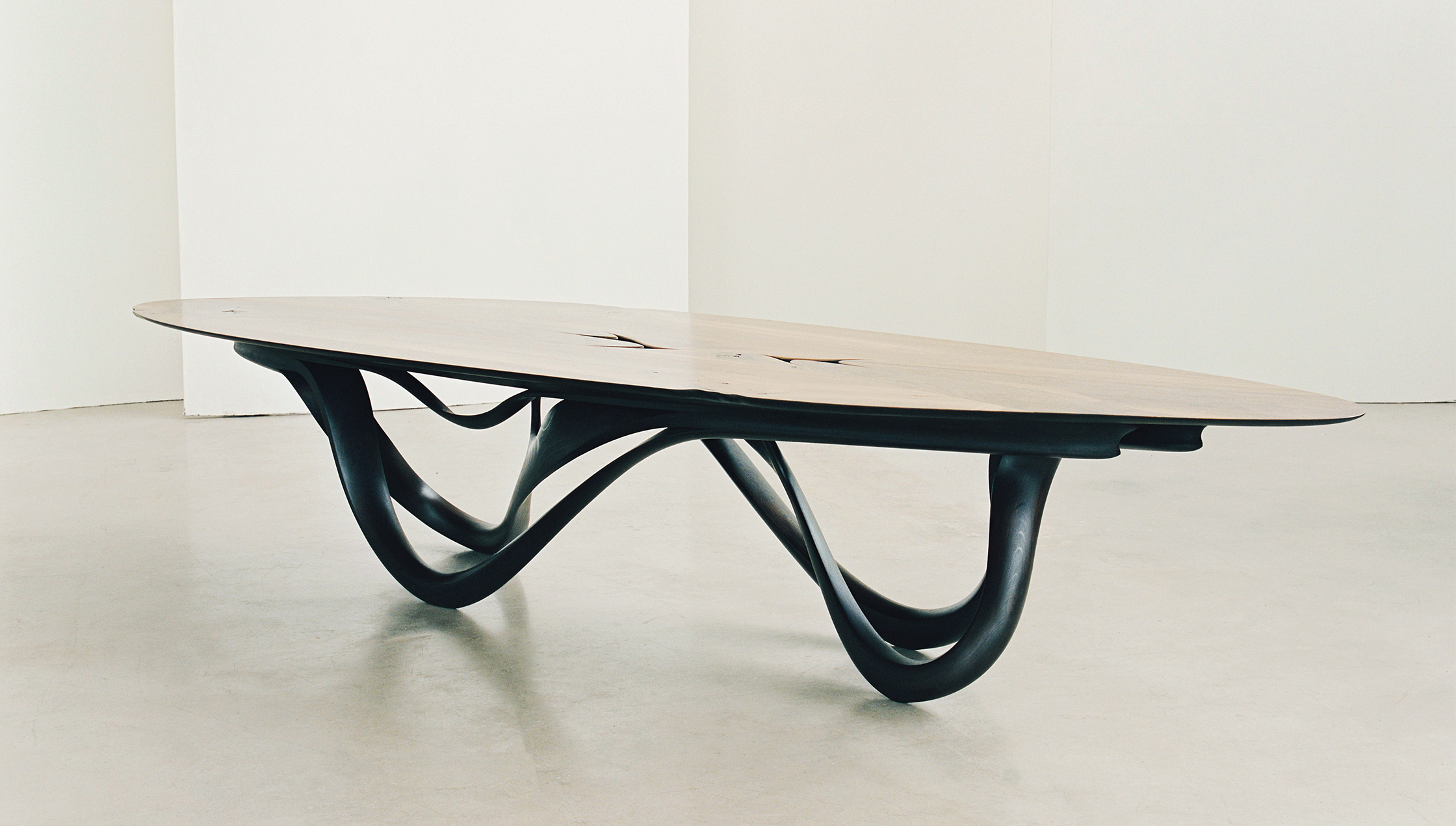
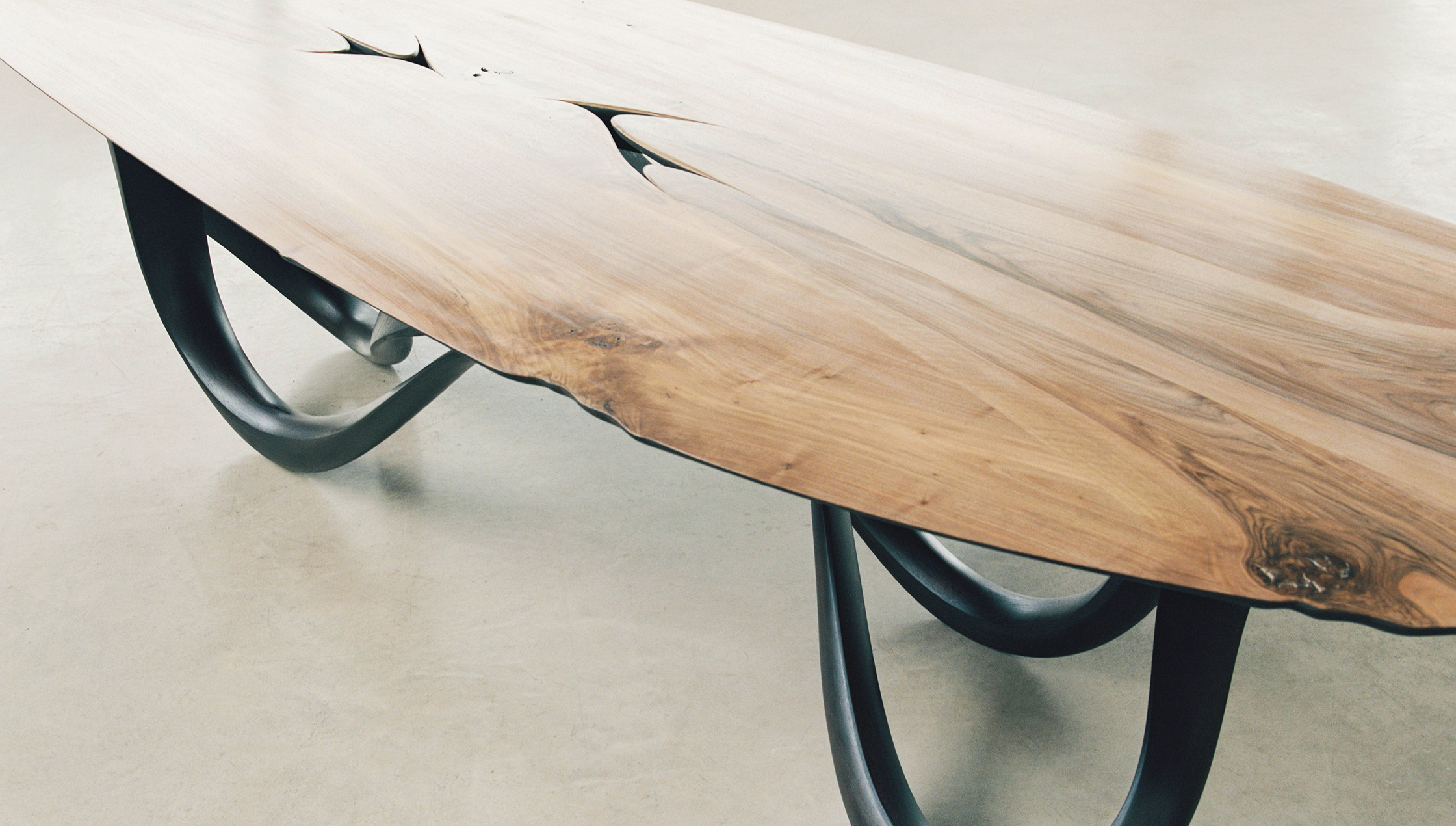
The walnut table in these pictures is the first Enignum piece made in walnut. The top reads almost calm — until you reach the dark base, where the layered wood loops down, crosses itself and comes back up like something poured rather than joined. None of it is carved from a solid block to imitate bending. It is bending, fixed.
Walsh came to this without a school behind him. Born in 1979, he started working wood at eight and is entirely self-taught; at nineteen he opened his studio at Fartha, Riverstick, County Cork, on the farm his family has worked for generations, and everything is still made there. Pieces begin as sketches, move through models and computer rendering, then reach the bench, where the strips are cut and formed by hand with a small team.
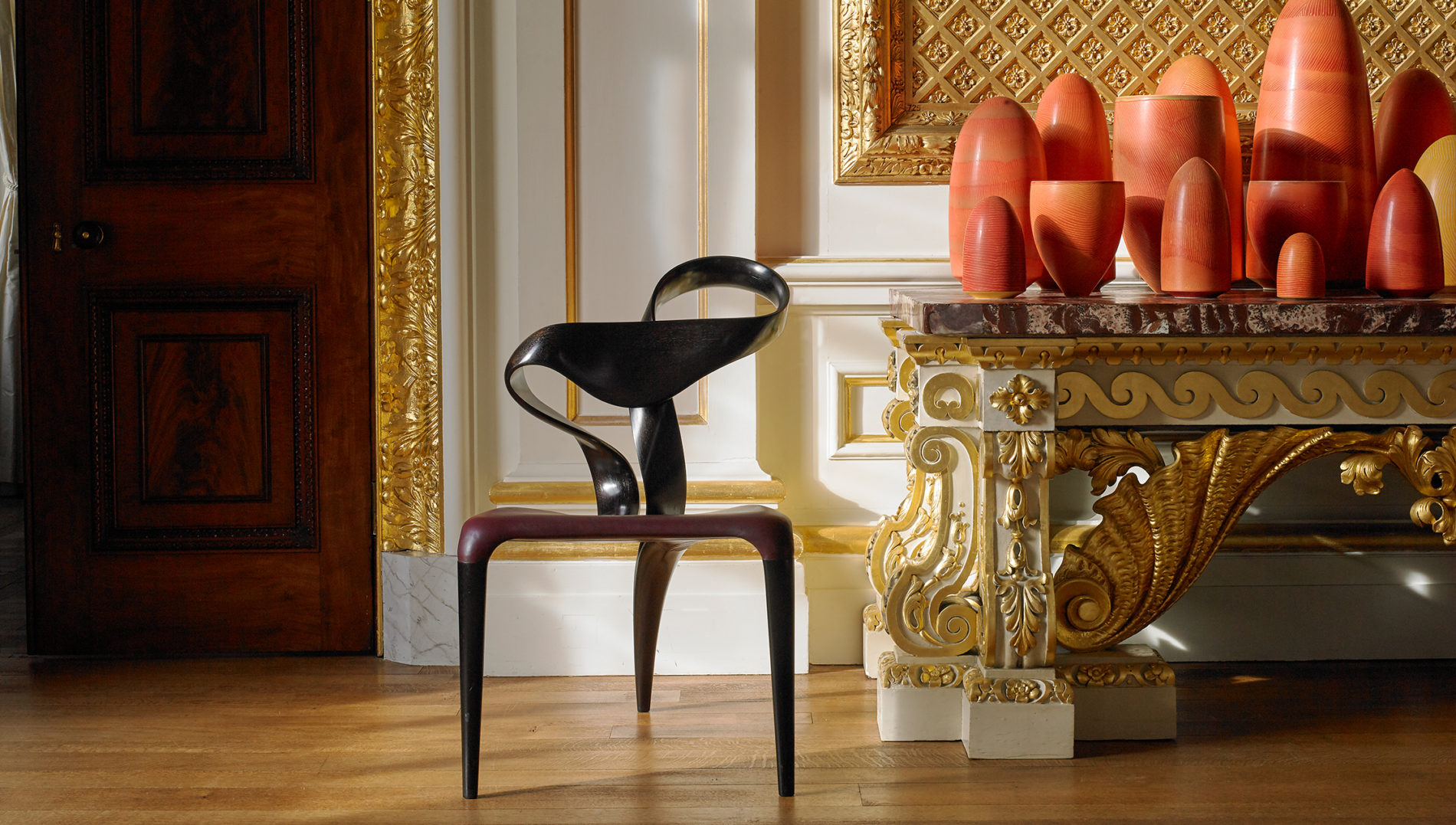
The work travels further than the farm suggests. The Duke and Duchess of Devonshire commissioned twenty-four Enignum Locus chairs for Chatsworth House, each one unique — no two sitters at that table get the same backrest. The Metropolitan Museum of Art holds the final artist's proof of that commission, in bleached European ash and lambskin, and the Cooper Hewitt acquired an Enignum Free Form Chair with its process pieces in 2015 — museums collecting not just the chair, but how it came to be.
Previously's Take
Most luxury furniture asks to be admired from a respectful distance. Walsh's asks a better question — how is that standing up? The Enignum pieces answer it in their own surfaces, layer lines and all. That honesty is the luxury: a table that shows its working, made by a self-taught man on a Cork farm.
The numbers
Sources · 4 sources
- Joseph Walsh Studio — Enignum Table portfolio page; studio address, Fartha, County Cork
- The Metropolitan Museum of Art — Enignum Locus Chatsworth Chair I, final artist proof (object 2019.301)
- Cooper Hewitt, Smithsonian Design Museum — "Flowing Form Blends the Man-Made with the Organic," 2017
- Sotheby's — Joseph Walsh, Modern Makers sale notes (Enignum from 2009; studio established 1999)
Photographs: Joseph Walsh Studio · Joseph Walsh Studio · Joseph Walsh Studio