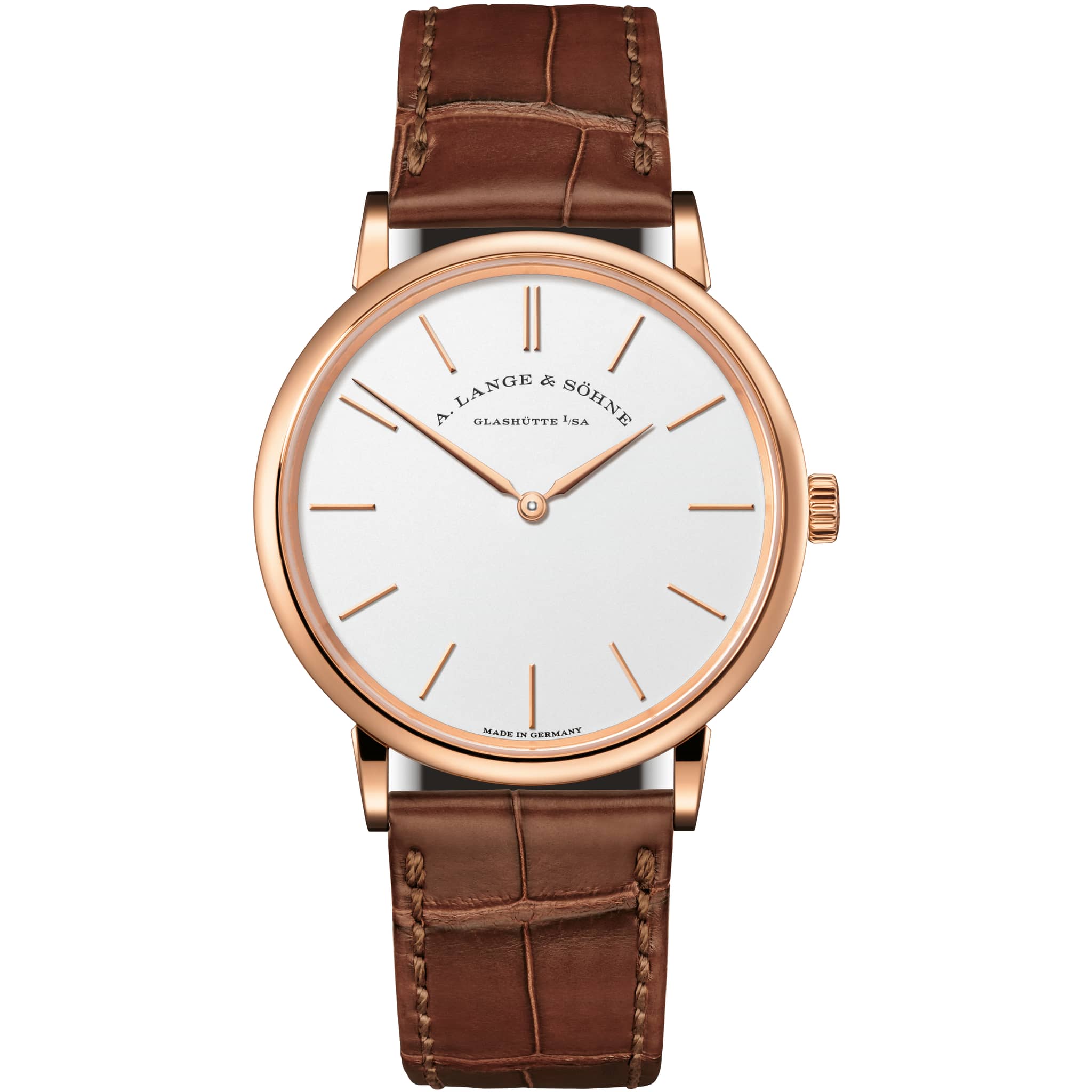

From the front, the Saxonia Thin refuses to perform. The reference 201.033 is a 37-millimetre case in pink gold, just 5.9 millimetres thick, holding a solid-silver argenté dial, two hands and a set of slim baton markers. It is the thinnest watch the manufacture makes, and it does the least of any watch in the catalogue: hours, minutes, full stop.
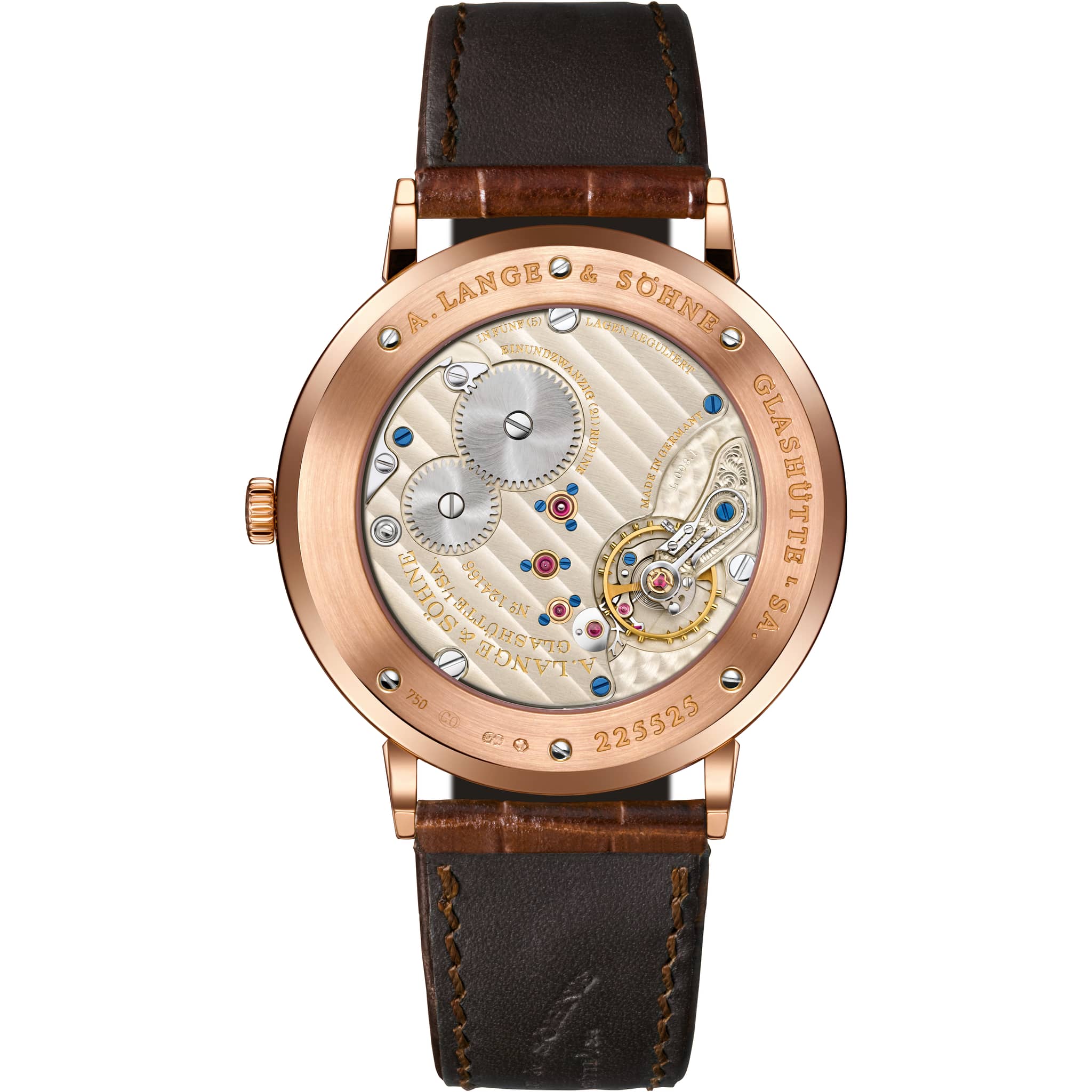
The restraint is a feint. Lange states the policy plainly on its own craft pages: every timepiece it makes, "from the SAXONIA THIN, a simple two-hand watch, to great complications," is finished by hand, and every component is decorated to the same standard whether or not it will ever be visible. The movement inside this one, the manually wound calibre L093.1, is only 2.9 millimetres thick — a flat mainspring barrel helps it hold a 72-hour power reserve anyway — and its 167 parts pass through eleven named finishing techniques. Ribbing across the three-quarter plate. Perlage stippled onto surfaces the owner will never see. Chamfers bevelled and polished to a uniform angle and width on virtually every edge. Internal angles polished by hand with a pencil-like tool because, as Lange puts it, a rounded internal angle is how you know a machine did it.
Some of the work is measured in units that have nothing to do with efficiency. A finisseur can spend up to two hours mirror-polishing a single small spring, pressing it into elderberry pith and guiding it in figures of eight over diamond-powder films, knowing one grain of dust can erase the whole session. Black polishing, reserved for a few select parts, can take several days. Lange says it takes months of practice just to execute a flat polish perfectly.
And then there is the balance cock. Every Lange watch carries one, hand-engraved with a floral motif that has come down through generations of the Lange family: petals gathered around the component's central screw, the pattern following the outline of the part itself. The motif is fixed. The hand is not. Each engraver cuts at a personal depth, with a personal curl to the lines, so no two balance cocks are alike — Lange calls the result an inimitable fingerprint, a signature that sets each individual watch apart. It sits on the back of the movement, under a sapphire caseback, smaller than a fingernail.
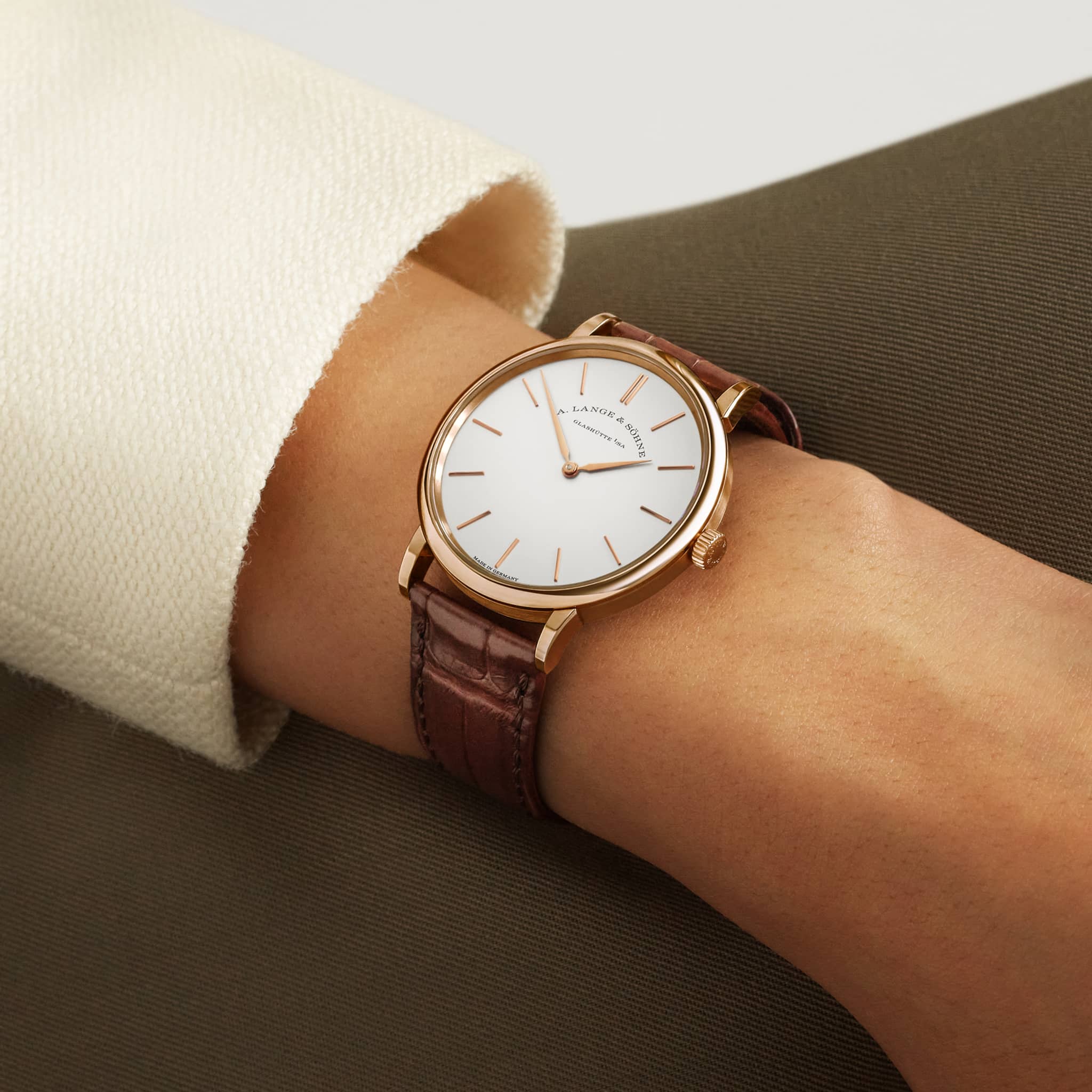
That is the Saxonia Thin's whole argument. The dial gives you almost nothing to look at, because the watch was never really addressed to the person glancing at your wrist. It is addressed to the person who turns it over.
Previously's Take
Most luxury pricing asks you to pay for what other people can see. Lange's simplest watch inverts the deal: the money is on the side facing your skin, in polishing nobody was owed and an engraving that functions as one craftsperson's handwriting. If you want to understand what finishing actually means in watchmaking, this two-hand watch is the cleanest lesson the industry offers.
The numbers
Sources · 4 sources
- A. Lange & Söhne — official Saxonia Thin reference 201.033 product page (specifications; price upon request)
- A. Lange & Söhne — official "Finishing and engraving" manufacture explainer (11 techniques; balance-cock engraving; Saxonia Thin named explicitly)
- Europa Star — Saxonia Thin technical specifications, calibre L093.1
- Monochrome Watches — hands-on, Saxonia Thin (calibre architecture and finishing detail)
Photographs: A. Lange & Söhne · A. Lange & Söhne · A. Lange & Söhne