
The Short Version
- Anthropic’s price war: Claude Haiku 5.5 launched October 7 at $0.10/$0.50 per million tokens for short prompts — 90% cheaper than Haiku 4.5 — with a 1M-token context window and adjustable effort controls.
- Deno’s exit: Cloudflare acquired Deno on October 9 to make its Workers model self-hostable. The Deno runtime gets one more year; Deno Deploy shuts down in six months. Covered in a separate story in today’s cycle.
- Europe’s trillion-parameter answer: Mistral launched Large 4 (“Le Chonk”) in public preview October 6 — roughly 1 trillion parameters, open weights promised by end of October.
- Plus: Reflection AI unveiled Beam, its first open-weight model (Oct 5); Nous Research closed a $90M Series B at a $1.5B valuation to sell its Hermes agent to businesses; and Cal AI co-founder Zach Yadegari, 19, raised $10M for Persona, a $179 AI wristband shipping in December.
SAN FRANCISCO
It was supposed to be the quiet week before the conference circuit. Instead, the first full week of October delivered one of the densest clusters of AI startup news this year: a price war in small models, the end of an independent JavaScript runtime, a trillion-parameter bet from Paris, the public debut of a $25 billion startup’s first model, a $90 million round for an open-source agent going enterprise, and a teenager’s $179 wristband. Here’s what actually happened — each item verified against multiple reports, with the speculation clearly labeled as speculation.
Anthropic’s Haiku 5.5 declares a price war
The week opened with Anthropic launching Claude Haiku 5.5 on October 7 — the third model in its Claude 5.5 family in a month, per Reuters, and a lineup expansion ahead of a planned IPO. This is the small, fast, cheap end of the Claude family, built for high-volume work: classification, summarization, extraction, live support, voice agents, in-app assistants. And the pricing is the story. For prompts up to 100,000 tokens, Haiku 5.5 costs $0.10 per million input tokens and $0.50 per million output tokens; above 100K it rises to $0.50 and $2.50. Anthropic says that’s a 90% price cut for short prompts and roughly 75% less to run on average than Haiku 4.5 — and notes that about 90% of Haiku 4.5 requests fell in the cheaper band.
The pricing directly matches OpenAI’s GPT-6 Luna — $0.10/$0.50 — and Anthropic’s own benchmark table claims Haiku 5.5 beats Luna on every shared test: 72.4% vs. 48.9% on OSWorld 2.1, 39.2% vs. 16.4% on Terminal-Bench 4.0 (where Haiku 4.5 scored 0%), 46.4% vs. 42.4% on FrontierCode. Treat those as vendor claims for now; Anthropic hasn’t said whether it ran Luna itself or used OpenAI’s figures. The specs are real either way: a 1M-token context window (up from 200K), 128K max output (up from 64K), and the first Haiku with adjustable effort controls and adaptive thinking — a dial for how long the model reasons before answering. It’s also the first Haiku with built-in safeguards for a narrow set of high-risk cybersecurity requests. The model shipped the same day on Claude.ai, the Claude Platform, Claude Code, AWS Bedrock, Google Cloud and Azure, and it’s in GitHub Copilot too. Anthropic also halved cache-read prices for Sonnet 5.5, which it says makes most agentic work about 20% cheaper.
Cloudflare buys Deno — the independent runtime era ends
Friday brought the week’s biggest infrastructure story: Cloudflare is acquiring Deno, the company behind the JavaScript runtime, to improve its Workers programming model. Terms weren’t disclosed; Deno had raised $26 million total, including a Series A led by Sequoia. The strategy is about portability — folding Deno’s celld, its self-hosted implementation of the Workers/Durable Objects model released in August, into workerd, Cloudflare’s open-source Workers runtime, so developers can run Workers on their own infrastructure. Deno co-founders Ryan Dahl (who created Node.js) and Bert Belder are joining Cloudflare to lead the effort alongside Workers principal engineer Kenton Varda.
The timelines are now hard deadlines, not vibes: the Deno runtime gets one more year of monthly maintenance releases, then Deno ends its development (it stays open source); Deno Deploy keeps operating for six months, then shuts down; JSR, the JavaScript/TypeScript registry, continues with its infrastructure moving to Cloudflare. The acquisition is covered in a separate story in today’s cycle, including what it means for the JavaScript toolchain Cloudflare has been assembling all year.
Mistral’s “Le Chonk” goes trillion-scale
On October 6, the day before Haiku 5.5, France’s Mistral launched the public preview of Mistral Large 4 — nicknamed “Le Chonk” — and it is the largest model the company has ever built: roughly 1 trillion total parameters (the model card says 1.05T) with around 49 billion active per the announcement, or 52 billion per the model card. Mistral’s own documentation disagrees with its announcement slightly on the active-parameter figure, which is worth noting in a launch otherwise heavy on superlatives. It’s a natively multimodal mixture-of-experts model with a 1.6B-parameter vision encoder and a 1M-token context window, trained from scratch on 3,800 Nvidia Grace Blackwell GPUs in Mistral’s own European data centers.
The positioning is geopolitical as much as technical. For most of the past year, the strongest open-weight models have come from Chinese labs — Kimi K3 in July, GLM-5.3 in August — while the strongest models overall stayed closed behind US APIs. Mistral wants a third slot: it says Large 4 already performs competitively with the strongest open models globally while outperforming any open-weight model built in the US or Europe. Independent evaluations back the cybersecurity claims and put it mid-pack on finance, so consider the sweeping claims provisional until outsiders can test the weights. Speaking of which: the API is live now — listed at $1.36/$4.18 per million tokens, currently half off during preview — and the open weights are promised by end of October, with the 27th as the date to watch. The license terms hadn’t been detailed at publication; check them on release day before building anything commercial on it.
Reflection AI finally shows its model: Beam
The week actually started October 5 with the most anticipated debut of the bunch. Reflection AI — the New York startup founded in 2024 by former DeepMind researchers Misha Laskin and Ioannis Antonoglou, valued at $25 billion in March, with $800 million from Nvidia on the cap table — unveiled Beam, its first open-weight model. The company had raised nearly $5 billion without ever shipping a public model; Beam is the first proof of what that money built. (We reported earlier this week that Nvidia is in talks to acquire Reflection or deepen its investment.)

Beam is a text-only sparse mixture-of-experts model: 501 billion total parameters, just 23 billion active per token, with a 1M-token context window, built for coding, reasoning and agentic work. The pitch is efficiency, not peak capability — Reflection claims Beam matches Z.ai’s GLM-5.2 on reasoning and coding benchmarks while using a quarter to a third of the inference compute. Those are company-reported figures, not yet independently verified; Moonshot’s Kimi K3 still leads on raw capability by most accounts. The weights are promised under an Apache 2.0 license later in October, with a technical report and model card to follow; for now it’s waitlist-only early access. For the scale of the bet: Reflection says it pretrained on 23.8 trillion tokens, then ran reinforcement learning generating more than 100 million rollouts across 10,500 Nvidia GB300 GPUs over four weeks. Whether efficiency wins the open-model race is now an empirical question — and we’ll get to test it this month.
Nous Research: $90M to take the open-source agent mainstream
October 7 also brought confirmation of one of the year’s most-watched AI fundraises. Nous Research closed a $90 million Series B at a $1.5 billion valuation — first reported by The Wall Street Journal, with TechCrunch having flagged the valuation back in July. Robot Ventures led the round, with Nvidia, Microsoft’s M12, Samsung, Union Square Ventures, Menlo Ventures, 1789 Capital and Y Combinator participating, bringing the three-year-old startup’s total funding to about $158 million.
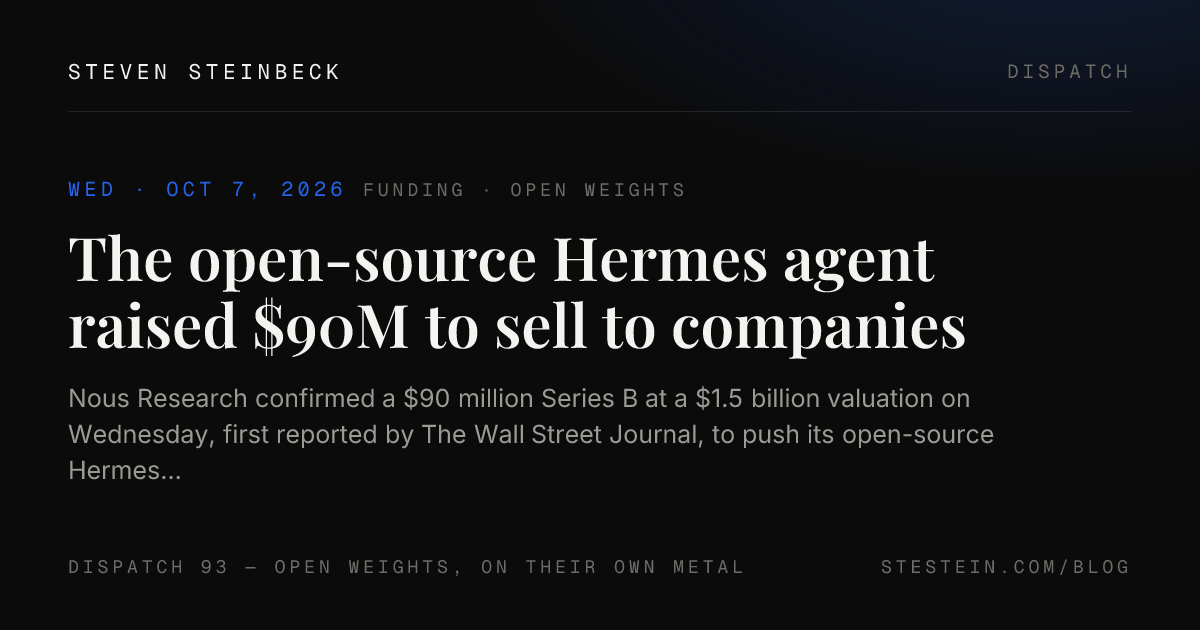
The money funds “Hermes for Businesses”: customized agents that do multi-step work while keeping a company’s data on its own terms — the open-weights pitch aimed at corporate buyers wary of depending on a single provider. The traction is real: the open-source Hermes agent has been downloaded more than 22 million times since its February launch, per the Journal (the company has put the figure as high as 24 million), and Nous estimates it drives about 2.5% of global AI token consumption. The Journal puts annualized revenue at roughly $36 million as of mid-September, with the company expecting to pass $100 million before year’s end — company-sourced figures, but a serious jump from the $50 million Series A led by Paradigm in April 2025. Founded in 2023 by Jeffrey Quesnelle, Karan Malhotra, Ryan Teknium and Shivani Mitra, Nous built its name on open weights without the usual content filters and a decentralized Psyche network that coordinates GPUs across the internet. Nvidia and Samsung writing checks here reads as a bet on agent infrastructure, not just another model.
The $179 wristband: Persona raises $10M
And then there’s the week’s most fun story. Zach Yadegari — 19 years old, co-founder of the calorie-tracking app Cal AI, which MyFitnessPal acquired in March 2026 for an undisclosed sum after reportedly topping $30 million in annual revenue in under two years — has raised $10 million for his next act: Persona, a personal AI agent. The round, announced October 8, was led by Vine Ventures, with Z Fellows founder Cory Levy, Collective Global, WHOOP and Eight Sleep participating.
Persona lives in two places. Right now it’s a free iMessage beta — “a few thousand” users, per the company — where you text it to book travel, order food and rides, manage email and take notes. In December comes the hardware: a $179 wristband that activates the assistant with a button press or a flick of the wrist, deliberately not always listening. The business model includes ads — sponsored results shown while the agent does shopping research — and purchases require your approval through outside providers like Stripe Link; the agent never sees your card details. Preorders are reportedly already in the “five figures” in revenue, per TechCrunch via company figures. As Yadegari told Inc.: “Our mission is really to just make computing seamless with human life, and that’s what physical hardware actually allows.” The graveyard of AI hardware is crowded — but a founder who already sold one company at 18 gets the benefit of the doubt.
Sources · 8 sources
- gtstu.com — Weekly AI startup news roundup (Oct 11, 2026)
- Reuters — Anthropic launches Claude Haiku 5.5, third Claude 5.5 model ahead of planned IPO (Oct 7, 2026)
- TechCrunch — Cloudflare acquires Deno to improve its Workers programming model (Oct 10, 2026)
- DataCamp — Mistral Large 4 (Le Chonk): specs, benchmarks, weights timeline
- DataCamp — Beam: Reflection AI’s 501B open-weight model
- stestein.com — Nous Research $90M Series B at $1.5B valuation (via WSJ; Oct 9, 2026)
- Forbes Europe — Nous Research targets business users with Hermes (via TechCrunch; Oct 2026)
- Inc. — Zach Yadegari raises $10M for Persona AI assistant and $179 wearable
More from the newsroom: Nvidia’s talks with Reflection AI · Claude Sonnet 5.5’s launch · AI’s vendor-financing debt fears





