
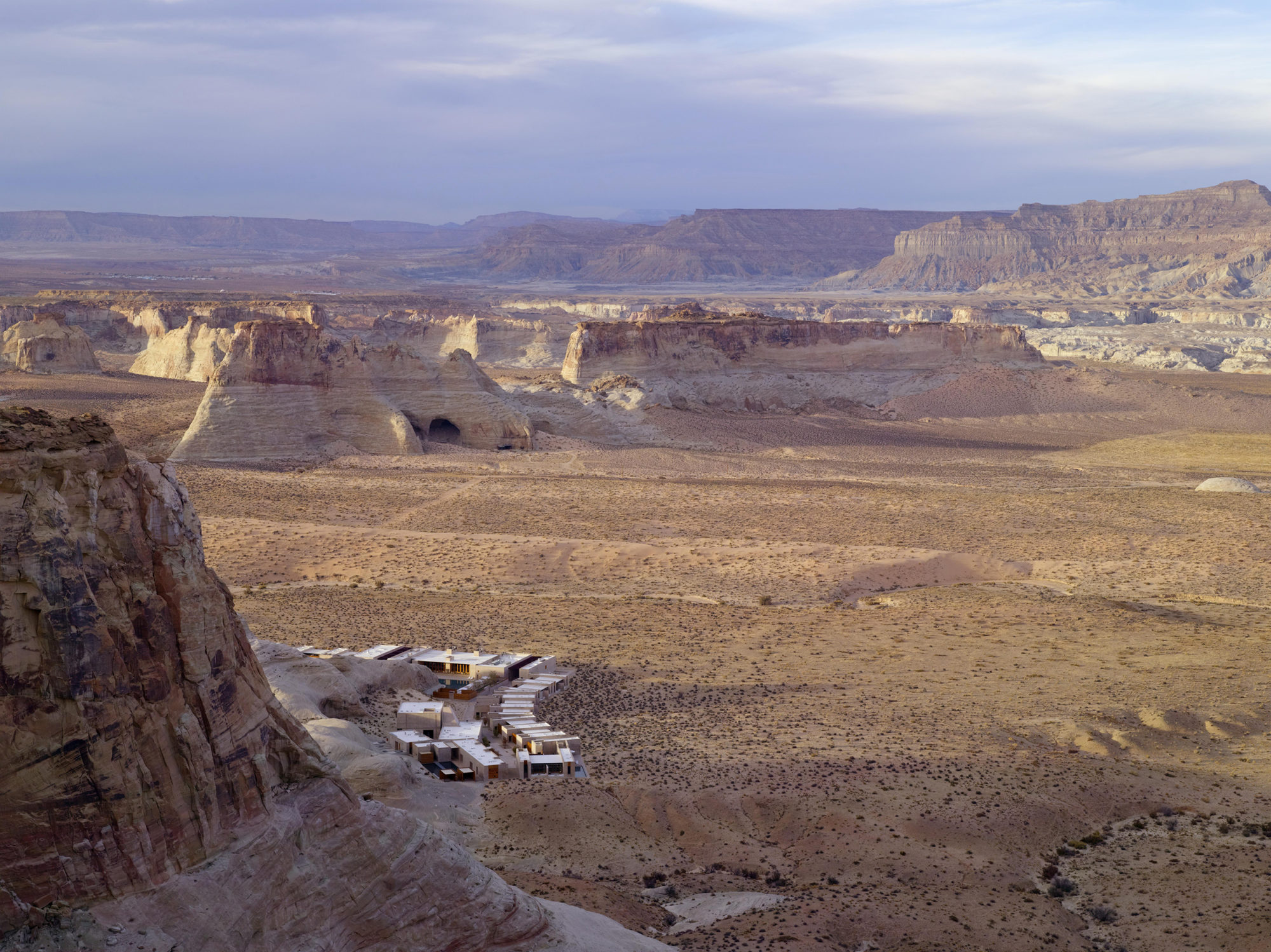
Amangiri sits in a protected valley at Canyon Point, near the Arizona line, looking toward the Grand Staircase-Escalante National Monument. Getting the location right was the whole design problem. The land is ancient — the rock formation the resort is organised around is routinely dated at more than 160 million years old — and any building that tried to compete with it would lose. So the architects chose surrender as a strategy.
The resort was a collaboration between three architects: Marwan Al-Sayed, Wendell Burnette and Rick Joy. Their shared answer was weight laid low. Amangiri is built from dense concrete cast in a custom mix that incorporates local sand, so the walls carry the colour and grain of the surrounding stone rather than sitting on top of it. The volumes are horizontal and broken into a striated, staccato profile that follows the strata lines of the mesas behind them. Studio Rick Joy's own project record describes the intention plainly: the architecture retreats into the rocky landscape through its dense materiality, and what comes to the foreground instead is the experience — sound, texture, light, mood.
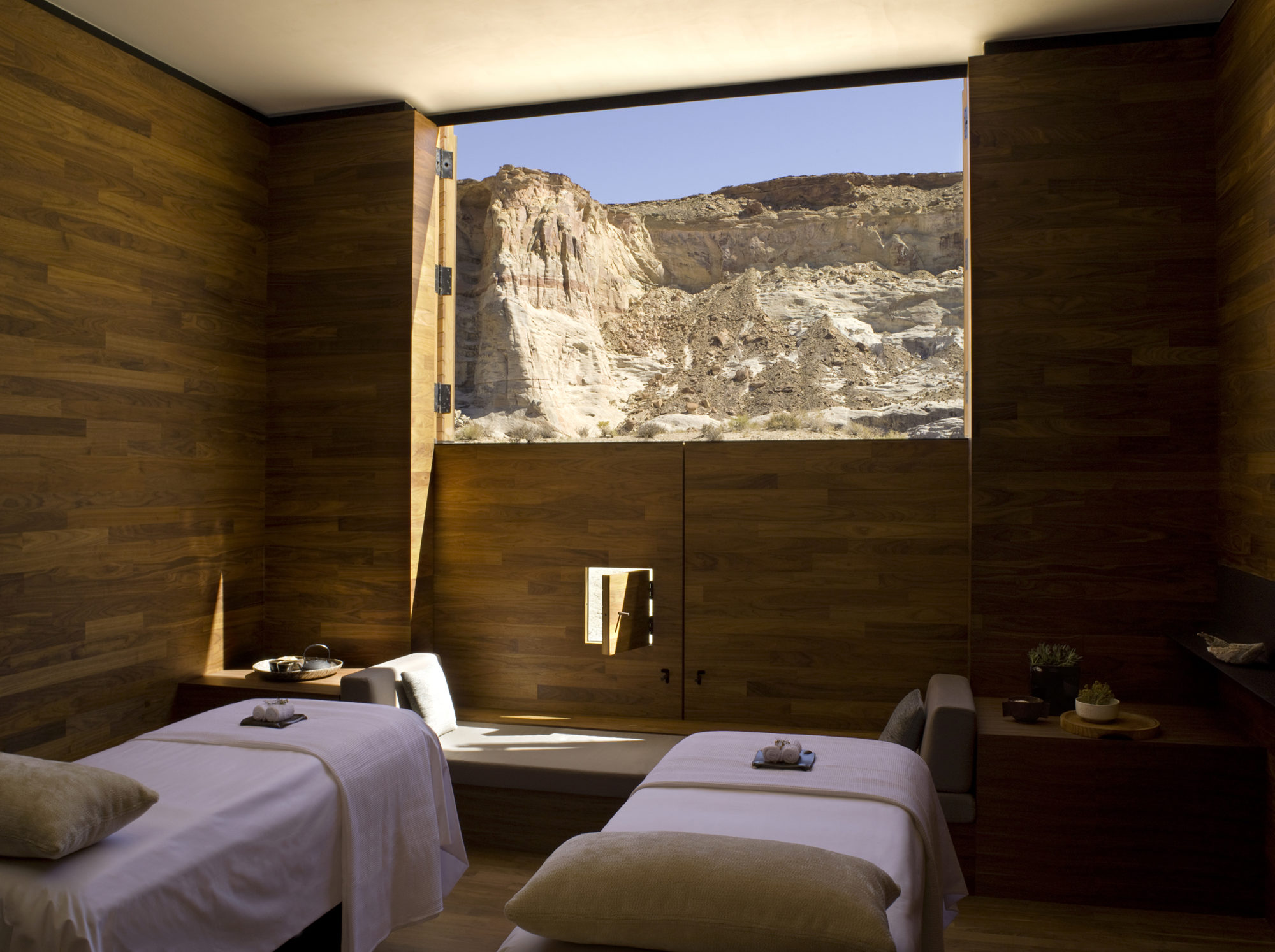
That restraint is engineered, not improvised. Concrete this massive holds the desert's temperature swings at bay. Openings are cut to frame specific horizons rather than to maximise glass. Each of the 34 suites opens to the desert, with an outdoor lounge and fireplace; some add a private pool or a roof terrace. Interiors stay deliberately plain — stone floors, natural timber, blackened steel — because every room's main feature is the view it was pointed at.
The shared life of the resort is concentrated in one central pavilion — living room, library and a dining room serving Native American-inspired cooking — with a 25,000-square-foot spa attached to the same quiet programme.
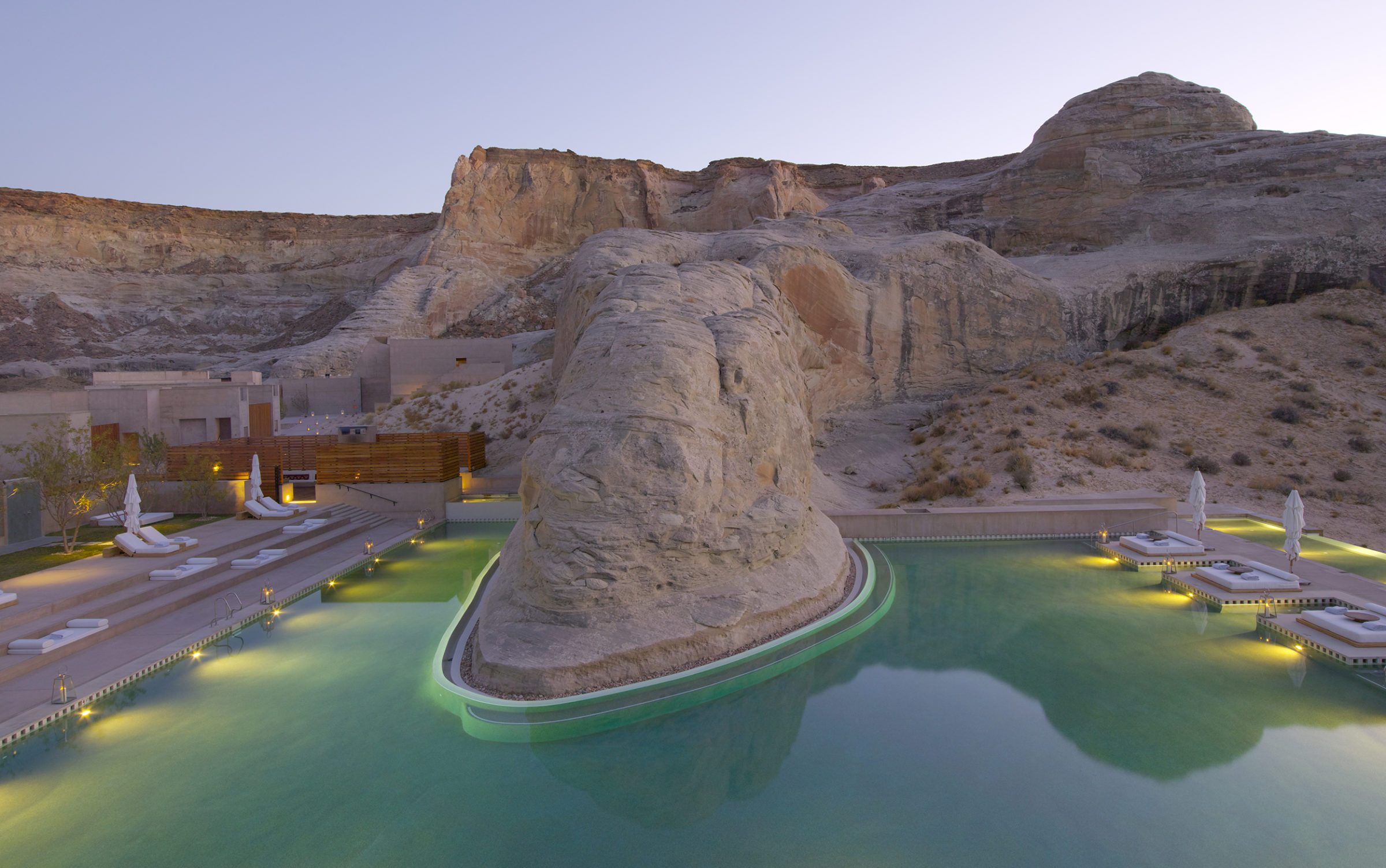
The clearest statement of the philosophy is the main pool. It was not dug into a convenient flat spot and decorated afterward. The pool curves around a towering sandstone escarpment that was already there, wrapping the rock so the water meets a hot tub at the base of the cliff face. The rock was not moved, blasted or imitated. The building went around it. That single decision explains Amangiri better than any amenity list: the site's oldest object is the resort's centrepiece, and everything else is arranged in deference to it.
Amangiri — the name means "peaceful mountain" — opened in 2009 and has been the benchmark for desert modernism ever since. It also proved influential in a way its architects may not have intended: it taught the luxury market that camouflage could be more desirable than display. A decade later the resort added Camp Sarika, a separate enclave of ten tented pavilions a short drive away — a different, softer expression of the same idea, and deliberately distinct from the concrete main resort.
Previously's Take
Restraint is usually described as a lack — fewer materials, fewer gestures, less noise. Amangiri shows what it actually costs: three architects, a custom concrete recipe, and the discipline to build a pool around a rock instead of through it. The most expensive thing in the building is everything the architects decided not to do.
The numbers
Sources · 4 sources
- Studio Rick Joy — official project record, "Amangiri Resort and Spa" (Kane County, Utah; completion 2008; photography credits Aman Resorts, Joe Fletcher, Kai Pippo, Studio Rick Joy)
- Wikipedia — "Amangiri" (opening 2009, 34 suites, architect credits, escarpment in the main pool; corroboration)
- A Small World, 2025 — "Architectural Storytelling with Amangiri, Utah" (three-architect credit, 2009 opening, custom concrete with local sand, pool wrapping the escarpment; corroboration)
- Robb Report Hong Kong — Amangiri stay review (372-hectare site, Camp Sarika distinction; corroboration)
Photographs: Studio Rick Joy · Studio Rick Joy · Studio Rick Joy