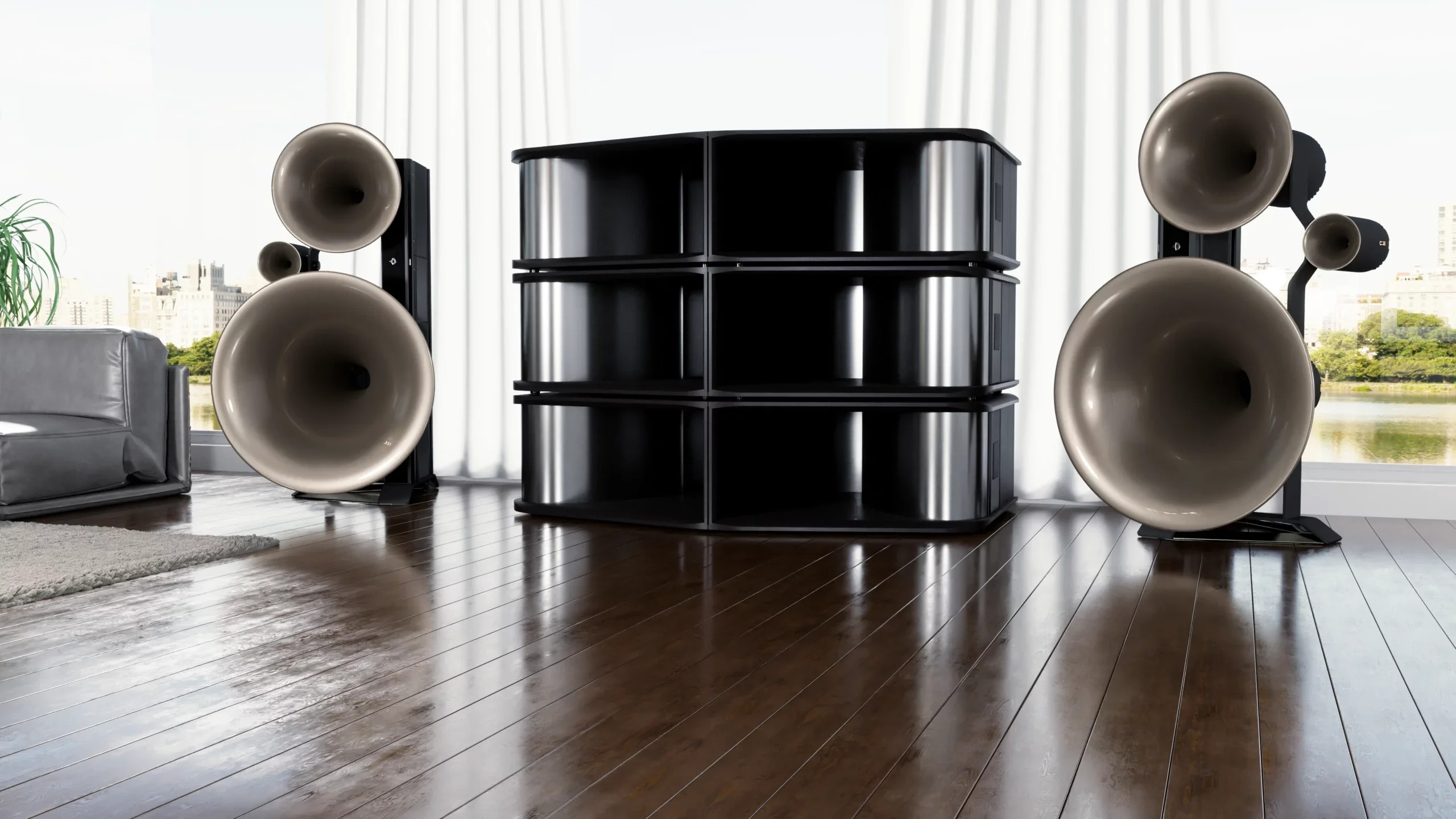

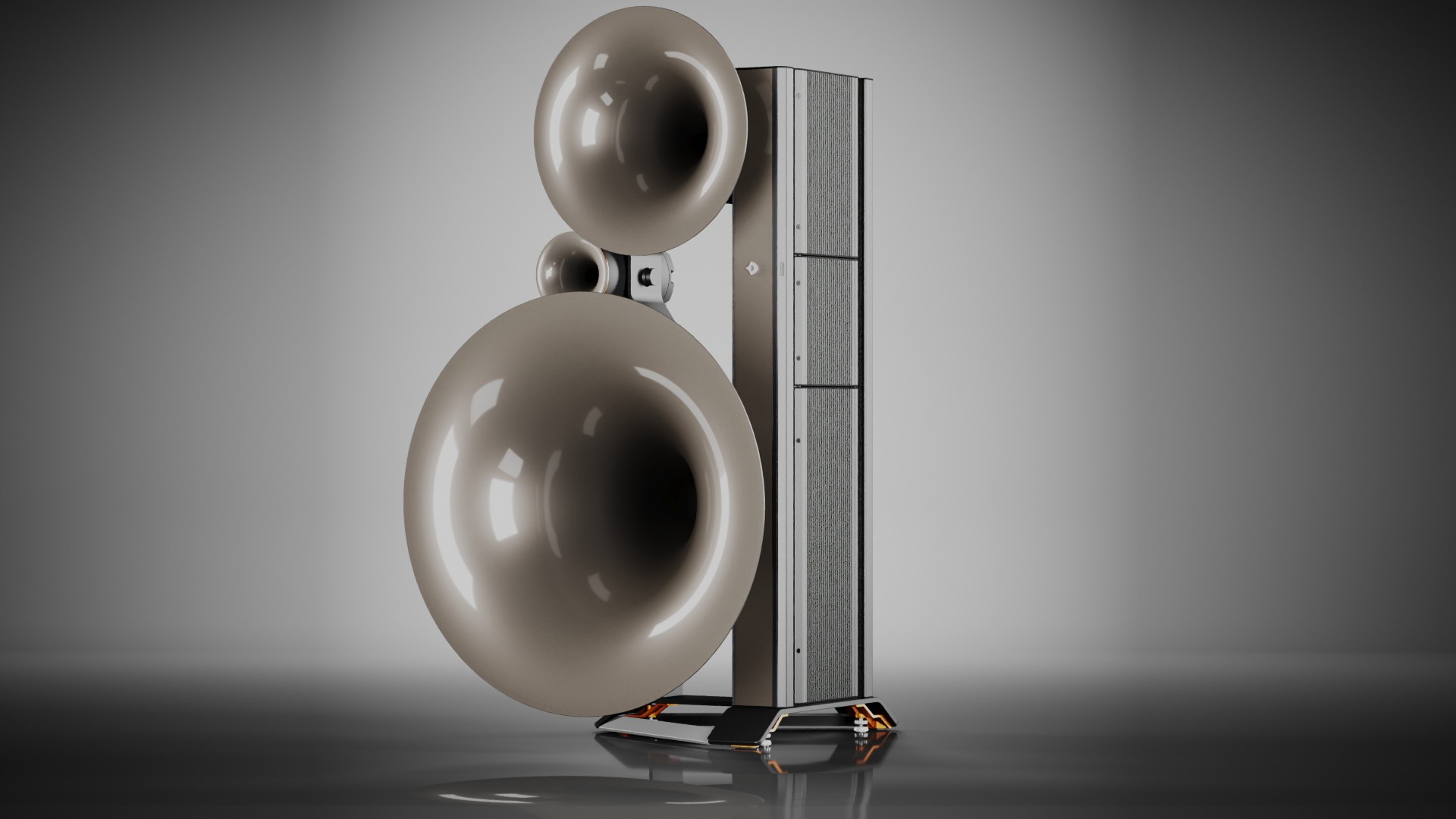
Start with the smallest horn, because it explains the other two. The TRIO G3's tweeter horn measures 200 millimetres across. The midrange horn below it spans 570. The bass horn at the bottom opens to 950 millimetres — close to a metre wide, and 650 millimetres deep. Nothing about those proportions is decorative. A horn is an acoustic transformer: it couples a small, hard-working driver diaphragm to the open air gradually, so the driver barely has to move to produce serious volume. The lower the frequency, the longer the wavelength, and the larger the horn's mouth and length must be to make that coupling work. Bass wavelengths run to metres. The horn that handles them honestly has to be built at that scale.
That is the whole design in one idea, and the numbers behind it are startling. The TRIO G3 is a three-way horn system — crossovers at 100, 600 and 4,000 Hz hand the signal from the bass horn to the midrange to the tweeter — with a sensitivity above 109 dB from a single watt. Avantgarde recommends amplifiers of more than two watts. Two. At that efficiency a driver moves a fraction of the distance a conventional speaker demands for the same loudness, and small movement is where low distortion lives. The Absolute Sound named the system its 2025 Cost-No-Object Loudspeaker of the Year and kept returning to the same quality: an effortlessness at high volume that most speakers never approach.
Below 100 Hz the horns hand over to a subwoofer, and Avantgarde offers two routes: the SpaceHorn, a horn-loaded reference subwoofer stacked in towers, or the smaller Twin Sub. The room requirement printed in the maker's own specifications tells you who this is for — more than 25 square metres, before the subwoofers are placed.
Alignment gets the same obsessive treatment as size. In the G3, all three drivers sit on one axis with their acoustic centres in a single plane, so sound from each horn leaves from the same depth and arrives together. The tweeter rides on a precision slide rail so that alignment can be fine-tuned rather than assumed.
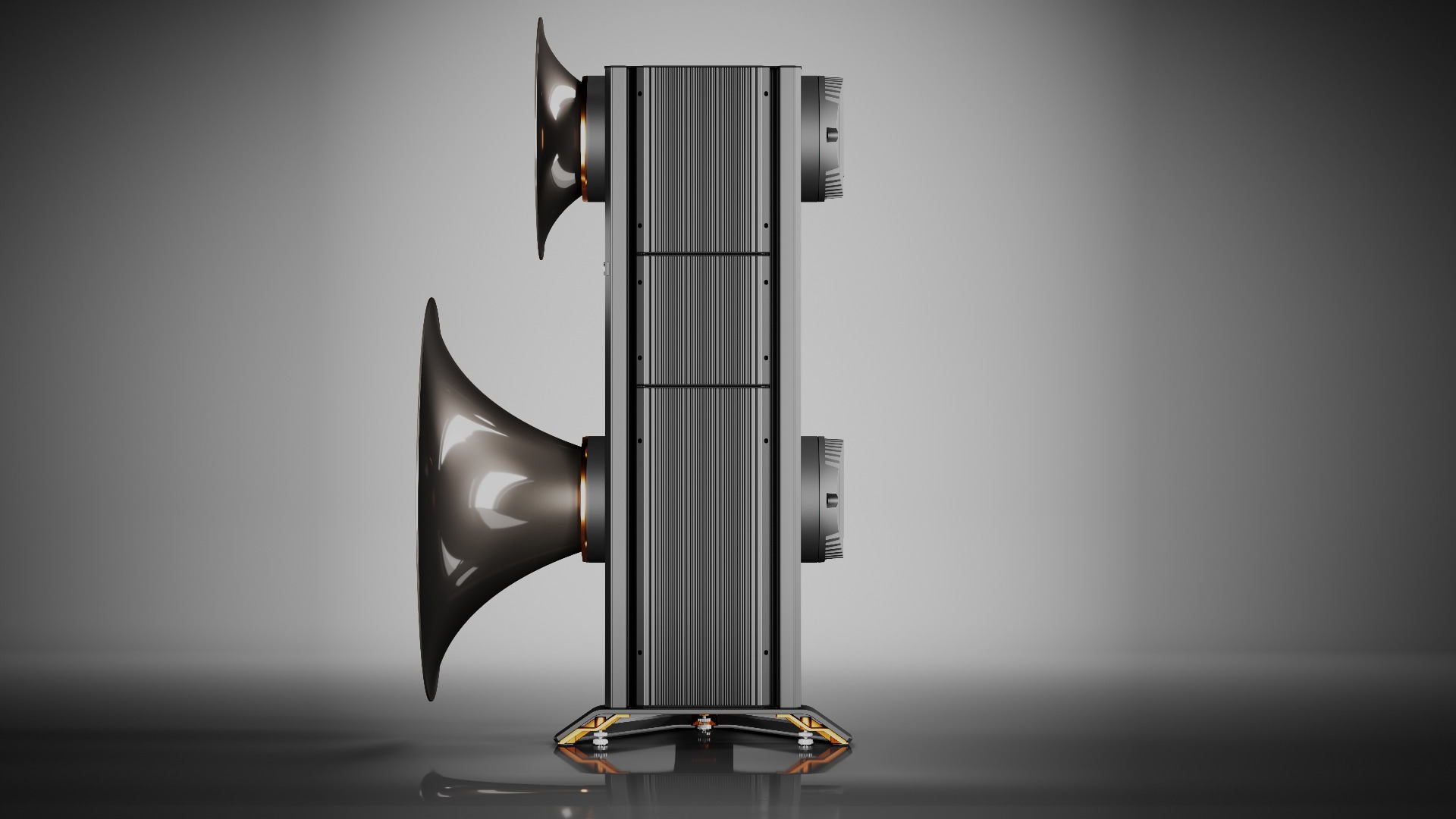
Then there is the part that decides whether a system like this can be owned for decades. The Trio concept is over 30 years old, and the G3's electronics live in replaceable technology modules that connect through a multi-pin plug. Buy the passive version today and the same speaker can be upgraded later to iTRON, Avantgarde's patented fully active current-drive electronics, which control the diaphragm's acceleration directly through current flow instead of voltage. When better electronics exist in ten years, the module swaps. The horns — the expensive, physical part — stay. Even the crossover capacitors follow the philosophy: the handmade NatureCap is roughly twenty-five times the size of the unit it replaced, because the maker decided the smaller one was a compromise.
Previously's Take
Most flagship speakers ask you to admire their cabinets. The TRIO G3 asks you to check its maths. Every dramatic curve on it is a wavelength made visible, and the modular electronics admit something the industry rarely says out loud: the physics will outlast the circuitry, so the circuitry should be the part you can change.
The numbers
Sources · 3 sources
- Avantgarde Acoustic — TRIO G3 official product page and specifications
- The Absolute Sound — 2025 Cost-No-Object Loudspeaker of the Year: Avantgarde Trio G3
- The Audio Beat — Avantgarde Trio G3 loudspeakers and SpaceHorn subwoofers review, April 2022
Photographs: Avantgarde Acoustic · Avantgarde Acoustic · Avantgarde Acoustic