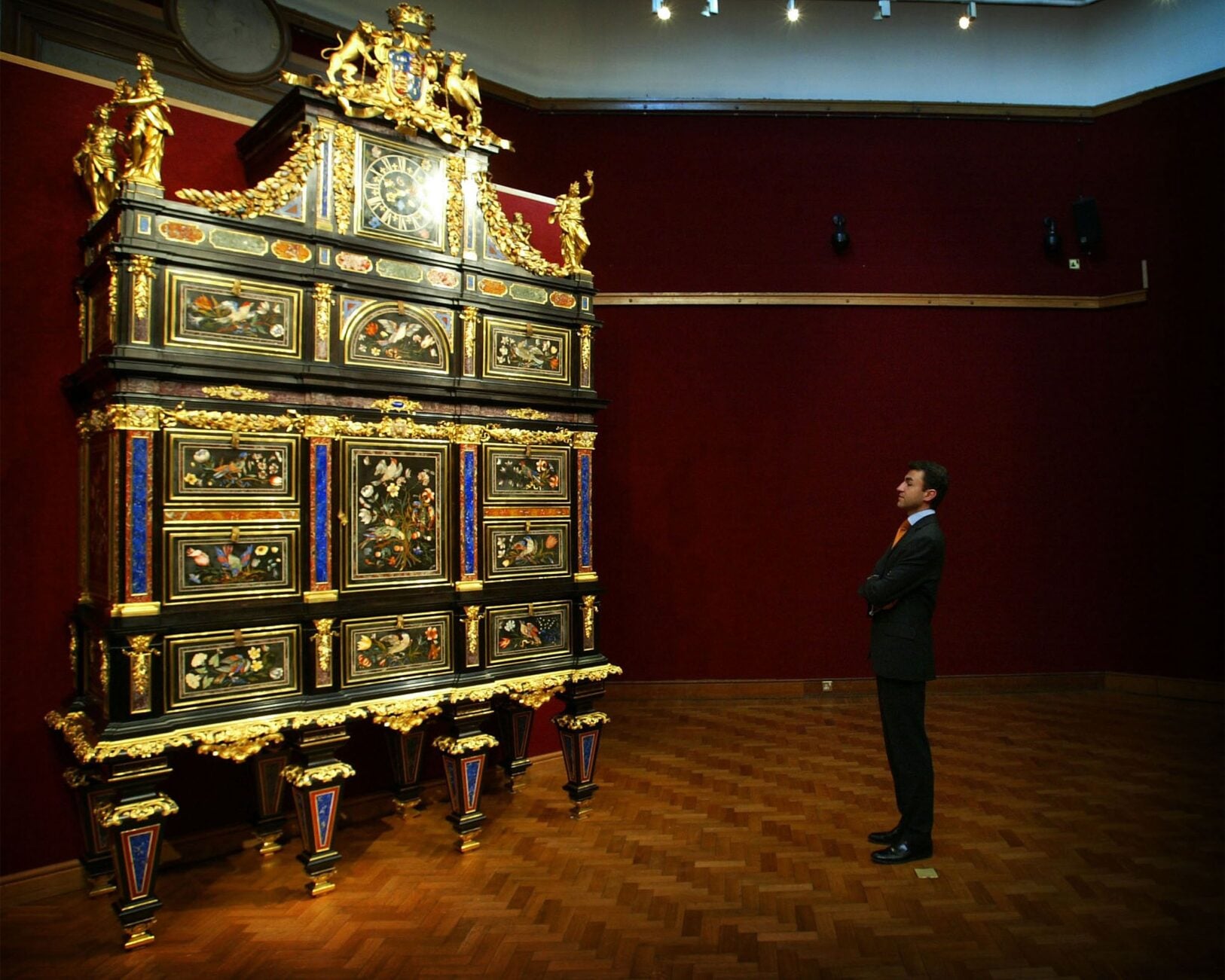

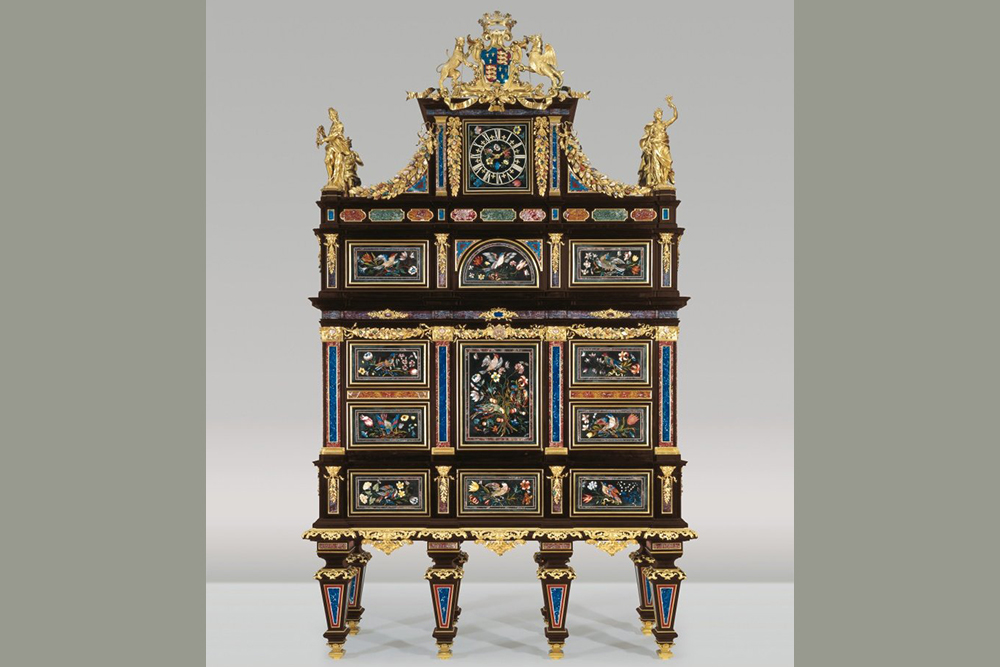
Henry Somerset, 3rd Duke of Beaufort, was nineteen when he commissioned the cabinet in 1726 from Florence's grand-ducal workshops — the Opificio delle Pietre Dure, the Medici court's hardstone atelier. What he ordered was closer to architecture than furniture: 386 centimetres high and 232.5 wide, ebony framed around panels of stone cut so fine the joins disappear — lapis lazuli, agate, Sicilian red and green jasper, chalcedony, amethyst quartz. Thirty craftsmen are reckoned to have worked on it, under the Foggini family's supervision, before it shipped from Livorno to England in 1732.
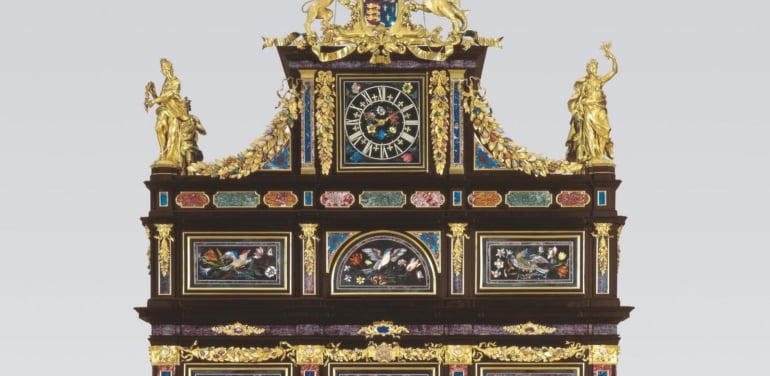
Pietre dure is painting with no pigment and no second chances. Each bird, flower and ribbon of colour is a separate piece of stone, sawn, ground and polished to veneer thickness, then fitted against its neighbours. Stone does not blend — the shading in a petal is a different mineral, found, matched and cut. The workshop built accordingly: a clock in the crest, its face marked with fleurs-de-lis, the Beaufort arms in gilt-bronze above it, gilt figures of the Four Seasons at the corners, and ten cedar-lined drawers carrying the stone pictures below.
Then the cabinet did what great houses do with great objects — it stayed. Badminton House kept it for over two and a half centuries, until the family's trustees sent it to Christie's in 1990. It sold on 5 July that year for £8,580,000 to the Barbara Piasecka Johnson Collection, a world record for furniture at the time. Fourteen years later her collection sent it back to the same rooms, and on 9 December 2004 it broke its own record: £19,045,250, bought in the room by Dr Johan Kraeftner, director of the Liechtenstein Museum, bidding for Prince Hans-Adam II. Christie's called it the most expensive piece of furniture ever sold at auction — a dated claim, made on the day, and still the cabinet's defining number.
The purchase was not a trophy hunt. The Princely Collections already held a serious pietre dure holding, and Kraeftner said the cabinet would centre a Kunstkammer gallery built around it — hardstone works alongside seventeenth-century still-life and flower painting, the painted versions of what its panels do in mineral. It went on permanent display at the Liechtenstein Garden Palace in Vienna in spring 2005, and still crowns that gallery: the family commission that outlasted the family that commissioned it, now held by a family that collects in centuries itself.
Previously's Take
Most record prices are weather — a hot room, a fashionable name. This one is geology and patience: value built by craftsmen cutting stone nobody could hurry, then confirmed the slow way too — the same object, sold twice, fourteen years apart, beating itself. Furniture is supposed to be the useful art. The Badminton Cabinet's real function turned out to be keeping score: of what a workshop could do in 1732, and what the world thinks that is worth each time it asks.
The numbers
Sources · 3 sources
- LIECHTENSTEIN. The Princely Collections — object and provenance record, Badminton Cabinet (collections online)
- Christie's — post-sale release, "The Badminton Cabinet Sells for £19 Million / $36 Million at Christie's," 9 December 2004; and pre-sale release, "Christie's to Offer the Badminton Cabinet," 2004
- The Art Newspaper, 1 January 2005 — "Prince of Liechtenstein buys Badminton Cabinet for over £19 million"
Photographs: Cheapism · Investory News · LuxuryLaunches