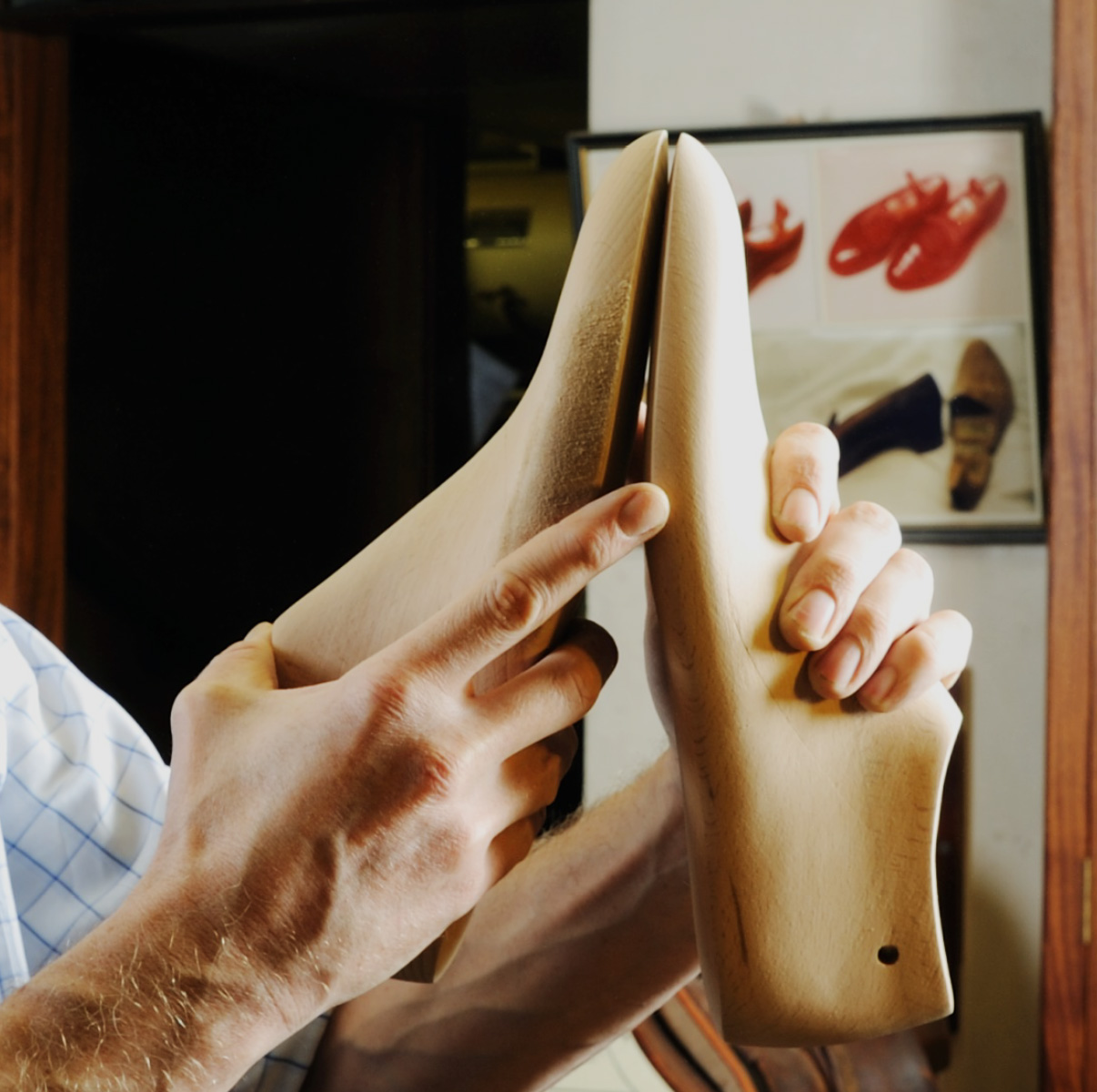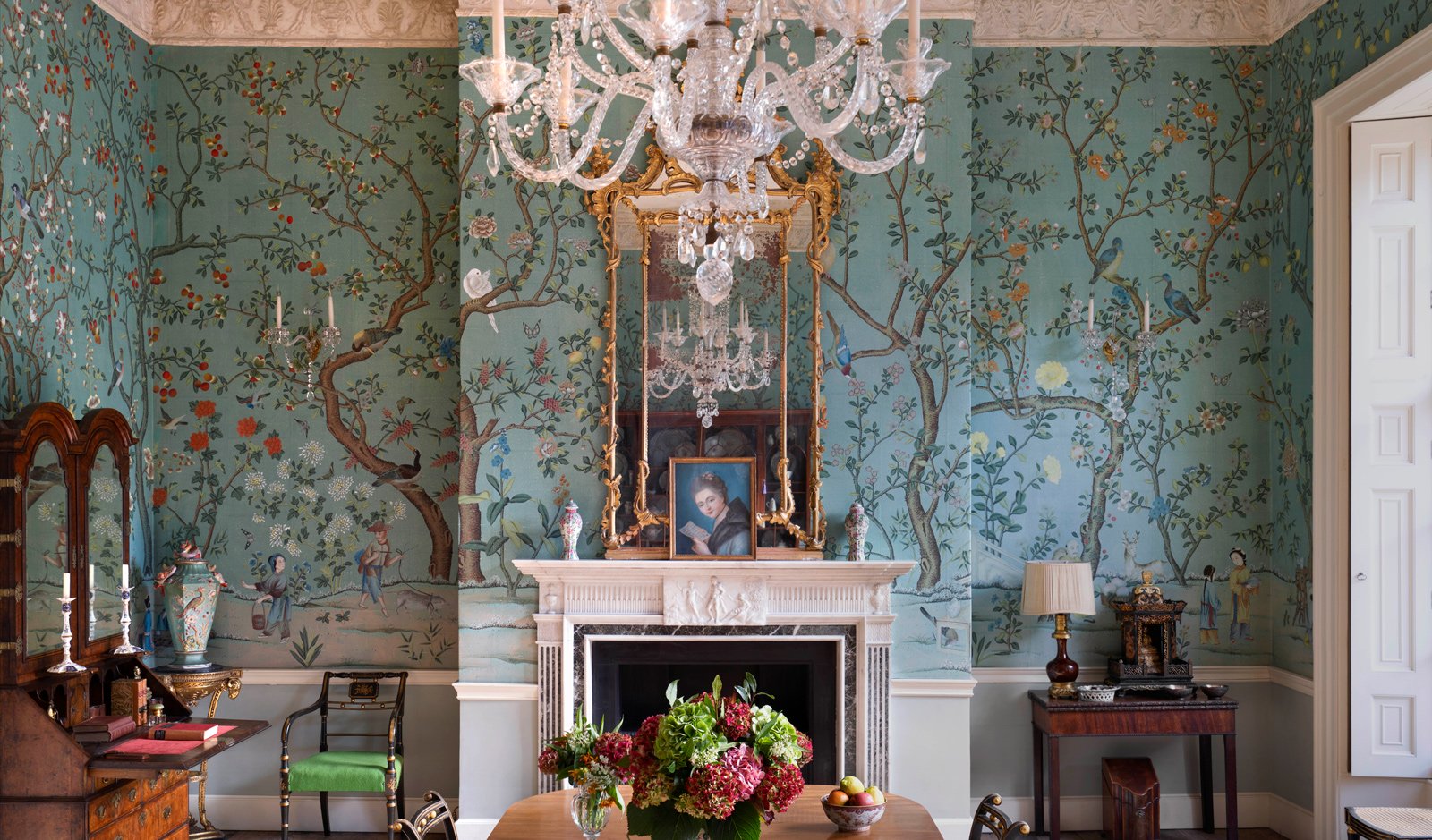

The company exists because of a restoration that nobody in Europe could do. In 1986 Claud Cecil Gurney went looking for artisans who could restore the antique Chinese wallpaper in his London home — hand-painted Chinoiserie of the kind that had hung in grand English houses since the 18th century. The skills had effectively vanished from Europe, so he travelled to China and found master artists still holding the techniques. He named the firm de Gournay, the medieval French spelling of his own surname, and built a house on a simple refusal: no printing. Every stage of every wallpaper is painted by hand, by the company's own artisans.
That is the part most people grasp. The part that explains the work is what happens before any paint is touched. For a Tailored project — the route most clients take, the house says — de Gournay's Architecture & Design team works from a room's elevations and floor plan and produces a drawing of every wall: exactly where the design will sit, how it turns a corner, what happens at the window, the door, the dado line. A branch can be bent so it clears a door frame. A bird can be moved to the stretch of wall that actually gets the light. The client approves the miniature, sometimes a large sample section too, and only then does production begin. Average production runs eight to ten weeks.
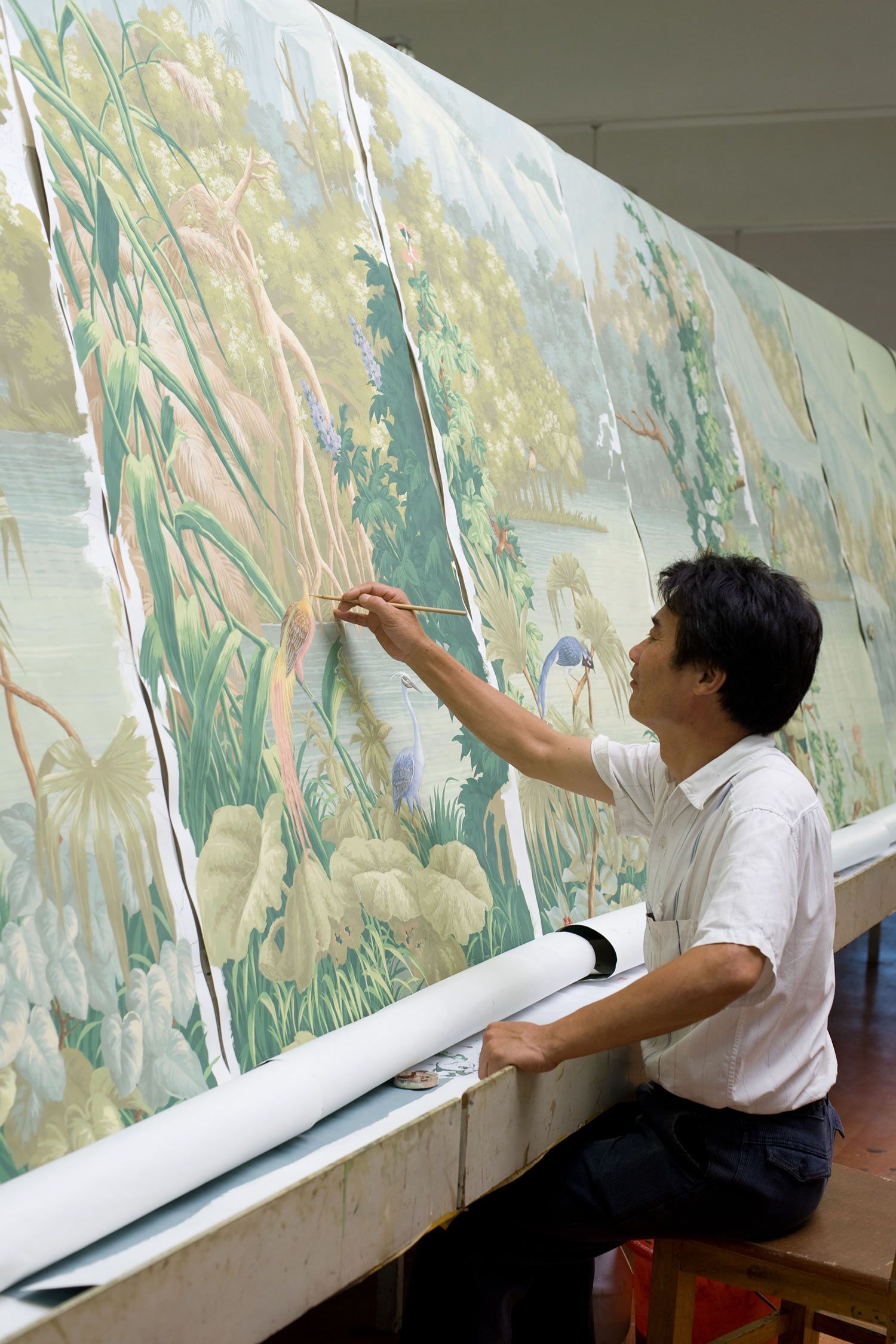
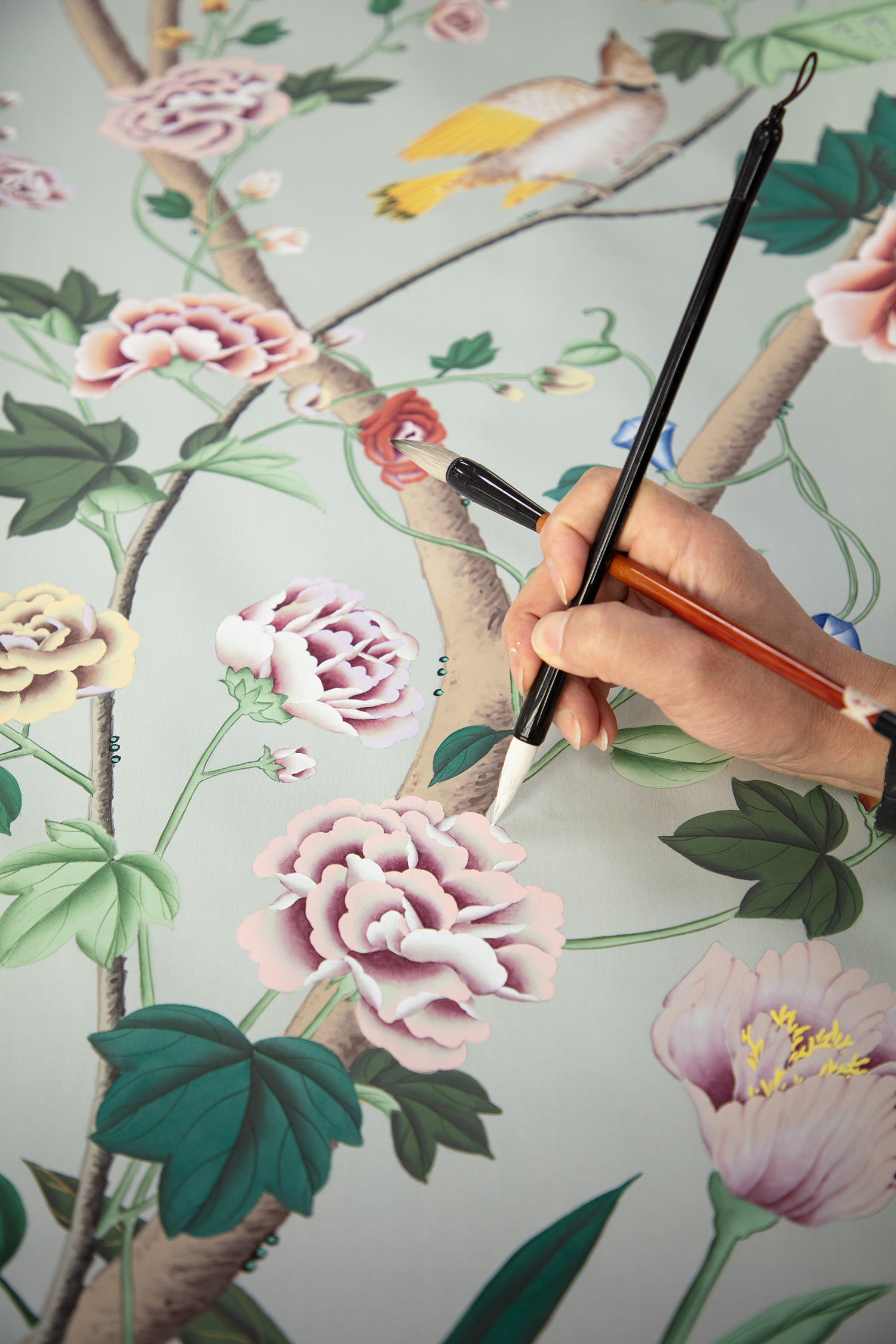
The painting itself is divided labour at full scale. An average panel is roughly 90 centimetres wide and two and a half metres tall; a team of four to six artists works an order, keeping one continuous scene coherent across separate panels that will only meet on the wall. Accounts of the studio put a single average panel at around 150 hours of painting. The grounds are part of the craft: Xuan paper, India tea paper, dyed silk, gilded papers — backgrounds built up, sometimes leafed in metal, before the design goes on in layers. Chinoiserie designs are painted to the height the room demands, anywhere between five and twelve feet, without simply enlarging the figures; for very tall walls the artists extend the sky with period detail instead. The pencil underdrawing stays faintly visible if you look closely. The house does not treat that as a flaw. It is the signature.
The repertoire grew out of the historic papers — the Chinoiserie collection first, with designs like Earlham and St Laurent still the most frequently chosen, then 19th-century French panoramic scenes, Japanese and Korean designs, Art Deco work, hand embroidery and beading done stitch by stitch. Every one of them goes through the same discipline: drawn for the room, painted by a team, checked against the elevation it was planned on.
Which is why a de Gournay interior reads differently from a papered room. A printed pattern is a decision about a wall in general. This is a decision about one wall — its chimney breast, its awkward return, the exact green that the north light in that house asks for. Two clients can order the same design and receive rooms that are related the way performances of the same score are related: same notes, different hands, different room.
Previously's Take
Luxury usually means a rarer material. Here it means a rarer sequence — measure, draw, approve, paint, in that order, for a room that will exist once. The wallpaper is almost incidental. What de Gournay actually sells is the fitting: forty years of refusing to let a machine do the repeating, because the room was never going to repeat either.
The numbers
Sources · 4 sources
- de Gournay — official FAQ (founding, Tailored service and EDM process, materials, production times, design heights)
- Homes & Gardens — "British Style: De Gournay" (1986 founding, the China journey, panel construction)
- Persephone Social — conversation with Rachel Cecil Gurney, de Gournay director (team of four to six artists per order; average panel dimensions)
- Homes to Love — "Kate Moss collaborates with design house de Gournay" (1986 founding; ~150 hours of painting per average panel)
Photographs: de Gournay · de Gournay · de Gournay