
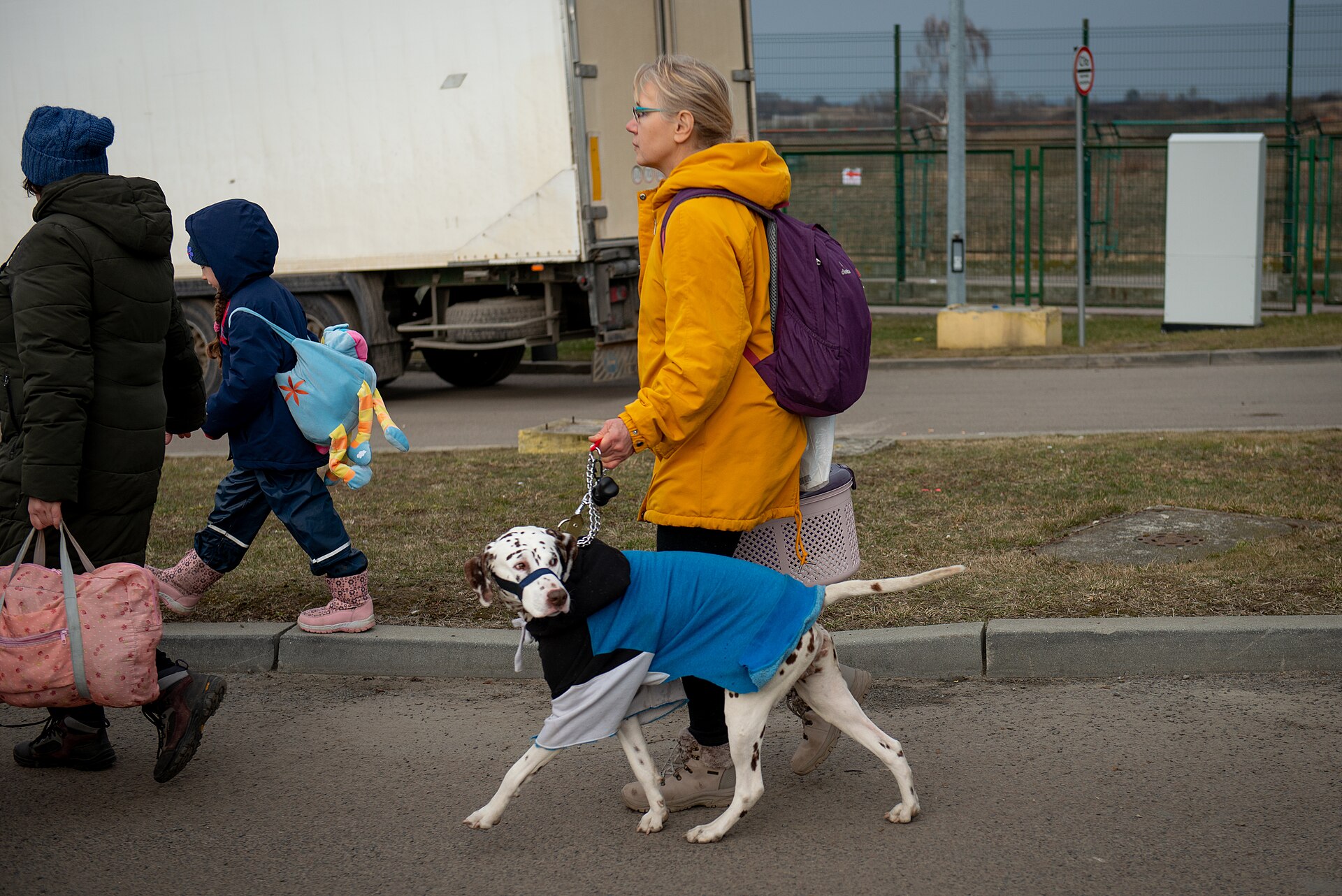
More than 100,000 immigrants from Ukraine and Sudan spent Monday, October 19, 2026, not knowing whether the legal right to live and work in the United States would still be theirs by nightfall. By the end of the day, the Department of Homeland Security had answered — in the most Washington way possible. Announcements about their Temporary Protected Status “will be made at the appropriate time,” a DHS spokesperson said in a statement, and in the meantime their immigration protections would remain in place, according to Reuters. No date. No duration. Just: not today.
The numbers behind the deadline are large, and they come in two versions that measure different things. The designations actually set to expire on Monday covered about 101,000 Ukrainians and 1,800 Sudanese, The Guardian reported. Reuters put the broader population higher: some 240,000 Ukrainians who fled Russia’s invasion have registered for TPS in the United States overall, and there are an estimated 6,800 TPS holders from Sudan under broader counts. The gap is the difference between one expiring designation and everyone who has ever registered under it — but for the roughly 103,000 people inside the expiring designations, Monday was the day the clock was supposed to run out.
Silence, it turns out, has a legal meaning
Here is the part DHS did not say out loud. Under the TPS statute, the homeland security secretary is supposed to announce a decision at least 60 days before a designation expires. If no determination comes, federal rules provide that the protection is automatically extended for six months, according to the Associated Press. States Newsroom described the same mechanic: Secretary Markwayne Mullin was required to declare his decision at least 60 days ahead, made no announcement, and “if no decision is made, an automatic six-month extension kicks in.” Counted from the October 19 expiry, six months runs to April 19, 2027.
DHS, notably, has not formally confirmed that the automatic extension is in place. It said only that holders “retain protection,” and it did not respond to a question about whether they can keep their work permits, the Associated Press reported — though TPS generally allows people to work while their protections remain in effect. For families trying to renew a driver’s license, reassure an employer or sign a lease, the difference between a formal six-month extension in writing and a spokesperson’s assurance is not a technicality. It is the whole thing.
The political pressure to say something clearer had been building for weeks. Thirty-one senators wrote to Mullin and Secretary of State Marco Rubio urging an 18-month extension for Ukrainians, the longest renewal TPS allows, according to States Newsroom. The letter’s Republican signers were Senators Susan Collins of Maine and Lisa Murkowski of Alaska. “Ukrainian nationals cannot safely return at this time,” the senators wrote, warning that letting the designation lapse “would risk sending more than one hundred thousand individuals back to an active war zone.” A separate group of Democratic senators had urged Mullin in August to extend protections for Sudanese nationals, States Newsroom reported.
The second reprieve in two months
If this feels familiar, it is. Reuters described Monday’s move as “the second in as many months” of its kind: in September, the administration likewise allowed TPS holders from El Salvador to retain their protections past a September 9 expiry, using the same “appropriate time” formulation. That decision covered nearly 200,000 Salvadorans, according to the Associated Press; States Newsroom put the figure at 200,000 people still in limbo, with DHS confirming only that they keep deportation protection and work authorization for now.
The reprieves sit inside a much harsher overall record. The administration has terminated TPS for more than 1 million people from 13 countries, including Venezuela, Haiti, Honduras, Nicaragua, Afghanistan and Syria, according to the Associated Press. Reuters listed Haiti, Venezuela, Somalia, Yemen and Syria among the countries whose protections the administration has moved to revoke as part of its broader immigration crackdown. Of the 17 countries that held TPS designations when the administration took office, States Newsroom reported, only Ukraine, Sudan and Lebanon — whose designation expires November 27 — still do.
Advocates: grateful, and not reassured
The groups that work with TPS holders chose their words carefully, and the carefulness itself told the story. “We’re grateful for an extension, however temporary, for TPS holders from Ukraine and Sudan,” said Myal Greene, president and CEO of World Relief, in remarks reported by the Associated Press. “We encourage the administration and Congress to consider longer term relief for women, men and children trying to carve out stability while their countries of origin remain in upheaval.”
Krish O’Mara Vignarajah, president and CEO of Global Refuge, noted that Ukraine and Sudan plainly meet the legal conditions for TPS, the Associated Press reported. “Russia’s war on Ukraine is nearing its fifth year, and Ukrainians are bracing for another winter under drone and missile strikes, driving civilian casualties and devastating critical infrastructure. Sudan remains locked in a brutal civil war marked by famine, widespread human rights abuses and the hallmarks of genocide,” Vignarajah said. “It is not safe for these families to go home.” Yuriy Boyechko, CEO of Hope for Ukraine, was blunter, describing the announcement to the Associated Press as one of the government’s “last-minute patches” — “a bandage that has been placed on a wound that does not solve the real issue.”
The conditions behind those quotes are not in dispute. Sudan’s war between the army and a rival paramilitary force has produced one of the world’s worst humanitarian crises, according to Reuters. Ukraine was first designated for TPS in April 2022, weeks after Russia’s full-scale invasion, and the designation was last extended in January 2025 for 18 months through October 2026, according to the Associated Press. Sudan’s TPS program dates to 1997 and has been extended by successive administrations through decades of conflict, the Associated Press reported. Congress created TPS in 1990 for people already in the United States whose home countries are hit by war or disaster; it allows them to stay and work, but it offers no path to permanent residency.
So Monday’s reprieve is real, and so is the limbo inside it. The decision also lands two weeks before the November 3 midterm elections, when the administration’s immigration policies face a direct test at the ballot box, the Associated Press noted. What to watch now: whether DHS ever puts the six-month extension in formal writing, and whether the same silent treatment awaits Lebanon’s designation on November 27. Until then, more than 100,000 people keep the right to stay — on the strength of a sentence that promises a decision at the appropriate time, whenever that turns out to be. DHS has been busy on other fronts, too; today’s League of Women Voters lawsuit over voter data is on our news front.
Sources · 4 sources
- Reuters — the DHS statement, the 240,000 Ukrainian registrations and 6,800 Sudanese estimate, and the El Salvador parallel
- The Guardian — the 101,000 Ukrainians and 1,800 Sudanese covered by the expiring designations
- Associated Press — the automatic six-month extension rule, the reaction quotes and the TPS program history
- States Newsroom — Secretary Mullin’s missed 60-day deadline, the senators’ letters and the Lebanon expiry