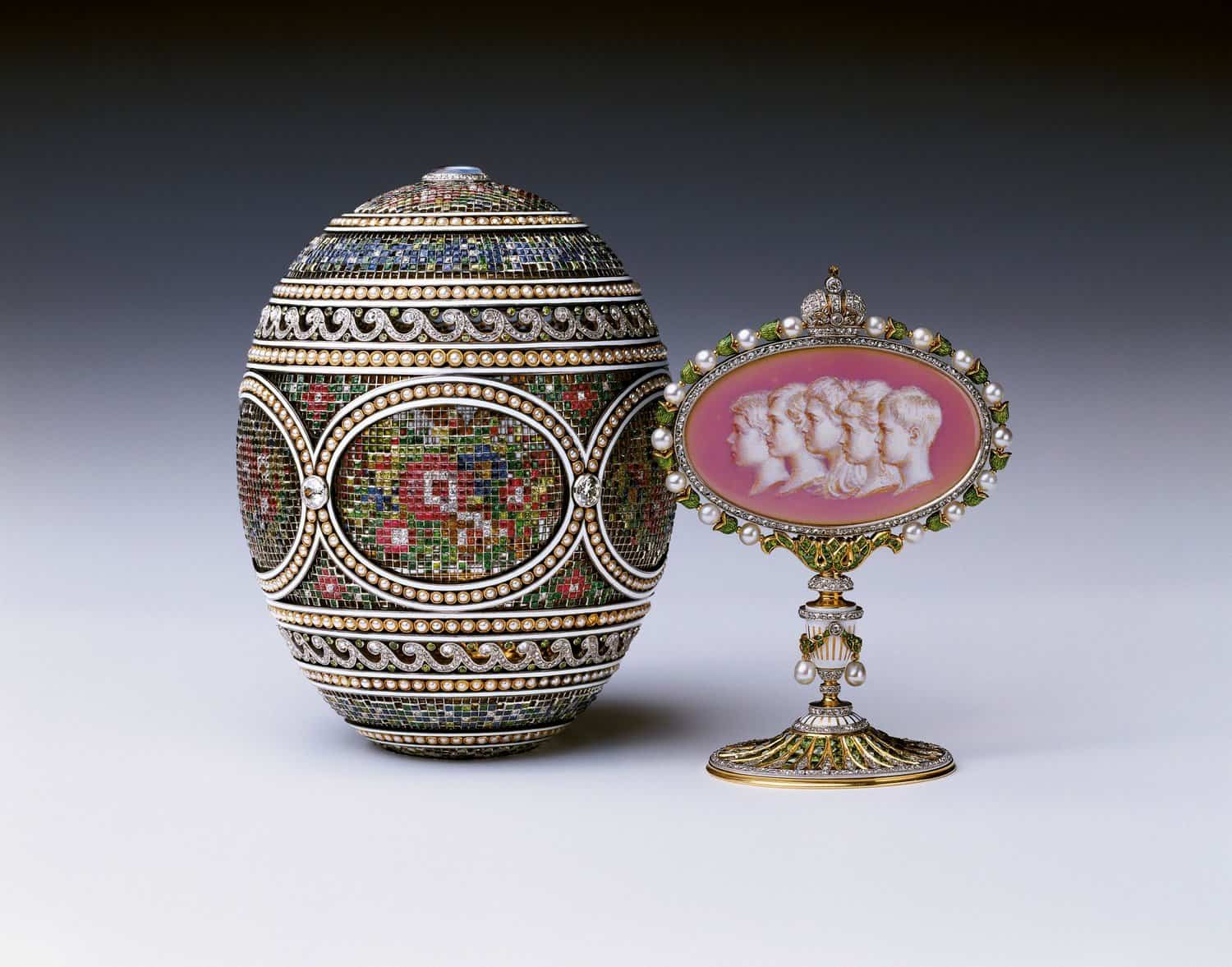

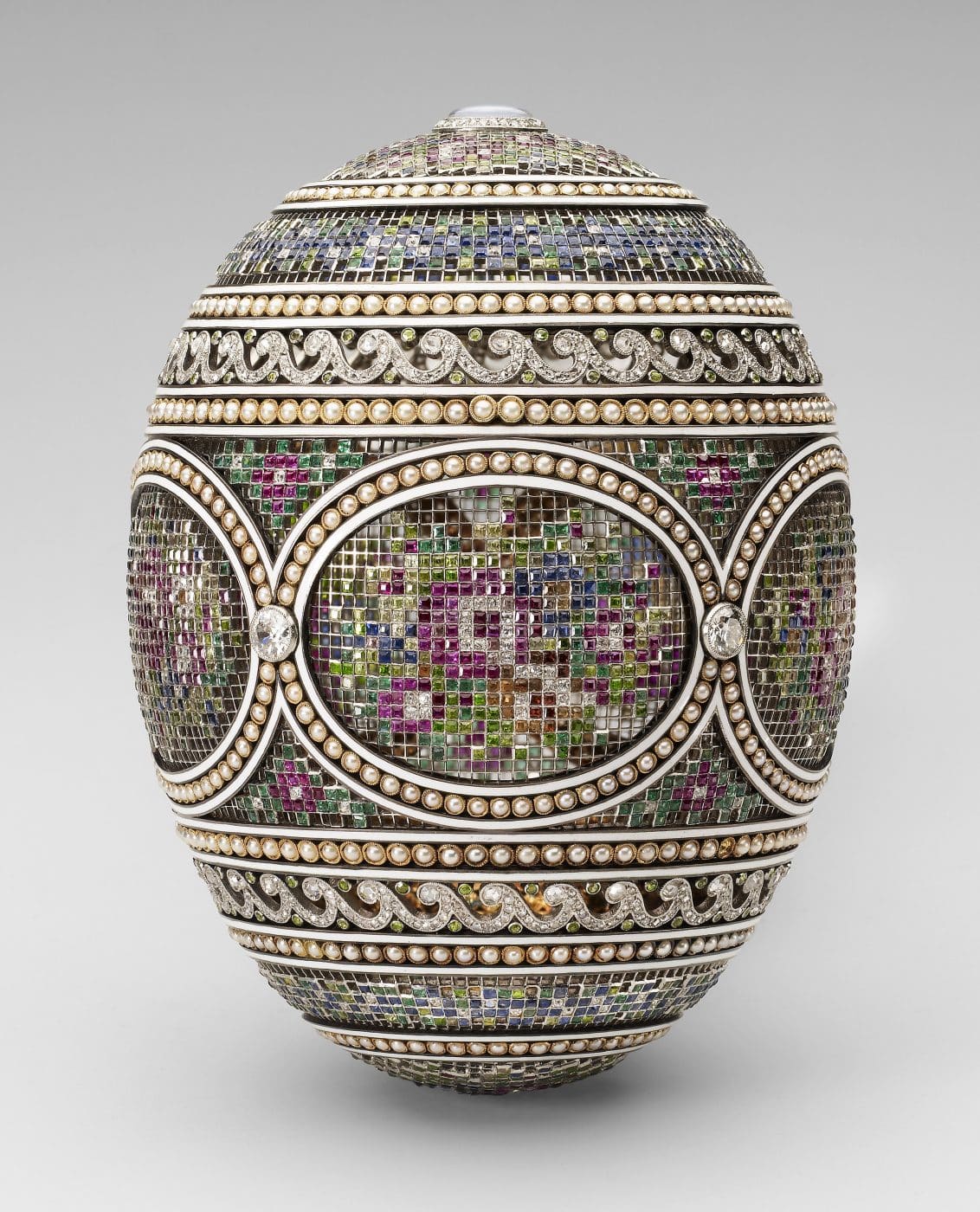
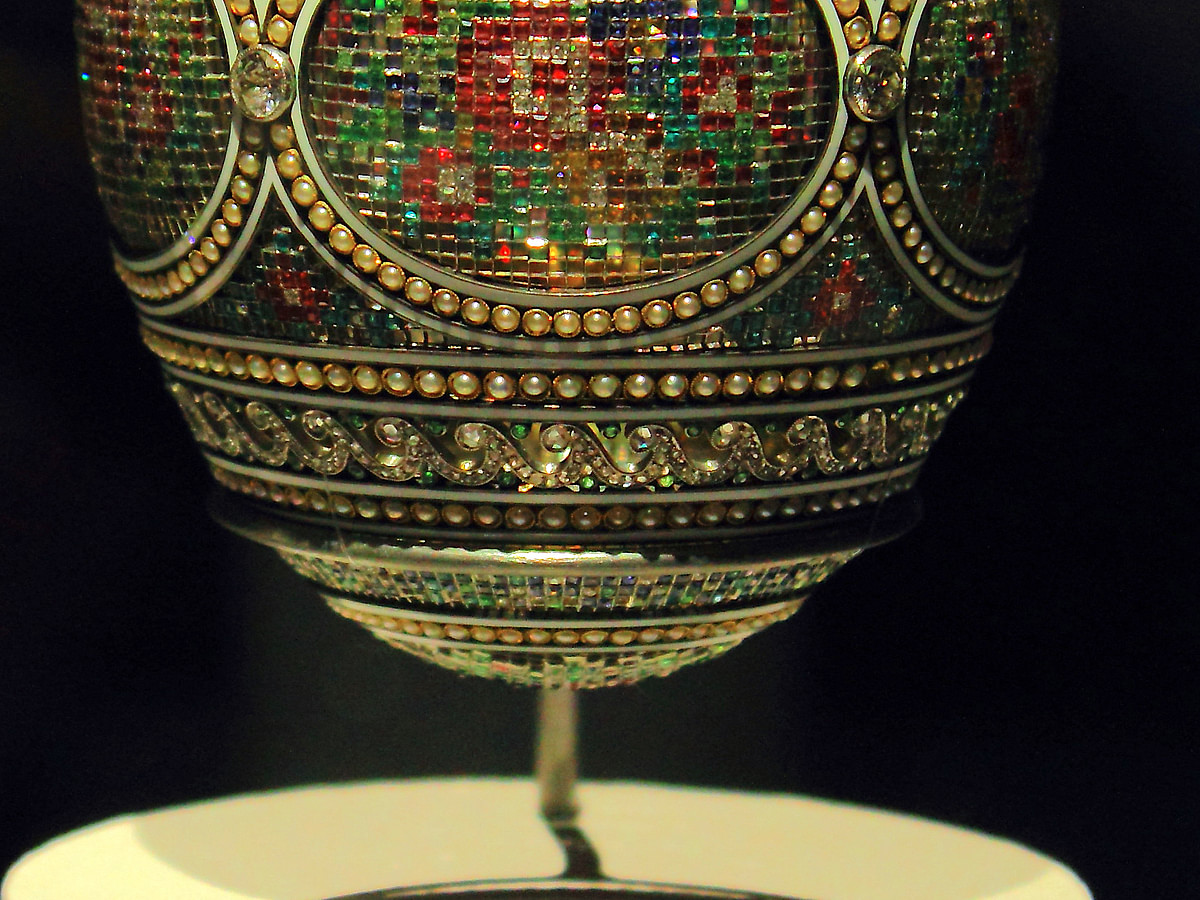
The Royal Collection Trust calls the Mosaic Egg technically one of the most sophisticated and extraordinary of Fabergé's Imperial Easter Eggs, and the reason is a construction problem, not a decoration problem. This egg is closer to a fabric than a shell: a platinum mesh into which tiny diamonds, rubies, topaz, sapphires, demantoid garnets, pearls and emeralds are fitted, each stone cut, polished and calibrated to fill its space exactly. The platinum is not welded. It is cut — the stones sit in a hand-cut frame, no one projecting above another, their tables following the curve of the egg.
The design came from Alma Theresia Pihl, one of only two women designers at Fabergé. The Trust's account is specific: she was watching her mother-in-law at her embroidery by the fire, and the needlework shimmering in the firelight gave her the motif. Around the centre, five oval panels bordered by half-pearls carry a stylised floral pattern replicating petit-point. Pihl came from a Finnish family of jewellers in Fabergé's employ; her uncle Albert Holmström ran the workshop that produced the egg, under Peter Carl Fabergé's supervision.
Tsar Nicholas II gave the egg to his wife, Alexandra, at Easter 1914. Her monogram and the date sit beneath a moonstone at the apex. Inside, held by gold clips, the egg keeps its surprise: a medallion painted on ivory, portraits of the five children on one side, a basket of flowers and their names on the other, on a stand surmounted by the imperial crown. Many Imperial eggs lost their surprises across the century. This one never did.
What it cost to make is unknowable, and the Trust says so plainly: the original invoice was destroyed. The confiscation list drawn up when the egg passed from the Anichkov Palace to the Sovnarkom in 1922 describes it, drily, as "1 gold egg as though embroidered on canvas." Confiscated in 1917, it was sold by the Antikvariat in 1933 for 5,000 roubles, and on 22 May that year King George V bought it from Cameo Corner in London for £250, recorded as "half-cost," probably for Queen Mary's birthday. Those are the only prices this egg has ever honestly carried, and they are history, not a valuation: the egg belongs to the Royal Collection, held in trust, and no current price exists to report.
Previously's Take
The cleverest object in the room is usually the one that makes a hard technique look soft. Needlework is patient, repetitive work; Pihl's design honoured it by demanding the same patience from jewellers, in a material that forgives nothing. A century on, the egg's real luxury is not the stones. It is that nobody was allowed to hurry.
The numbers
Sources · 3 sources
- Royal Collection Trust — RCIN 9022 object record; Fabergé in the Royal Collection
- TES Magazine — "Small and perfectly formed"
- Fabergé (the modern house) — Royal Fabergé exhibition highlights, 2011
Photographs: Royal Collection Trust · Royal Collection Trust · World History Encyclopedia