
Sanssouci was the palace Frederick the Great built for himself at Potsdam between 1745 and 1747 — a single-storey summer retreat on vineyard terraces, named with a French phrase meaning "without a care." A king escaping his own court, in a deliberately small palace. But Frederick's taste for stone was anything but small. After Prussia took Silesia, he reserved the finest decorative stones for himself by sovereign right — chrysoprase above all, the emerald-to-apple-green quartz he travelled to Silesia to select in person — and poured them into the New Palace at Sanssouci: marble wall coverings, floors inlaid with jasper, amethyst and serpentine.
That appetite is what Graf von Faber-Castell set out to translate. The "Sanssouci, Potsdam" Pen of the Year 2015 is the middle chapter of the maker's Pillars of History trilogy — Catherine Palace in 2014, Sanssouci in 2015, Schönbrunn in 2016 — and its design source, in the maker's own telling, is the New Palace, the most stone-hungry of Frederick's buildings.
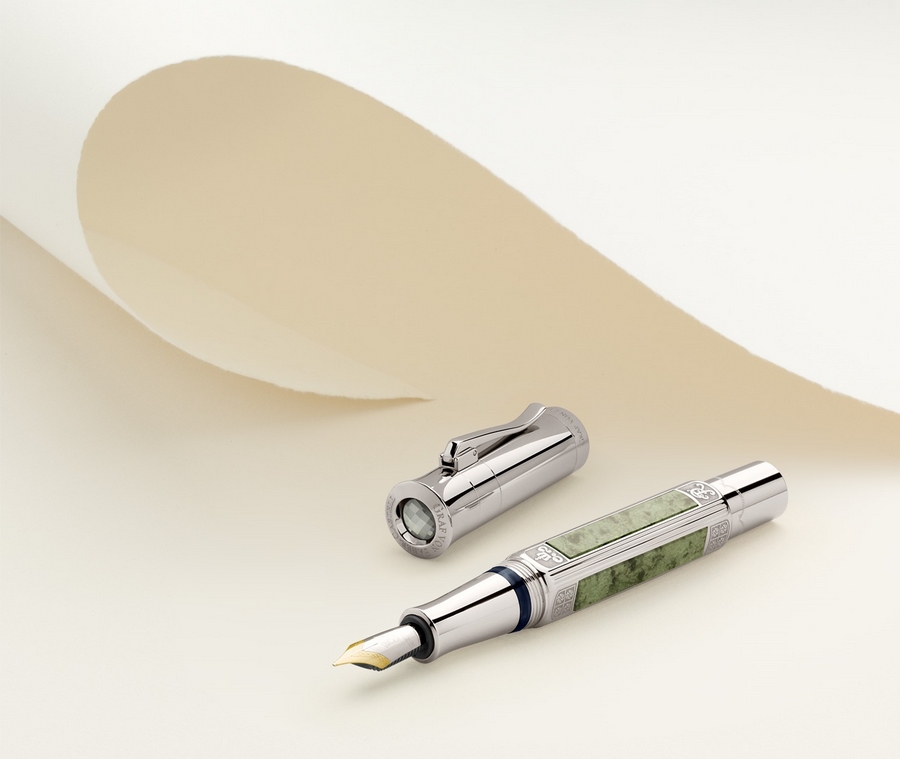
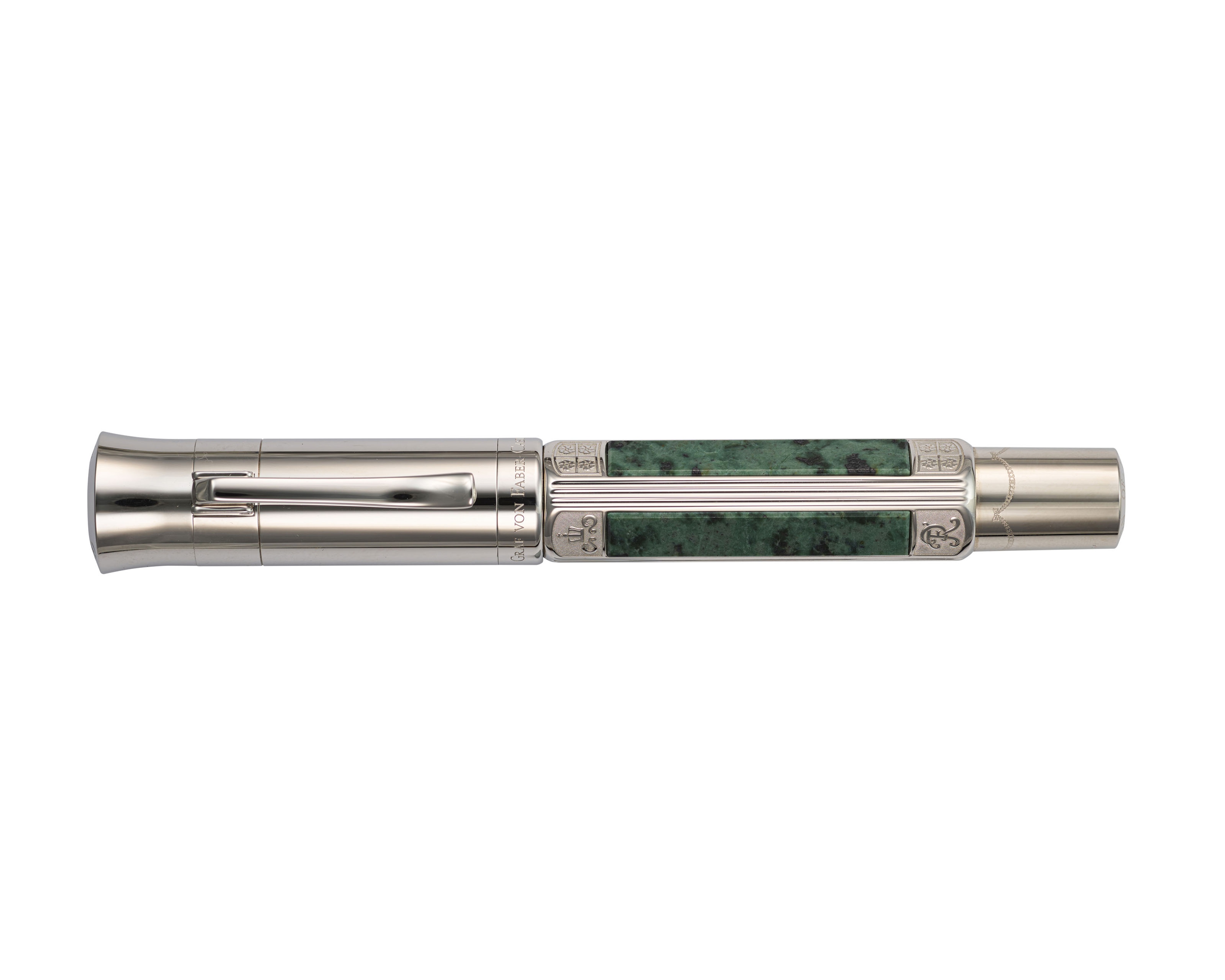
A pen cannot carry a palace. What it can carry is the material. The platinum-plated edition wears four panels of green Silesian serpentine in its barrel, with Russian smoky quartz in the cap, crowned by a grey, faceted Russian quartz. The Special Edition changes the metal and the stone: 24-carat gold plating, green serpentine, and chrysoprase — Frederick's favourite stone, once kept entirely for the crown.
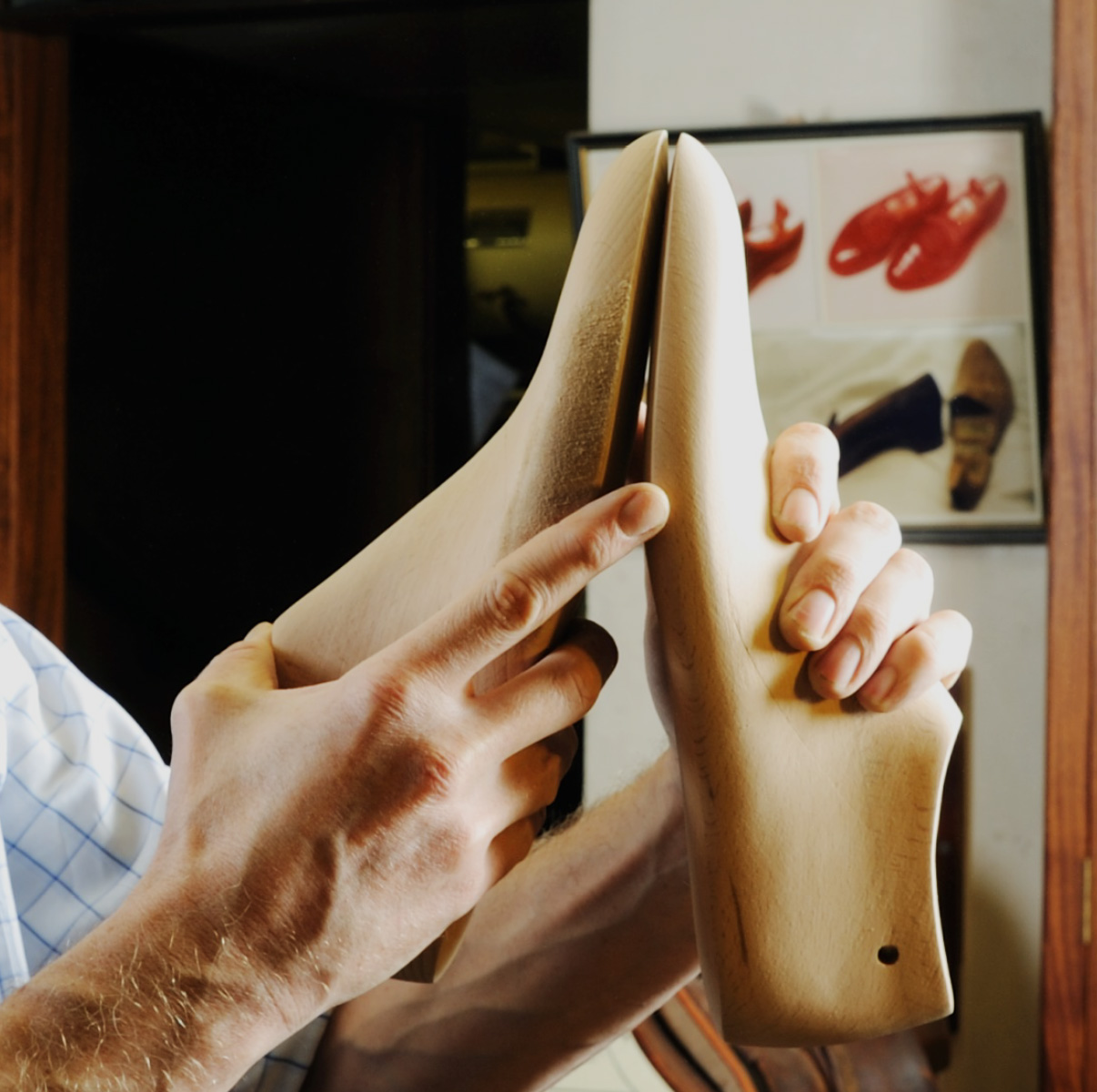
None of that stone arrives ready to use. The work went to the Herbert Stephan gemstone manufactory, heir to the Idar-Oberstein cutting workshops whose tradition runs back to the fifteenth century. Every panel was ground and polished by hand, and the fit is the whole craft: stone does not flex or forgive, so a panel is cut to the metal or it is cut again. The master craftsman signs each pen's certificate of authenticity.
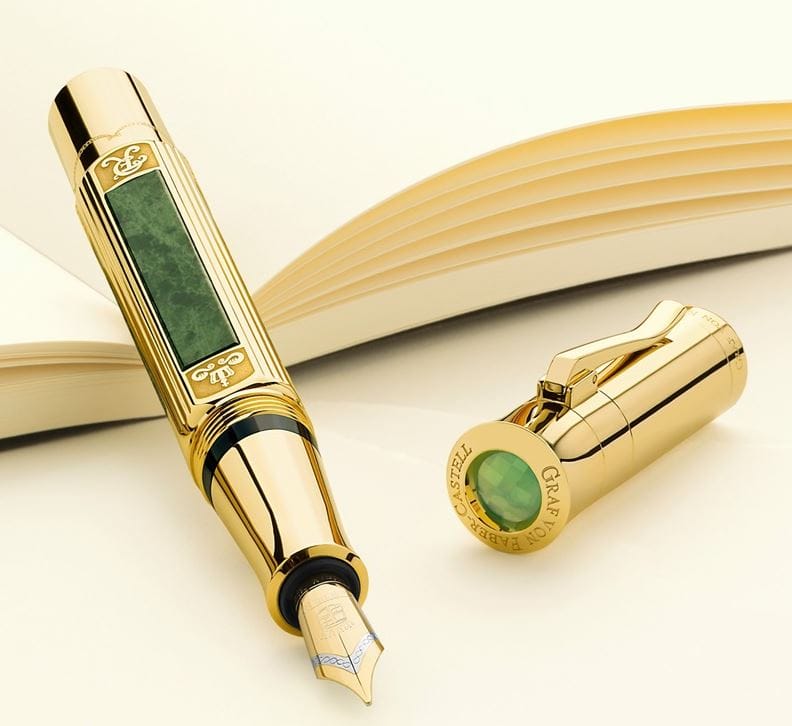
Under the stonework, the pen stays a serious writing instrument. The nib is 18-carat bicolour gold, run in by hand, in M, F, B and BB widths. It fills by plunger, each pen is individually numbered, and the platinum-plated fountain pen was limited to 1,000 pieces, with 300 rollerballs alongside.
The maker states no current price for the 2015 pen — a historical edition, not a launch — and it does not need one. Its value sits in the translation: a king's monopoly on green stone, reopened two centuries later by a workshop still cutting stone the old way.
Previously's Take
Most tribute pens print a picture of their subject and call it homage. This one went and got the actual material — the same Silesian serpentine, the same guarded chrysoprase — and handed it to gemstone cutters rather than pen decorators. That is the difference between merchandise and translation.
The numbers
Sources · 4 sources
- Graf von Faber-Castell — official "Sanssouci, Potsdam" craft story (POTY 2015), republished by Chatterley Luxuries
- The Pen Shop — Pen of the Year timeline (features, production figures)
- City of Potsdam — Sanssouci Palace history (built 1745–1747)
- Pen Boutique — Pen of the Year 2016, on the trilogy
Photographs: Piguet · 2luxury2 · The Pen Shop